Introduction
Water has always been one of the most important resources for communities living in arid and semi-arid environments. In regions where rainfall is limited and rivers may be seasonal, people developed different methods to collect, store, transport, and improve the quality of available water.
Some communities used wells, cisterns, reservoirs, channels, and underground water systems. Others may have employed small-scale filtration methods to remove suspended particles and improve the appearance or usability of collected water.
Archaeologists investigate these practices through ceramic vessels, stone basins, sediment layers, channels, filter materials, and other remains. Although large water-management structures often receive more attention, small domestic filtration systems can reveal how households addressed everyday water challenges.
Water Scarcity and Life in Arid Environments
Arid environments are characterized by limited rainfall, high evaporation, and uneven access to freshwater. Water may be available only during certain seasons or in specific locations, such as springs, wells, and underground aquifers.
Communities adapted by collecting rainwater, storing seasonal runoff, digging wells, and developing systems that transported water from distant sources.
Storage was essential because rainfall could be unpredictable. Cisterns and reservoirs allowed households and settlements to preserve water for periods when natural sources were less reliable.
However, collected water could contain sand, silt, organic matter, and other suspended particles. Maintaining water quality therefore required regular cleaning and, in some cases, additional treatment.
Understanding Ancient Water Filtration
Filtration is the process of passing water through a material that traps or separates particles. Ancient communities may have used sand, gravel, cloth, plant fibers, porous ceramics, or combinations of these materials.
A simple filter could consist of layers of coarse and fine materials placed inside a container. Water passing through the layers might lose some suspended particles, resulting in clearer water.
However, filtration should not be confused with complete purification. A filter that removes visible sediment does not necessarily eliminate harmful microorganisms, dissolved chemicals, or salts.
Archaeologists must therefore be careful when interpreting ancient installations. A structure that appears to have filtered water may instead have been used for settling, storage, cooling, or another purpose.
Settling Basins and Sediment Traps
One of the simplest ways to improve the clarity of water is to allow suspended particles to settle. When water remains undisturbed in a container or basin, heavier particles gradually sink to the bottom.
Ancient households may have used small settling vessels or basins to separate sediment from collected water. Larger systems could have included chambers where water slowed down before entering a storage tank.
Archaeological evidence for settling systems may include multiple connected basins, sediment deposits, channels, and differences in the thickness of accumulated material.
A sediment trap can be especially important in a cistern. By allowing mud and sand to collect before water reaches the main storage area, it may reduce the amount of sediment entering the reservoir.
Still, a basin containing sediment does not automatically prove that it was intentionally designed for water treatment. Researchers must examine its relationship to channels, inlets, outlets, and the surrounding architecture.
Sand, Gravel, and Charcoal as Filter Materials
Sand and gravel are natural materials that can trap particles as water passes through them. Their effectiveness depends on grain size, layer arrangement, water flow, and maintenance.
A system using coarse gravel followed by finer sand could reduce the amount of suspended material entering a collection vessel. Replacing or cleaning the materials would have been necessary as particles accumulated.
Charcoal may also have been used in some water-treatment practices. Certain forms of charcoal can adsorb some substances, although its effectiveness depends on how it was produced and prepared.
The discovery of sand, gravel, or charcoal near a water installation does not prove that these materials were used as filters. They may have entered the structure naturally or served other construction purposes.
A convincing interpretation requires evidence of deliberate placement, suitable flow arrangements, and a clear relationship between the materials and the water system.
Porous Ceramic Vessels and Household Water Treatment
Ceramic vessels were widely used for storing and transporting water. Depending on the clay and firing conditions, some vessels could allow small amounts of water to pass through their walls.
In certain environments, porous containers may have helped cool water through evaporation. This cooling effect is different from filtration, even though the vessel's porous structure allows moisture to move through its surface.
Other ceramic devices may have been designed to strain or separate particles. Archaeologists can investigate their shape, wall thickness, perforations, surface treatments, and wear patterns to determine possible functions.
A vessel with a narrow opening might have reduced the entry of debris, while a perforated ceramic component could have served as part of a larger filtration or drainage system.
Researchers should avoid assigning a filtration function based on appearance alone. Residues, associated structures, and experimental testing can help establish how a vessel was used.
Cloth and Plant-Based Filtering Materials
Organic materials such as cloth, woven fibers, and plant matter can serve as simple strainers. They may have been placed over vessel openings or used to separate larger particles from collected water.
Unfortunately, these materials rarely survive in ordinary archaeological conditions. They can decay quickly, especially in warm and humid environments.
In exceptionally dry or sealed contexts, fragments of textiles, plant fibers, or other organic materials may survive. Their presence near water installations could provide useful evidence, although their original purpose must still be established.
Historical and ethnographic sources can help researchers understand how similar materials were used in later communities. Such comparisons are useful for developing hypotheses but cannot independently prove that the same practices existed in earlier periods.
Archaeological Evidence of Small-Scale Systems
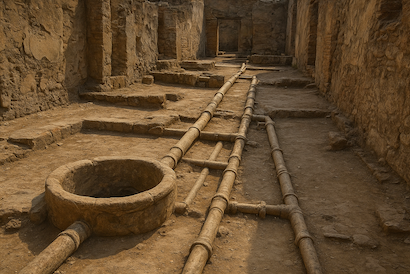
Small water-treatment installations may leave relatively modest archaeological traces. These can include stone or plaster basins, ceramic containers, channels, settling chambers, sediment deposits, and carefully arranged layers of granular material.
Researchers examine the location of these features in relation to houses, courtyards, wells, cisterns, and drainage systems.
The sequence of construction and repair can reveal whether a system was used regularly. Repeated cleaning layers, replacement materials, and modifications to channels may indicate ongoing maintenance.
Residue analysis can identify mineral deposits left by water. Microscopic sediment analysis may also reveal whether material accumulated through natural processes or was deliberately placed.
The strongest interpretations come from combining architectural evidence with sediment analysis, artifact studies, and environmental reconstruction.
Water Filtration, Storage, and Other Functions
A major challenge in studying ancient water systems is distinguishing filtration from other forms of water management.
A covered cistern may have been designed primarily for storage. A basin may have allowed sediment to settle without using a filter. A porous vessel may have cooled water through evaporation rather than removing contaminants.
Other installations may have been used for washing, food preparation, dyeing, irrigation, or industrial activities.
Archaeologists investigate these possibilities by examining water flow, surface wear, residues, connections between structures, and the broader domestic or industrial setting.
This distinction matters because describing every basin or porous vessel as a filtration device can exaggerate the technological abilities demonstrated by the evidence.
Reconstructing Ancient Water Quality
Scientific analysis can help reconstruct the conditions of ancient water systems. Mineral deposits, sediment layers, and chemical residues may preserve information about the water that passed through a structure.
Stable isotopes and other geochemical techniques can sometimes provide clues about water sources and environmental conditions. Microfossils may reveal the presence of organisms associated with particular aquatic environments.
Experimental archaeology also plays an important role. Researchers can construct replica filters using materials available in the archaeological context and test how they affect water flow and sediment removal.
Such experiments can demonstrate whether a proposed system is technically plausible. However, modern experiments cannot establish that ancient people used a particular method unless archaeological evidence supports the interpretation.
Maintenance and Community Knowledge
Water systems required regular maintenance. Cisterns needed cleaning, channels could become blocked, and filters could accumulate sediment.
In small settlements, households may have managed their own storage and treatment equipment. Larger communities might have organized collective labor to maintain wells, reservoirs, and shared channels.
Knowledge of suitable materials and seasonal water conditions could be passed between generations. People learned which sources were reliable, how to protect stored water, and when cleaning was necessary.
These practices were not merely technical responses to environmental pressure. They were also part of the social organization of communities living in places where water availability influenced daily life.
Conclusion
Small-scale water filtration systems provide an important perspective on how communities in arid environments managed limited water resources. Settling basins, sand and gravel layers, porous ceramic vessels, and organic strainers may reveal attempts to improve the clarity and usability of collected water.
However, the archaeological identification of filtration requires careful analysis. Storage, cooling, settling, drainage, and other activities can leave similar physical traces. Clear water does not necessarily mean safe water, and simple filtration should not be confused with the removal of all biological or chemical contaminants.
By combining archaeological excavation, material analysis, environmental reconstruction, and experimental research, scholars can better understand the practical technologies used to manage water. These small installations remind us that the history of water engineering is not limited to monumental aqueducts and reservoirs; it also includes the everyday systems that helped households survive in challenging environments.