Introduction
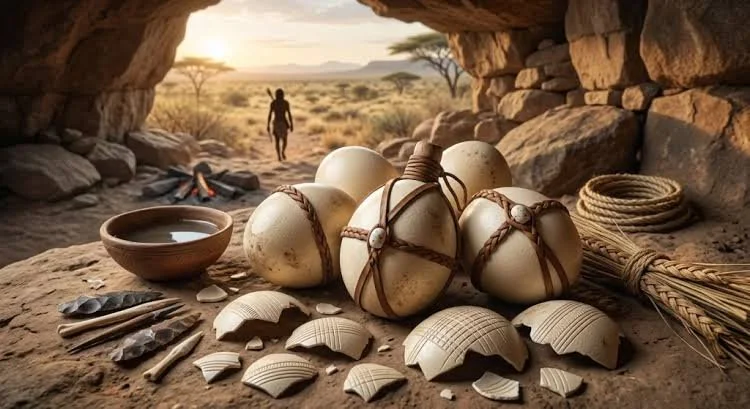
Ostrich eggs are among the largest eggs produced by living birds. Their thick shells are strong enough to preserve recognizable fragments under suitable archaeological conditions, and their natural shape makes them potentially useful as containers.
Prehistoric communities in parts of Africa and other regions where ostriches lived or where ostrich eggs circulated may have used emptied eggshells to hold water, small quantities of food, pigments, or other materials.
The phrase "ostrich egg sacs" is not a standard archaeological term. The more accurate description is usually ostrich eggshell containers or ostrich eggshell vessels. These objects are important because they demonstrate how people transformed naturally available materials into practical technologies.
Ostrich Eggs as Natural Containers
An ostrich egg provides a naturally enclosed space protected by a hard outer shell.
Once the contents are removed, the shell can potentially function as a container.
Its rounded shape allows it to hold liquids or small objects, while its relatively thick structure provides greater durability than many other eggshells.
However, the shell is still vulnerable to cracking and impact. It would require careful handling, particularly if used during travel.
The natural form of the egg therefore offered useful possibilities but also imposed practical limitations.
Preparing an Eggshell Container
To turn an ostrich egg into a container, people would first need to remove its contents.
This could be achieved by creating an opening in the shell.
The size and location of the opening would influence how easily the container could be filled, emptied, and cleaned.
Some archaeological examples of ostrich eggshells show deliberate perforation, shaping, or modification.
Researchers must distinguish intentional openings from damage caused by breakage, erosion, or excavation.
Storage and Transportation
Ostrich eggshell containers could have been useful for holding small quantities of water or other materials.
Their relatively compact form may have made them practical for personal use or short-distance transportation.
However, transporting a fragile container over long distances would require protection.
A carrying net, leather covering, woven support, or other protective arrangement is possible in some contexts, but such accessories should not be assumed unless supported by archaeological evidence.
The container's usefulness would depend on its size, the nature of its contents, and the conditions under which it was carried.
Decoration and Symbolic Meaning
Ostrich eggshells were not necessarily used only for practical purposes.
In several archaeological contexts, ostrich eggshell fragments were shaped into beads, ornaments, and decorative objects.
Their smooth surface and pale appearance made them suitable for personal adornment.
Some complete or modified eggshell objects may also have carried symbolic significance.
Decoration could indicate personal identity, social relationships, or cultural preferences.
Nevertheless, an object could have both practical and symbolic value. These functions are not mutually exclusive.
Archaeological Evidence
Ostrich eggshell fragments are often recovered from prehistoric sites in Africa and other regions where ostrich products were available through local environments or exchange.
Archaeologists examine the thickness, curvature, surface condition, and patterns of breakage to determine how the shell was used.
Perforations, cut marks, polishing, and traces of shaping may indicate deliberate modification.
Residue analysis can sometimes provide information about the materials stored inside a container, although organic contents may not survive.
The surrounding archaeological context is essential. An eggshell found in a domestic area may have been used differently from one recovered in a burial or ceremonial deposit.
Distinguishing Containers from Ornaments
One of the main challenges is determining whether a modified eggshell was intended to function as a container or as an ornament.
Small perforated fragments may have been beads or decorative components.
Larger modified sections could have served as vessels, although their exact function may remain uncertain.
Researchers consider the dimensions of the opening, the completeness of the shell, evidence of suspension, wear patterns, and associated objects.
A single perforation does not automatically indicate that the shell was used to hold liquid.
Ostrich Eggs and Long-Distance Exchange
Ostrich eggshell objects have sometimes circulated beyond the immediate environments where ostriches lived.
Their presence at distant sites can reveal trade, exchange, migration, or the movement of finished ornaments.
However, the discovery of an ostrich eggshell bead does not necessarily mean that an entire egg or container traveled the same distance.
Raw materials could be transported and modified in different locations.
Researchers therefore distinguish between the movement of eggshell as a material and the movement of finished objects.
Preservation and Archaeological Limitations
Ostrich eggshell can survive well in some archaeological environments, but preservation is not guaranteed.
Soil acidity, moisture, temperature, and mechanical disturbance influence how much material remains.
Large shells may break into fragments that are difficult to reconstruct.
Some containers may have been made from other materials, such as gourds, wood, or animal products, which are less likely to survive.
The archaeological record may therefore overrepresent durable eggshell objects while underrepresenting other container technologies.
Broader Importance of Prehistoric Container Technologies
The use of ostrich eggshells illustrates how prehistoric communities adapted natural materials to solve practical problems.
Containers were essential for storing water, food, pigments, medicines, and other substances.
Different societies used materials available within their environments, including gourds, shells, bark, wood, leather, pottery, and woven fibers.
The development of containers was not simply a technological issue. It also influenced mobility, food preparation, resource storage, and social exchange.
Conclusion
Ostrich eggshell containers demonstrate how prehistoric communities could transform a naturally occurring object into a useful piece of technology. Their strength, shape, and availability made them suitable for certain forms of storage and transportation, while their decorative potential gave them additional cultural value.
Archaeologists must distinguish deliberately modified containers from ornaments, food remains, and naturally broken shells. Through microscopic analysis, residue studies, and careful examination of archaeological context, researchers can better understand how ostrich eggshells contributed to prehistoric material culture.