In Boeotia, an archaeological excavation has uncovered the 7th-century BC burial known as the Lady of the Inverted Diadem, offering rare artifacts and revealing new details about elite life and political change in ancient Greece.
Located in the eastern foothills of Lake Kifisída, part of the ancient Kopaïs basin, the site was initially a routine rescue excavation ahead of a photovoltaic park construction. However, it revealed a fortified lakeside settlement and an elite necropolis, shedding light on the period when hereditary kingship was declining and aristocratic rule was emerging.
The excavation was conducted by the Ephorate of Antiquities of Phthiotis and Evrytania, largely funded by the Mytilineos Group through its subsidiary METKA ATE. Led in the field by archaeologist Maria Papageorgiou and her team, the project uncovered a cemetery spanning the Archaic to Classical periods. The findings illuminate the burial practices and daily life of a wealthy lakeside community, while also reflecting the broader political transformations occurring in 7th-century BC Greece.

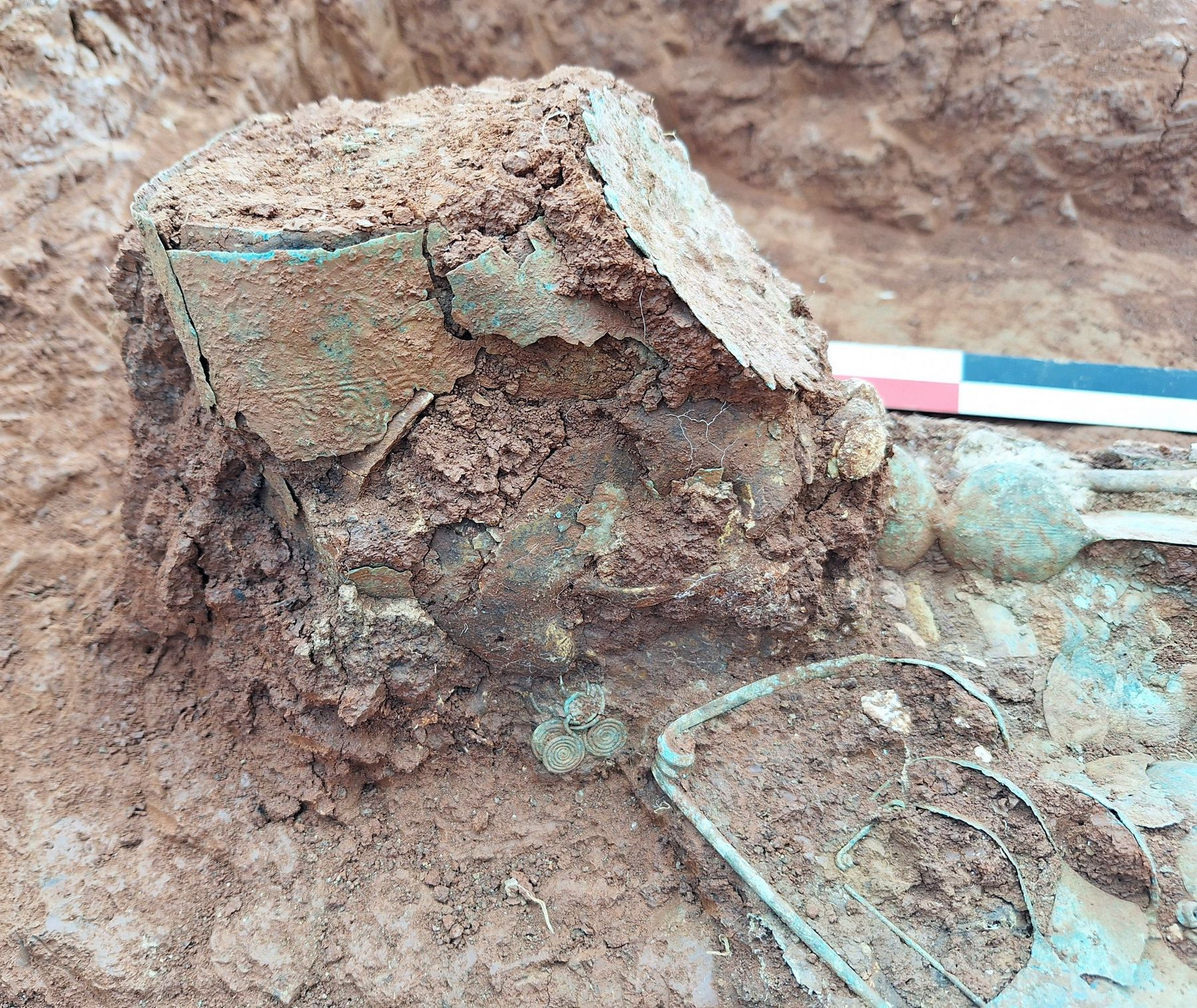
The burial of the aristocratic woman, known as the Lady of the Inverted Diadem, uncovered in the 7th-century BC necropolis of Boeotia.
A Necropolis Revealed in the “Houses–Sinkhole”
Ancient maps mark the excavation site as Spítia–Katavóthra, meaning “Houses–Sinkhole,” a name that proves fitting. Beneath the surface, archaeologists have uncovered clusters of pit graves, tile-covered burials, and cremation pyres—totaling at least forty tombs so far. The evidence indicates that those interred here were part of a wealthy landowning society with access to luxury goods, skilled artisans, and extensive trade networks.
This necropolis is associated with the remains of a contemporaneous fortified settlement, suggesting a community carefully positioned on the edge of the Kopaïs basin, one of central Greece’s most vital agricultural regions.
Yet among all the discoveries, one grave has seized the imagination of scholars and the public alike: the burial of a woman now known as “the Lady of the Inverted Diadem.”

Bronze diadem band adorned with repoussé pairs of heraldic lions—male and female—symbols of sovereign authority across the ancient Mediterranean.
The Lady of the Inverted Diadem: A Silent Witness to Political Change
Dated to the second half of the 7th century BC, her burial is part of a cluster of three pit graves. Dental analysis indicates she was a young adult woman, likely between 20 and 30 years old. However, it is the extraordinary treatment of her body and the remarkable objects found with her that make this tomb particularly significant.
Resting on her head was a finely crafted bronze diadem, its band decorated with pairs of repoussé lions—both male and female—symbols of authority recognized across the ancient Mediterranean. At the center, a large rosette shaped like a radiant sun once gleamed above her brow, signaling high rank, prestige, and possibly even a connection to royalty.
Yet in a striking and unusual gesture, the diadem was placed upside down, hinting at symbolic or ritual meanings now lost to history.
The lions on the diadem lay upside down, and the central rosette rested at the lower edge rather than crowning her forehead. Across cultures—from ancient times through the medieval period and even into modern ceremonial practices—an inverted crown has often symbolized abdication, the fall of a ruler, or the deliberate removal of authority.
For archaeologists, this deliberate inversion likely reflects a profound political transformation occurring in Boeotia and throughout Greece in the mid-7th century BC, when hereditary kingship was waning and emerging aristocratic elites were consolidating power. The woman interred here may have belonged to a lineage whose authority was being systematically dismantled, with her inverted diadem serving as a striking emblem of a changing social and political order.
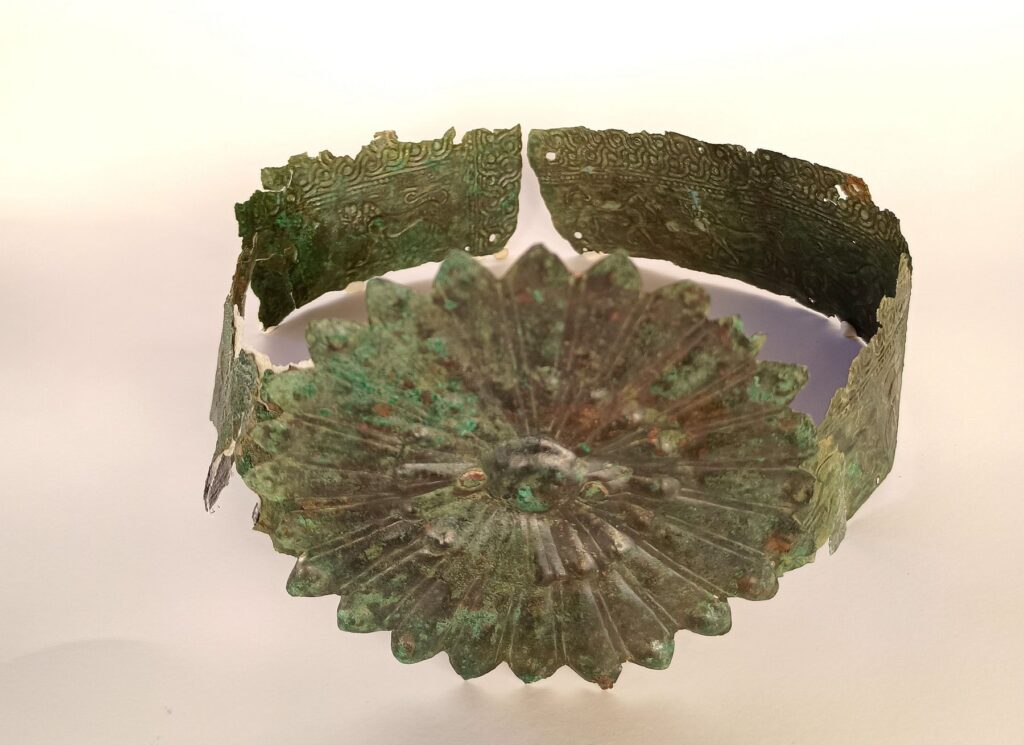
At the center of the diadem, a large sun-shaped rosette once gleamed above her forehead, signaling rank, prestige, and a possible royal connection.
Treasures of a High-Born Lineage
The richness of her grave goods highlights her elevated status, with an exceptional collection of bronze and luxury items placed beside her. These included two oversized Boeotian-type fibulae engraved with geometric patterns and stylized horses, a finely crafted necklace with a large vase-shaped pendant, and intricately worked ornaments of bone and ivory. She was also adorned with amber beads, thin sheet-bronze rosettes, bronze earrings, bracelets, and numerous spiral rings along nearly every finger phalange. Collectively, these treasures reflect not only her personal prestige but also the wealth, craftsmanship, and social influence of the elite lineage she belonged to.
A Child’s Crown and Traces of Kinship
In the same burial cluster, archaeologists discovered the tomb of a four-year-old girl wearing her own bronze diadem, decorated with inlaid rosettes. Her grave, richly furnished with jewelry similar to the woman’s, strongly suggests a familial relationship—likely a daughter, niece, or younger relative intended to inherit status that never came to fruition.
The treatment of this child indicates hereditary privilege passed at birth, supporting the idea that the necropolis belonged to an elite family during a time when such lineages were losing traditional power.
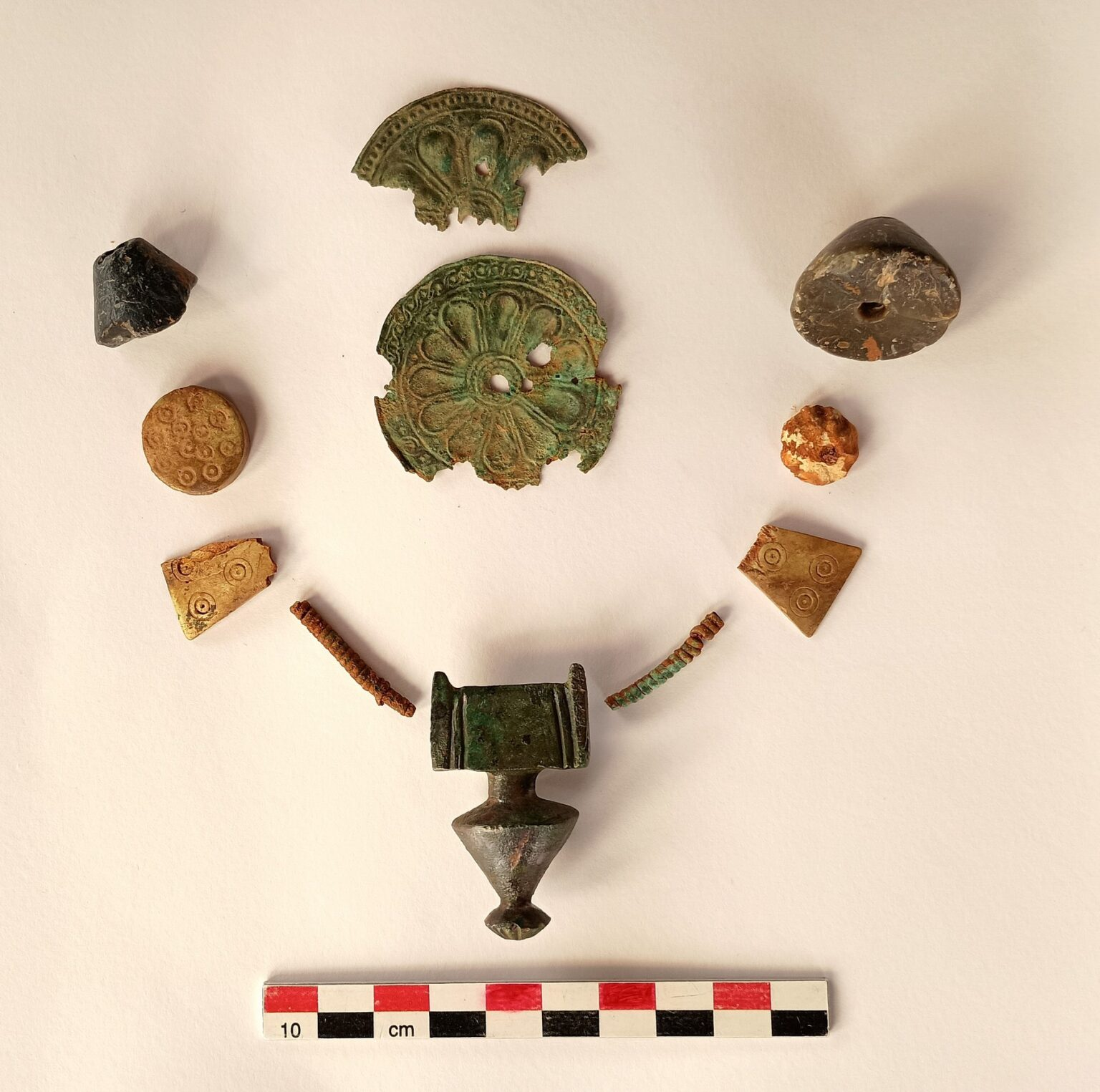
Jewelry and ornaments found in the burial, reflecting the wealth and status of the aristocratic woman.
A Window into a Changing World
Other tombs in the necropolis enrich the broader story. A 6th-century BC woman was buried with a Siana-type kylix featuring roosters and a trilobed olpe decorated with mythical creatures and Hermes as psychopompós, the guide of souls. Bronze bowls with central omphaloi and black-figure pottery from nearby Acraipha workshops demonstrate local craftsmanship and economic sophistication.
Together, these finds trace the shift from the hierarchical societies of the post-Mycenaean “Dark Age” to the politically complex, aristocratically governed poleis of the Archaic period.
The Legacy of a Fallen Aristocrat
The Lady of the Inverted Diadem remains one of early Greece’s most compelling archaeological figures—a woman who bore the symbols of authority even as they were ritually inverted in her final rites. Her tomb captures the tension of an era when ancient power structures were collapsing and new political realities were emerging.
From the shores of Lake Kifisída, she reminds us that history does not always celebrate the victors. Sometimes, its most revealing stories lie buried with those who lost their crowns.