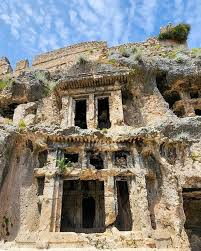
The Lycian rock-cut tombs of ancient Anatolia (modern-day Turkey) are among the most striking funerary monuments of the classical world. Carved directly into the sheer faces of limestone cliffs, these "eternal houses" were designed to reflect the domestic architecture of the living, ensuring that the deceased remained a visible and integrated part of the landscape.
1. The Lycian Belief: Wings to the Afterlife
The Lycians believed that the souls of the dead were carried to the afterlife by winged, siren-like creatures. To facilitate this journey, they placed their dead in high, precarious locations.
The Vertical City: By carving tombs into the cliffs above their cities, such as at Myra or Fethiye, the Lycians created a literal "City of the Dead" (Necropolis) that overlooked the "City of the Living."
Status and Height: Generally, the higher and more elaborately carved the tomb, the higher the status of the individual buried within.
2. Architectural Styles: Stone Mimicking Wood
The most fascinating aspect of Lycian tombs is their skeuomorphism—the practice of recreating wooden architectural features in stone.
The House Tombs: These tombs replicate the everyday timber houses of the 5th and 4th centuries BCE. Archaeologists can see stone carvings of wooden beams, joints, and even the protruding ends of circular logs (roundels).
Temple Tombs: Influenced by Greek architecture, these feature grand facades with Ionian or Doric columns, pediments, and carved reliefs. The Tomb of Amyntas in Fethiye is the most famous example of this "temple-in-the-rock" style.
3. The Necropolis of Myra
The site of Myra features two spectacular necropolises: the River Necropolis and the Ocean Necropolis.
The "Honeycomb" Effect: The tombs are carved so closely together that they resemble a stone honeycomb.
Polychrome History: While they appear as monochromatic stone today, traces of pigment suggest these tombs were originally painted in vibrant shades of red, blue, and yellow, making them even more visible from a distance.
4. Inscriptions and the Lycian Language
Many tombs are inscribed with the Lycian language, an Indo-European tongue that used a unique alphabet based on Greek.
The Trilingual Stele: Much like the Rosetta Stone, the discovery of trilingual inscriptions (Lycian, Greek, and Aramaic) at the Letoon sanctuary allowed scholars to decipher the language and understand the legal protections placed on these tombs.
Protective Curses: Inscriptions often contain warnings or "curse formulas," threatening fines or divine retribution against anyone who attempted to reuse the tomb or disturb the remains.
5. Archaeological Significance
The Lycian rock tombs provide a rare continuity of history. They show the synthesis of local Anatolian traditions with Persian and Greek influences. Because they were carved into the living rock, they have survived earthquakes and pillaging better than many free-standing structures, serving as a permanent record of a culture that eventually merged into the Roman Empire.