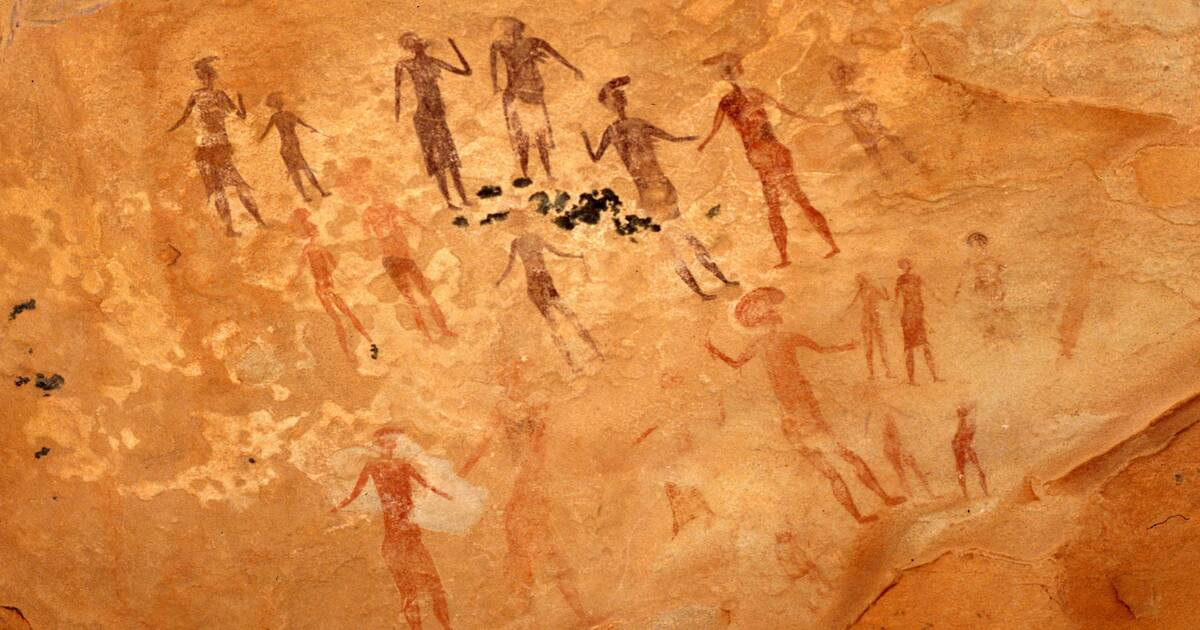
The Tassili n'Ajjer plateau in southeastern Algeria is one of the most significant "open-air museums" of prehistoric art in the world. Spanning over 72,000 square kilometers, this vast lunar-like landscape of eroded sandstone contains more than 15,000 individual paintings and engravings.
These murals provide a startling visual record of the "Green Sahara"—a time when what is now a hyper-arid desert was a lush savanna teeming with wildlife and complex human societies.
1. The Chronology of the Sahara
Archaeologists have divided the art of Tassili n'Ajjer into several distinct periods, each reflecting a shift in the climate and the animals that inhabited the region.
The Wild Fauna Period (c. 10,000–6,000 BCE): The earliest engravings depict massive, extinct animals like the Bubalus antiquus (giant buffalo), along with hippos, crocodiles, and elephants. This confirms that the region once had permanent lakes and rivers.
The Round Head Period (c. 8,000–6,000 BCE): This period features mysterious, ethereal human figures with large, featureless round heads. They are often depicted floating or engaged in ritualistic dances, leading to much speculation about ancient shamanic practices.
The Pastoral (Bovidian) Period (c. 5,000–2,500 BCE): The most prolific era. The art shifts to naturalistic depictions of daily life—herders tending cattle, people inside skin tents, and domestic scenes. This marks the transition from hunting-gathering to a pastoralist economy.
The Horse and Camel Periods (c. 1,000 BCE – Present): As the Sahara began to dry out (desertification), the animals changed. We see horse-drawn chariots and eventually camels, reflecting the rise of trans-Saharan trade and the arrival of Berbers (Amazigh).
2. The "Great Martian God"
One of the most famous and controversial figures in Tassili is a massive, 18-foot-tall figure in the Jabbaren area.
The Discovery: Early explorer Henri Lhote nicknamed it the "Great Martian God" due to its strange, bulky appearance and helmet-like head.
The Reality: Modern archaeologists interpret the figure as a powerful deity or an ancestral spirit. The "suit" is likely a depiction of ceremonial body paint or traditional ritual regalia, rather than an "ancient astronaut."
3. Shamanism and the "Mushroom Man"
The murals offer deep insights into the spiritual life of the prehistoric Saharans.
The Tin-Tazarift Mural: This painting shows a figure with a mask and mushrooms sprouting from his body, often referred to as the "Mushroom Man."
Altered States: Scholars like Giorgio Samorini suggest this is evidence of the ritual use of hallucinogenic plants. The "lines" connecting figures in the art are thought to represent the flow of energy or the "soul" during a trance state.
4. The Pigments and Preservation
The artists used minerals found in the local sandstone to create their palette.
The Palette: Iron oxides (hematite) provided deep reds and browns, while kaolin clay provided white. Charcoal or manganese was used for black.
The Binder: These pigments were mixed with binders like milk, animal fat, or egg whites to create a "paint" that could soak into the porous sandstone.
Natural Protection: The dry air and the placement of the art in deep rock shelters have preserved these colors for nearly 10,000 years.
Archaeological Significance
Tassili n'Ajjer was designated a UNESCO World Heritage site in 1982. It is vital because it proves that the Sahara was not always a barrier; it was once a bridge—a fertile cradle of culture where diverse groups of humans lived, experimented with domestication, and developed complex mythologies long before the rise of Ancient Egypt.