The Nazca Puquios: Ancient Hydraulic Systems That Still Work Today
Built between 300 and 600 CE in the hyper-arid coastal desert of southern Peru, the puquios are a masterful network of underground aqueducts, surface channels, and reservoirs developed by the ancient Nazca culture. Located just a few miles from the famous and mysterious Nazca Lines, the puquios represent a triumph of practical engineering that allowed the civilization to transform an arid landscape into a green, habitable valley.
Remarkably, more than 30 of these ancient aqueducts are still functioning and providing water today.
1. The Design and Architecture of the System
The puquios are essentially filtration galleries designed to tap into underground aquifers and guide the water to where it is needed without significant loss to evaporation.
Underground Galleries: The core of the system consists of underground channels dug into the gravelly alluvial fans of the Andean foothills. They typically measure 50 to 80 cm wide and up to 1.5 meters high, lined with river cobbles and built without mortar to allow water to filter in slowly and naturally.
Open Trenches: As the tunnels approach settlements and cultivated fields, they transition into open, stone-lined trenches (socavón) where the water re-emerges at the surface.
Reservoirs (Cochas): The open canals empty into small, stone-lined reservoirs or pools, which serve as distribution points for drinking water and crop irrigation.
2. The Ojos (The Spiral Eyes)
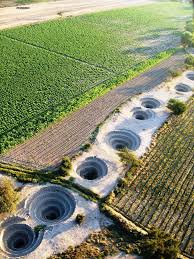
One of the most striking features of the puquios is the presence of large, funnel-shaped, spiraling wells known locally as ojos (eyes) that dot the desert floor.
Maintenance Access: The wide, corkscrew design allowed workers to climb down into the deep subterranean tunnels for regular desilting and maintenance.
Ventilation and Pumping: Studies, particularly those led by researchers using satellite imagery, revealed an ingenious secondary function. The funnel shape of the ojos and their alignment with the prevailing desert winds catch and force air into the underground tunnels. This increases air pressure inside the channels, acting as a natural, wind-driven pump to push water through the system.
3. Construction and Materials
To withstand millennia of seismic activity and climate shifts, Nazca engineers chose highly durable, locally sourced materials:
River Boulders: The tunnels and trench walls are lined with smooth, round river boulders without the use of mortar. This porous structure prevents the soil from collapsing while still allowing subsoil water to percolate into the channel.
Traversing Slopes: The system relies on a gentle gradient (averaging 1.4%) to maintain a constant, controlled water flow velocity, preventing soil erosion or flooding.
4. Climate Resilience and Modern Utility
The puquios offer a remarkable lesson in sustainable water management:
Insensitivity to Precipitation: Because the system taps into deep groundwater aquifers rather than relying on surface rainfall, it provides a consistent water supply even through prolonged droughts.
Community Management: The ongoing maintenance of the puquios relies on community cooperation, ensuring that access to the life-giving water is managed democratically and sustainably across generations.