The Threshold of Urbanization
Çatalhöyük, located in modern-day Turkey and dating from approximately 7500 BC to 5700 BC, represents one of the most significant archaeological sites in human history. Often cited as the world's "first city," it challenged the long-held archaeological belief that large-scale, sedentary societies could only emerge after the invention of advanced state bureaucracies or specialized agriculture. Instead, Çatalhöyük suggests that the transition to urban life was a social and architectural evolution that predated the "civilizations" of Mesopotamia by millennia.
1. The Architecture of Density: Life Without Streets
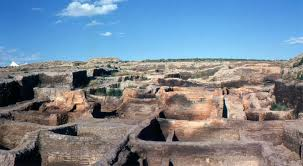
The most striking feature of Çatalhöyük is its layout. The settlement was not a collection of individual detached homes, but a sprawling, cellular honeycomb of mud-brick dwellings packed so tightly together that there were no streets.
The Rooftop Economy: To move between houses, residents climbed ladders to their flat rooftops. The entire surface of the "city" functioned as a public plaza where daily activities—such as food processing, social interaction, and craft manufacturing—took place.
The Entrance System: Residents entered their homes through a hole in the roof, which also served as the primary ventilation point for the smoke from the central hearth. This design choice provided maximum security and insulation, though it necessitated a high degree of communal cooperation.
2. Social Equality in the Domestic Sphere
Archaeological analysis of the site reveals a society that remained remarkably egalitarian for several centuries.
Uniform Household Size: Excavations have found that almost every dwelling was roughly the same size and contained similar types of goods. There is no clear evidence of "palaces" or "elite quarters," suggesting that wealth and status were likely distributed broadly across the population rather than concentrated in a ruling class.
The "Domesticated" City: Every house was also a shrine. Beneath the floors of the dwellings, the inhabitants buried their dead, with the living and the ancestors living in direct proximity. This blurring of the boundary between the domestic space and the ritual space indicates that social order was maintained through familial and ancestral ties rather than centralized laws or police forces.
3. Symbolic Expression: The Art of the Walls
The interior walls of these mud-brick homes were frequently replastered and decorated with elaborate murals, suggesting a rich symbolic and religious life.
Representational Murals: Many of these paintings depict the dangerous, powerful animals of the local environment—bulls, leopards, and wild boar—often surrounded by human figures, suggesting that the residents viewed themselves as part of a complex ecological hierarchy.
The "Mother Goddess" Motif: The discovery of numerous clay figurines, including the famous "seated woman" flanked by leopards, sparked early theories about a matriarchal society. Modern scholarship is more cautious, suggesting these figurines likely functioned as tokens of fertility, power, or personal identity rather than evidence of institutionalized gender-based rule.
4. Economic Complexity: Sustaining a Proto-City
At its peak, Çatalhöyük may have housed between 5,000 and 8,000 people. Feeding such a large population required a sophisticated understanding of the surrounding environment.
The Wetland-Agro System: The residents were not exclusively grain-farmers. They practiced a mix of cultivation—wheat, barley, and peas—combined with the intensive harvesting of wild plants and the hunting of local fauna. This "mixed economy" provided a safety net; if a crop failed, the community could rely on the abundant resources of the nearby marshlands.
Obsidian Trade: The city was a major hub for the extraction and processing of obsidian, a volcanic glass highly valued for its sharp cutting edge. Çatalhöyük controlled access to the nearby volcanic deposits, trading this material across the region and bringing in exotic goods like sea shells, flint, and copper.