Ancient Greek Sanctuaries: The Sacred Topography of Olympia
The Sacred Topography of Olympia: A Convergence of Divinity and Athletics
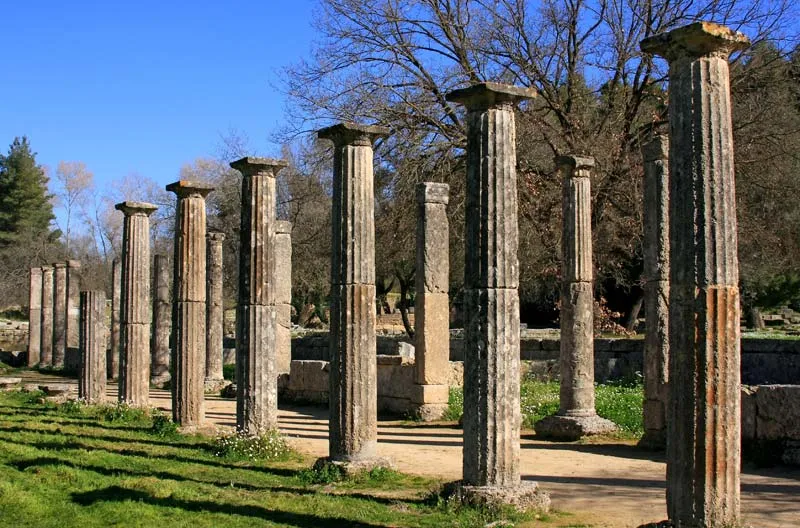
The sanctuary of Olympia was not merely a cluster of temples; it was a carefully curated sacred landscape that functioned as the pan-Hellenic nerve center of the Greek world. Located in the fertile valley of the Alpheios River in the Peloponnese, Olympia was designed to facilitate a profound sensory experience, where the boundary between the mortal realm of athletic achievement and the divine realm of Zeus was intentionally blurred.
1. The Altis: The Sacred Enclosure
At the heart of Olympia lay the Altis, the sacred grove dedicated to Zeus. Unlike the residential quarters of a city-state, the Altis was a strictly consecrated space, demarcated by a boundary wall (peribolos) that separated the mundane world from the divine.
Density of Devotion: Inside the Altis, space was intensely dense. It contained the oldest and most sacred sites, including the Pelopion (a mound dedicated to the hero Pelops) and the massive Temple of Zeus, which housed the gold-and-ivory statue of the god, one of the Seven Wonders of the Ancient World.
The Votive Forest: Over centuries, the Altis became crowded with thousands of bronze statues, tripods, and commemorative victory monuments dedicated by triumphant athletes and city-states. This "forest" of bronze served as a permanent, visible archive of Greek history, piety, and rivalry.
2. The Relationship Between Sanctuary and Stadium
A defining feature of Olympia’s topography was the integration of the athletic facilities directly into the sacred site. The Stadium was not separated from the religious core; rather, it was functionally and physically tied to it.
The Stoa of Echoes: Athletes and spectators entered the stadium through a vaulted entrance. Near the entrance sat the Stoa of Echoes, designed to reflect sound back toward the spectators, creating an acoustic environment that amplified the roar of the crowd.
The Ritual of Entry: Athletes entered the sacred precinct after taking an oath before the statue of Zeus Horkios (Zeus of the Oaths), swearing that they had trained for ten months and would not cheat. This ritual placement meant that the physical act of sprinting or wrestling was an extension of a religious promise made to the god of the sanctuary.
3. The Hydrography and Natural Features
Olympia’s location was chosen specifically for its natural features, which were integrated into the myths and cult practices of the site.
Mount Kronion: The northern boundary of the sanctuary was dominated by the hill of Kronos (Mount Kronion). In mythology, this hill was the site of a battle between the older generation of gods (the Titans) and the younger generation led by Zeus. By placing the sanctuary at the foot of this hill, the Greeks physically linked their ritual activities to the primordial victory of Zeus over chaos.
The Alpheios and Kladeos Rivers: The sanctuary was bordered by two rivers, the Alpheios and the Kladeos. These rivers provided the water for the sacred precinct’s elaborate hydraulic systems, including the public fountains and the drainage systems necessary to keep the stadium from flooding. Ritual washing—a prerequisite for entering a sanctuary—was performed at these water sources, purifying the athletes and pilgrims before they approached the altars.
4. The Administrative Infrastructure
While the Altis was for the gods, the periphery of Olympia was a sophisticated administrative machine designed to support the thousands of pilgrims, officials, and athletes who descended upon the site every four years.
The Bouleuterion: The council house where the Olympic officials (Hellanodikai) deliberated. It was here that the rigorous rules of the games were enforced and where athletes were disqualified if they failed to meet the standards of the sanctuary.
The Leonidaion: A massive guest house built to accommodate the dignitaries and wealthy delegates from distant city-states. Its presence highlights that Olympia was a diplomatic hub; during the Olympic Truce (Ekecheiria), warring Greek city-states were legally required to suspend hostilities, allowing safe passage for all who traveled to the sanctuary.
Olympia was effectively a "controlled environment." By funneling the competitive energy of the Greek world into this singular, sacred topography, the Greeks transformed individual athletic prowess into a communal religious experience, ensuring that the winner’s victory belonged as much to the gods as it did to the man who crossed the finish line first.