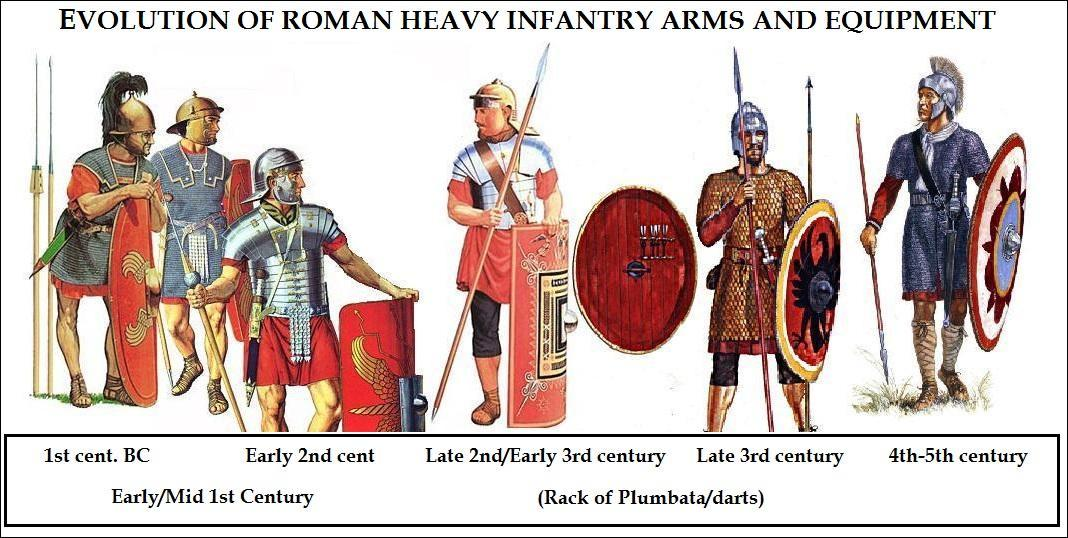
The Evolution of the Roman Cuirass: From Chain to Segmented Plate
The image of the Roman legionary is almost universally associated with the Lorica Segmentata—the iconic, gleaming plate armor composed of horizontal metal strips. However, this armor was neither the beginning nor the end of Roman military protection. It represents a specific, highly engineered middle period in the evolution of Roman defensive equipment, born from the unique requirements of the early Imperial army.
1. The Predecessor: Lorica Hamata (Chainmail)
For the majority of the Roman Republic, the standard protection was the Lorica Hamata—a chainmail shirt.
Design: Composed of thousands of interlocked iron rings, it was flexible, relatively easy to repair in the field, and effective at stopping glancing sword cuts.
Limitations: It was heavy, and because it lacked structural rigidity, it offered poor protection against heavy crushing blows (like maces or heavy polearms) and could easily be pierced by high-velocity thrusts.
2. The Innovation: The Lorica Segmentata
By the early 1st century AD, as Rome expanded into the hostile frontiers of Britannia and Germania, the army encountered enemies using long, heavy swords and spears that necessitated superior impact protection. The Lorica Segmentata was the technological answer.
Design: It consisted of broad, overlapping iron or steel plates (segmenta) arranged in horizontal bands around the torso and shoulders, secured by internal leather straps, brass hooks, and split pins.
Strategic Advantages:
Impact Distribution: Unlike chainmail, the rigid plates acted as a shell, spreading the kinetic energy of a blow across a larger surface area, drastically reducing blunt-force trauma to the ribs and internal organs.
Thrust Deflection: The curved shape of the plates was designed to deflect thrusts from spears and swords, causing them to slide off rather than bite into the metal.
Portability: Perhaps its most brilliant logistical feature was that it could be unbuckled into four main sections (the two shoulder guards and the two torso halves), allowing it to be stored compactly in a leather bag during long marches.
3. The Structural Mechanics
The Lorica Segmentata was an engineering masterpiece, but it relied on a delicate balance of parts.
The Internal Skeleton: The plates were held together by leather straps riveted to the inside of the metal. This allowed for a surprising degree of movement, letting the soldier breathe and swing his sword while keeping the torso fully encased.
The Vulnerability: The reliance on leather straps was its greatest weakness. In the humid, muddy, or marshy environments of the northern frontiers, the leather would rot, rust, or harden. This made the armor notoriously high-maintenance; legionaries required constant access to oil and replacement straps to keep their gear functional.
4. The Transition: Why the Plate Disappeared
Despite its superior protective qualities, the Lorica Segmentata was largely phased out by the end of the 3rd century AD. The Roman military underwent a strategic shift—prioritizing mobility, lower manufacturing costs, and ease of maintenance in a decentralized, crumbling empire.
Logistical Simplification: The production of the Segmentata was a labor-intensive, specialized craft that required skilled blacksmiths. By contrast, the older Lorica Hamata and the simpler Lorica Squamata (scale armor) were much faster and cheaper to mass-produce for the vast, mobile frontier armies.
Field Durability: Soldiers on long-term garrison duty in remote outposts found chainmail more reliable because it didn't require the complex, fragile strap-and-buckle system of the plate armor. The Roman military returned to a design philosophy that favored durability over specialized protection.