The reign of Emperor Nero (54–68 CE) marks one of the most volatile, theatrical, and destructive periods in Roman history. At the absolute center of his dark legacy sit two interconnected events that redefined the topography of the imperial capital: the Great Fire of Rome in 64 CE and the subsequent construction of the Domus Aurea (the Golden House)—a colossal, avant-garde palace complex that pushed ancient Roman engineering and concrete architecture to its absolute limits.
1. The Great Fire of Rome (64 CE): Myth vs. Reality
On the night of July 19, 64 CE, a catastrophic blaze erupted in the commercial district surrounding the Circus Maximus. Driven by strong summer winds, the fire raged unchecked for six days, paused briefly, and then flared up again, ultimately destroying or severely damaging 10 of Rome’s 14 urban districts.
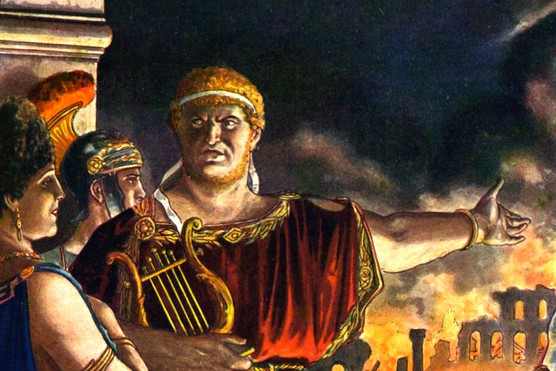
Did Nero Fiddle While Rome Burned?
The popular image of Nero dressed in theatrical garb, playing his lyre and singing about the destruction of Troy while his capital burned, is a myth popularized by later, deeply hostile Roman historians like Suetonius and Cassius Dio.
The contemporary historian Tacitus, who actually lived through the fire as a child, records a vastly different reality:
The Alibi: Nero wasn't even in Rome when the fire started; he was at his coastal villa in Antium (modern Anzio), roughly 30 miles away.
The Crisis Response: Upon rushing back to the burning capital, Nero personally funded and organized massive relief efforts. He opened the Campus Martius and the imperial gardens to shelter the homeless, rushed grain supplies up from the port of Ostia to prevent starvation, and slashed food prices.
The Scapegoats
Despite his relief efforts, a persistent rumor spread through the ash-choked streets that Nero had ordered the fire himself to clear land for a grand new palace. To deflect public fury, Nero pointed the finger at an obscure, unpopular Eastern religious sect: the Christians. Tacitus notes that Nero had these early Christians arrested, covered in wild beast skins to be torn apart by dogs, or nailed to crosses and set ablaze to serve as nighttime illumination for his circus games.
2. The Domus Aurea: The Golden House
Once the debris was cleared, the public's worst suspicions seemed confirmed. Nero seized a massive swathe of scorched land—spanning over 100 to 300 acres across the Palatine, Esquiline, and Caelian hills—to build the Domus Aurea.
Designed by the brilliant architect-engineers Severus and Celer, this was not a traditional Roman palace, but a sprawling, surreal countryside landscape transported directly into the heart of a dense metropolis.
The Colossus: At the main entrance stood a breathtaking 37-meter (120-foot) bronze statue of Nero depicted as the sun god Sol, sculpted by Zenodorus.
The Landscape: The complex featured vast artificial pastures, vineyards, woodlands stocked with imported wild animals, and a massive, shimmering artificial lake at the center. (Decades later, Emperor Vespasian would drain this very lake to build the Flavian Amphitheatre, naming it the Colosseum because it sat next to Nero's giant statue).
The Decor: The palace walls were sheathed in rare, imported marbles, inlaid with mother-of-pearl, and heavily gilded with gold leaf—giving the palace its name. The ceilings were covered in innovative, playful frescoes painted by the artist Famulus, whose whimsical style later inspired Renaissance artists like Raphael.
3. Engineering Masterpiece: The Octagonal Hall
While the gold and frescoes captured the anger of the Roman elite, the true historical significance of the Domus Aurea lies in its structural engineering. The palace represents the definitive arrival of the Roman Concrete Revolution, transitioning architecture from rigid post-and-beam stone structures to fluid, light-filled interior spaces.
The absolute pinnacle of this revolution is the Octagonal Hall.
Severus and Celer broke completely away from traditional square room designs to engineer an architectural marvel:
The Dome: They constructed a perfectly circular concrete dome resting on top of an octagonal base of eight brick-faced concrete pillars.
The Oculus: At the absolute peak of the dome, they left a wide, circular opening called an oculus. This served as the primary light source, pouring a dramatic column of natural sunlight into the room.
The Clerestory Windows: To illuminate the surrounding radiating rooms branching off the main hall, the architects left hidden, vertical gaps between the outer edge of the dome and the inner walls. This primitive but ingenious clerestory lighting system made the heavy concrete dome appear to float seamlessly on a ring of pure light.
According to Suetonius, this or a similar dining hall featured a mechanical, rotating wooden ceiling that turned slowly day and night to mimic the movement of the celestial spheres, while hidden pipes showered perfume and flower petals down onto Nero’s elite dinner guests.
4. The Political Fall and Damnatio Memoriae
The sheer extravagance of the Domus Aurea bankrupted the imperial treasury. Nero devalued the Roman currency and forced wealthy citizens to sign over their estates, alienating the Senate and the powerful provincial military governors. In 68 CE, facing a massive military rebellion, the Senate declared Nero a public enemy. He fled the city and committed suicide, famously crying out, "Qualis artifex pereo!" ("What an artist dies in me!").
Following his death, Nero was subjected to damnatio memoriae (the erasure of memory).
The Roman state systematically dismantled the Domus Aurea to return the stolen land back to the Roman public. The upper pavilions were stripped of their gold and marble, filled entirely with dirt, and utilized as the structural foundations for the Baths of Trajan.
Paradoxically, this act of political erasure is exactly what saved Nero’s architecture. By burying the lower levels of the Domus Aurea in deep soil, successive emperors inadvertently sealed and protected the historic concrete arches, vaults, and frescoes, allowing them to survive completely intact into the modern era.