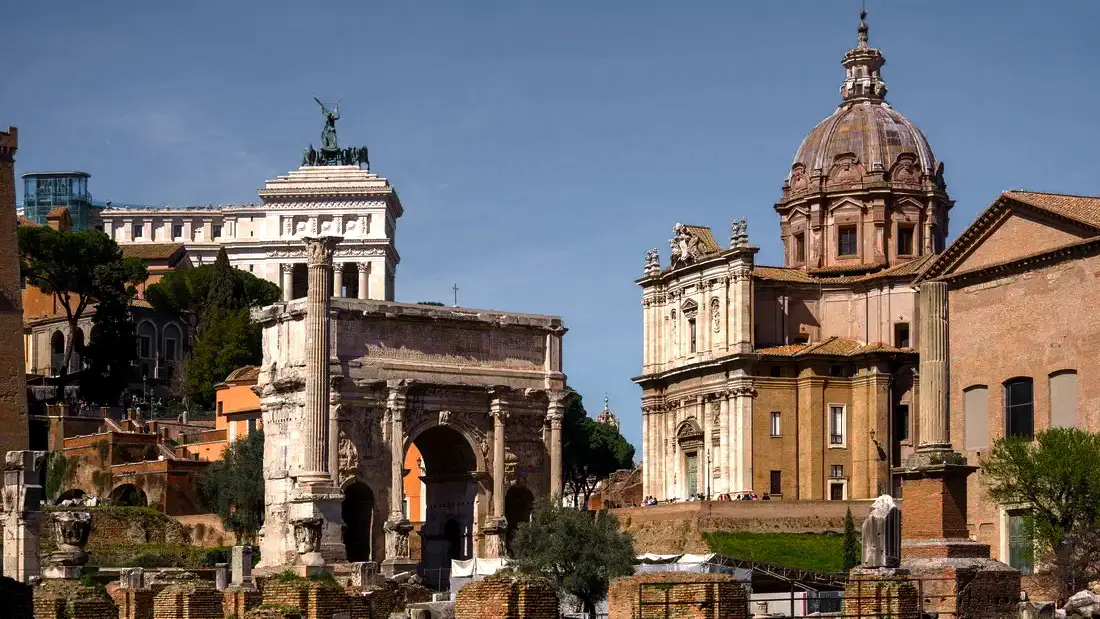
The Roman Forum (Forum Romanum) was the beating heart of the Roman Republic—a dense, chaotic, and vibrant space where politics, law, religion, and commerce collided. Originally a marshy valley between the Palatine and Capitoline Hills, it was transformed in the 6th century BC by the construction of the Cloaca Maxima, a massive drainage system that allowed the area to become the city's primary public gathering place.
Deep Dive: The Six Pillars
1. The Comitium: The Legislative Assembly
The Comitium was the original heart of political activity, a circular outdoor space where the Roman people met to vote and decide the future of the state. It was the "democratic" counterpart to the Senate, representing the Populus Romanus. Over time, as Rome grew, the Comitium became the focal point for the struggle between the patricians and the plebeians, serving as the setting where the most foundational laws, such as the Twelve Tables, were presented to the citizenry.
2. The Curia: The Senatorial Power
If the Comitium represented the people, the Curia represented the power of the aristocracy. As the official meeting place of the Senate, it was the site where the most influential men in Rome debated foreign policy, declared war, and controlled the state’s massive budget. The Curia was more than just a building; it was a symbol of continuity, and its frequent reconstructions after fires or civil riots tracked the turbulent evolution of Rome’s ruling class.
3. The Rostra: The Power of Political Oratory
The Rostra was the most volatile spot in the Forum, a raised platform adorned with the prows of captured enemy ships. This was the primary interface between the elite and the masses. In a society without mass media, the ability of a statesman to command the attention of the crowd from the Rostra was the most vital political skill. From here, Cicero defended the Republic against conspiracy, and here, too, the inflammatory speeches were given that ignited the populist movements of the late Republic.
4. The Basilicas: The Legal and Economic Hub
As Rome’s legal and commercial needs expanded, the open-air courts proved insufficient, leading to the development of the basilica. These long, roofed halls provided the necessary shelter for complex legal trials and intense commercial banking. By concentrating the city's financial and legal activities into these massive public structures, the Republic effectively institutionalized its judicial process and established the Forum as the permanent headquarters for Roman contract law and international trade.
5. The Temple of Saturn: The State Treasury
The Temple of Saturn served the critical function of the aerarium, or the public treasury of the Roman Republic. Located at the foot of the Capitoline Hill, it safeguarded the wealth that sustained Rome’s expansive military campaigns and civic projects. Its role as a bank turned it into a target during periods of political upheaval, as control over the treasury was synonymous with control over the state's ability to pay its legions and satisfy its creditors.
6. The Via Sacra: The Processional Spine
The Via Sacra, or "Sacred Way," was the central artery of the Forum. It functioned as the ritual spine of the city, serving as the final leg of the Roman Triumphs—the grand processions where victorious generals marched their captives, gold, and legions to the temple of Jupiter on the Capitoline. By forcing this route through the center of the Forum, the Republic ensured that every military victory was inextricably linked to the sacred and political identity of the city, transforming battlefield success into divine sanction.