Introduction: The Imperial Carpets of Sicily
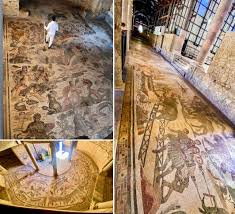
Deep within the rural heart of Sicily, near the town of Piazza Armerina, lies the Villa Romana del Casale. Constructed in the early 4th century AD, this sprawling, palatial country estate is not famous for its standing architecture, but for what covers its floors. Spanning over 37,000 square feet (3,500 square meters), the villa contains the most complex, expansive, and well-preserved collection of Roman mosaics in situ anywhere in the world.
The villa was buried by a massive landslide in the 12th century, which inadvertently acted as a protective blanket, sealing the floors from the elements and looters for hundreds of years. When excavated in the 20th century, archaeologists uncovered a vibrant, colorful, and staggeringly detailed narrative of Late Roman elite life, imperial propaganda, and mythological storytelling, executed by master craftsmen brought directly from North Africa.
1. Architectural Layout and Purpose
The Villa del Casale was engineered as a self-contained theater of power, likely owned by a member of the Roman senatorial aristocracy or even a member of the Imperial Tetrarchy (such as Maximian, co-emperor with Diocletian). The layout of the rooms dictated the prestige of the mosaics within.
The Monumental Entrance: Visitors entered through a horse-shoe-shaped courtyard, immediately encountering geometric, welcoming motifs.
The Public Spaces: Rooms meant for receiving guests, legal hearings, and banqueting featured highly complex, large-scale narrative mosaics designed to awe visitors with the owner's wealth and global reach.
The Private Apartments: The northern and southern wings housed private bedrooms (cubicula). These floors featured more intimate, domestic, and often mythological or erotic scenes, tailored for family eyes rather than public display.
2. The Great Hunt (Ambulacro della Grande Caccia)
The crown jewel of the Villa del Casale is the Great Hunt, a monumental mosaic carpet stretching over 200 feet (60 meters) down a long, vaulted corridor. It is not actually a hunting scene, but a massive geographical travelogue documenting the capture and transport of exotic animals for the Roman Colosseum games.
The Narrative Arc: The mosaic reads left to right as a map of the Roman empire, moving from the western provinces (Numidia and Mauretania) across the Mediterranean to Egypt and India.
The Menagerie: Masters of the tesserae art captured the anatomy and movement of elephants, tigers, leopards, rhinos, and hippos being trapped by Roman soldiers, bound, and loaded onto galleys.
The Hidden Details: Beyond the animals, the mosaic provides invaluable historical insight into Late Roman military uniforms, ship construction, and the sheer logistical nightmare of supplying the imperial venationes (beast hunts).
3. The "Bikini Girls" (Sala delle Dieci Ragazze)
Perhaps the most famous room in the modern era is the Room of the Ten Girls. This floor provides a vivid, surprisingly modern glimpse into ancient athletic culture, shattering long-held assumptions about the societal role of Roman women in sport.
The Attire: The mosaic depicts ten young women engaged in rigorous athletic competition, dressed in two-piece garments that bear an uncanny resemblance to modern bikinis.
The Events: The women are shown competing in a variety of pentathlon-style events, including weightlifting with dumbbells, discus throwing, running, and playing a form of beach volleyball.
The Coronation: In the corner of the scene, one woman is awarded an imperial laurel crown and a palm frond of victory, proving these were formal, celebrated athletic events rather than casual recreation.
4. Materials, Palette, and North African Craftsmanship
The artistic mastery of the Casale mosaics stems from their unique texture, depth, and vibrant color variance, which was achieved through specific regional materials and trade routes.
The North African Connection: Stylistic analysis proves that the artisans who laid these floors were not local Sicilians, but elite master craftsmen from Carthage and Hippo Regius (modern Tunisia and Algeria). North Africa was the epicenter of mosaic innovation in the 4th century.
The Tesserae Palette: Unlike standard Roman mosaics that relied heavily on local black and white stone, the Casale floors utilize millions of tiny stone cubes (tesserae) cut from marble, porphyry, basalt, and limestone imported from across the empire.
The Illusion of Depth: By carefully shifting shades of terracotta, ochre, and deep blues, the African masters achieved a painterly effect, capturing the shimmer of water, the muscle tone of gladiator legs, and the translucent quality of silk clothing.
5. Mythological Metaphors of Power
For the Roman elite, mythology was never just decoration; it was a socio-political statement. The grandest rooms of the villa utilize myth to project the owner's absolute authority.
The Chamber of Polyphemus: Located in the private apartments, this mosaic depicts Ulysses outsmarting the Cyclops Polyphemus. It is a classic metaphor celebrating Roman intellect and civilization overcoming raw, barbarian savagery.
The Hall of the Circus: A massive depiction of the Circus Maximus in Rome, complete with chariot races crashing and turning around the central spina. This floor served to show that the owner possessed the immense wealth required to sponsor public games in the capital.
The Basilica: The main reception hall features a floor showing the labors of Hercules. This choice was highly political: during the Tetrarchy, emperors explicitly associated themselves with Hercules to legitimize their divine right to rule.
6. Legacy and Archaeological Preservation
The Villa Romana del Casale stands as the definitive transition point between Classical Roman art and the early stages of Byzantine abstraction.
While classical art emphasized perfect proportion and restraint, the Late Antique mosaics of Casale favor raw emotion, heavy outlines, massive crowds, and dramatic action. They capture a superpower at its zenith, obsessed with spectacle, luxury, and global dominion. Today, protected by a state-of-the-art glass and steel enclosure system, these floors remain an incomparable biological and cultural archive, allowing modern viewers to walk through the exact same visual landscape that a Roman aristocrat stepped on 1,700 years ago.