Introduction
Children are often difficult to identify in archaeological records because their activities may leave fewer durable traces than the work of adults. Yet childhood is a major part of human social life. Children learn skills, develop relationships, imitate adults, play games, and participate in household and community activities.
Toys, miniatures, small tools, gaming pieces, and distinctive spatial patterns can help archaeologists investigate these experiences. Rather than treating childhood as a purely biological stage, spatial archaeology examines how children interacted with houses, streets, workshops, courtyards, sacred spaces, and other environments.
The interpretation requires caution. A small object is not automatically a toy, and an area containing miniature objects is not necessarily a children's learning space. Such conclusions become stronger when artifacts, wear patterns, building layouts, and comparative evidence support the same explanation.
Childhood as a Social Experience
Childhood is shaped by culture as well as age.
Different societies establish different expectations about when children begin working, learning specialized skills, participating in rituals, or taking on responsibilities.
Some children may spend much of their time in domestic spaces, while others learn through work in fields, workshops, markets, or herding environments.
Archaeologists should therefore avoid projecting modern ideas about childhood directly onto ancient communities.
The goal is to investigate how children participated in the social and economic life of a particular society.
Toys and Play
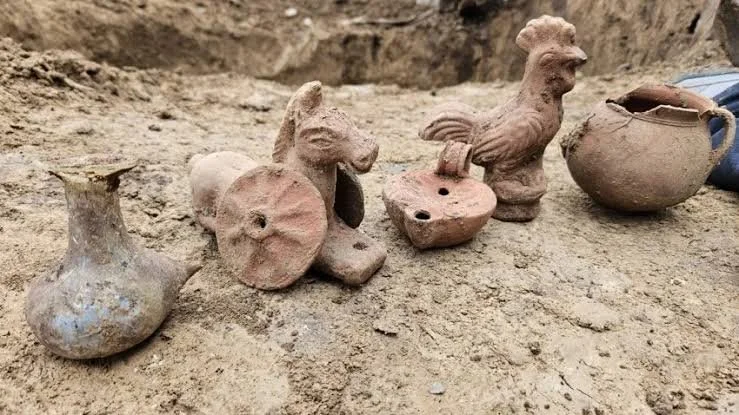
Toys can include dolls, miniature animals, balls, spinning objects, gaming pieces, and objects designed for movement or imaginative play.
Some ancient toys are recognizable through their form or context. Others are ambiguous.
A miniature vessel might have been used by a child during play, but it could also have served a ritual purpose, functioned as a votive offering, or been manufactured as a sample or decorative object.
Researchers examine wear, manufacturing quality, size, context, and comparisons with known examples.
A toy may also have had several functions over its lifetime. An object used in play could later become a keepsake or an offering.
Miniatures and Imitation
Miniature objects can reveal how children learned about the adult world.
A small vessel may imitate household equipment, while a miniature animal may represent livestock or an animal important to local life. Small tools could be used for play, training, or practical tasks.
Imitation can be a way of learning. Children may reproduce activities they observe in adults, including cooking, building, farming, craft production, or trade.
However, miniature objects were not exclusively associated with children. Adults also used miniatures in religious practices, funerary customs, teaching, and symbolic representation.
Their meaning must be established from context rather than size alone.
Learning Through Practice
Many skills are learned by watching and doing.
Children may observe adults preparing food, making tools, caring for animals, weaving, repairing equipment, or conducting ceremonies. They may begin with simplified tasks before gradually assuming more complex responsibilities.
Archaeological evidence of learning can include imperfectly finished objects, repeated practice pieces, small-scale tools, and production waste.
Yet poorly made artifacts are not automatically the work of children. They may result from hurried production, inexperienced adults, specialized tasks, or other factors.
Researchers need to compare objects systematically and consider alternative explanations.
Identifying Children's Spaces
Children may have used different areas for play, learning, and social interaction.
Possible spaces include courtyards, domestic rooms, open areas near houses, workshops, streets, and communal gathering places.
Spatial archaeology investigates how artifacts are distributed across these environments.
A concentration of gaming pieces near a courtyard might indicate repeated activity, but the objects could also have accumulated through sweeping or waste disposal. Their original location must be reconstructed as carefully as possible.
Building access, visibility, floor surfaces, hearths, and circulation routes can help researchers investigate how spaces were used.
Domestic Architecture and Childhood
Houses provide important evidence for family life.
Rooms may have supported cooking, sleeping, storage, craft production, and other activities. In some societies, domestic spaces were flexible and changed function according to the time of day or season.
Children could participate in several activities within the same room.
A house should therefore not be divided too rigidly into adult and child areas unless the evidence supports that interpretation.
The arrangement of doorways, storage areas, workspaces, and courtyards can help reconstruct the opportunities children had to observe and participate in daily tasks.
Children in Workshops
Workshops can reveal how practical knowledge was transmitted.
Children may have learned by observing skilled workers, preparing materials, assisting with simple tasks, or practicing techniques.
Evidence might include small tools, unfinished products, repeated experimental pieces, or production areas with varied levels of technical skill.
However, identifying a specific worker's age from an artifact is difficult.
The presence of small tools does not automatically indicate child labor. Tools may have been designed for precision work, used by adults, or intended for particular tasks.
Games and Social Relationships
Games can teach children rules, cooperation, competition, and strategic thinking.
Archaeological gaming pieces may include counters, dice, boards, or marked surfaces. Some games are recognizable through surviving boards or written descriptions, while others remain uncertain.
The distribution of gaming objects across a settlement may reveal where people gathered and interacted.
Yet the presence of a gaming piece does not prove that children used it. Adults also played games, and some gaming objects may have had divinatory or ritual uses.
Age-related interpretations should therefore be based on several lines of evidence.
Childhood and Burial Archaeology
Burial sites provide another source of information about children.
Graves of infants and young people may contain objects that researchers interpret as toys, ornaments, or status markers.
The meaning of such objects varies. An item buried with a child may have been used during life, selected specifically for the funeral, or intended to express the family's hopes and beliefs.
Differences in burial treatment may reflect age, social status, family relationships, religious traditions, or changing customs.
Researchers should avoid assuming that every object in a child's grave was a personal possession.
Wear Analysis and Use
Microscopic wear can sometimes help identify how an object was handled.
Repeated abrasion, polish, breakage, or residue may indicate use rather than deliberate burial placement.
Experimental archaeology can compare wear produced by different activities. For example, a miniature object repeatedly handled during play may develop different traces from one used only in a single ceremony.
However, wear patterns overlap, and post-depositional processes can create misleading marks. Microscopic evidence should be combined with context and material analysis.
Gender and Childhood
Some artifacts may be interpreted as associated with boys or girls, but such assumptions require care.
Modern gender stereotypes cannot automatically be applied to ancient societies. Objects may have been shared, and children may have learned different activities according to family needs, social position, or local custom.
Researchers can investigate patterns in artifact distribution, burial practices, and representations of children, but conclusions should reflect the limits of the evidence.
The goal is to understand how a particular society organized childhood rather than to impose a universal model.
The Limits of Archaeological Evidence
Children's activities often leave traces that are difficult to distinguish from those of adults.
Objects can be reused, moved, or discarded far from the places where they were originally used. Buildings may serve multiple functions over time, and archaeological deposits may contain material from several generations.
Preservation also affects what survives. Wooden toys, cloth objects, and other perishable materials may disappear, leaving an incomplete record dominated by stone, ceramic, and metal objects.
The absence of toys therefore does not prove that children did not play.
Conclusion
The spatial archaeology of childhood investigates how children learned, played, worked, and developed relationships within their communities. Toys, miniatures, gaming pieces, small tools, and the layout of domestic and working spaces can provide important evidence, but each must be interpreted within its cultural and archaeological context.
Small objects are not automatically children's possessions, and spaces are not automatically dedicated to childhood. Strong conclusions emerge when artifact distributions, wear patterns, architecture, burial evidence, and comparative research support one another.
By examining these connections, archaeologists can move beyond the assumption that ancient communities were made up only of adults and recover a more complete picture of everyday life. Childhood was not separate from society; it was one of the ways knowledge, skills, identities, and traditions were transmitted between generations.