Introduction
Clothing in cold environments required more than protection from wind and rain. People living in high-latitude and high-altitude regions needed materials capable of retaining body heat while remaining flexible enough for movement.
Animal skins, fur, wool, plant fibers, and other materials provided different forms of insulation.
Feathers are another possible source of insulation. Their structure traps air and can reduce heat loss, making them useful in certain types of clothing and bedding.
However, identifying feather insulation in ancient garments is challenging because feathers are organic materials that rarely survive for long periods. The phrase "osteo-trace evidence" also requires clarification: bones may provide indirect evidence of feather-bearing animals, but they do not independently demonstrate that feathers were used in clothing.
How Feather Insulation Works
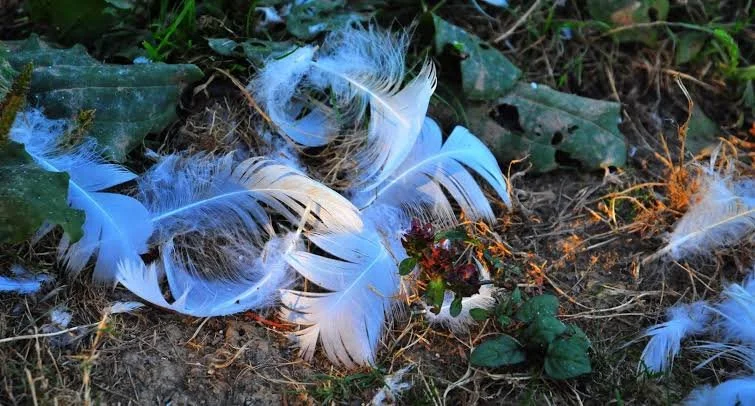
Feathers have structures that can trap air between their branches and barbs.
Down feathers are particularly effective at retaining warm air because of their soft, three-dimensional structure.
When placed inside clothing or bedding, feathers can create an insulating layer.
The effectiveness depends on the species, feather type, density, moisture, and construction of the garment.
Feathers can also become less effective when wet or heavily compressed.
Possible Uses in Early Clothing
Feathers may have been used in several ways.
They could have been attached to the exterior of garments for decoration or protection.
Down or other soft feathers might have been placed inside sewn layers of hide or textile.
Feather-filled coverings could also have served as blankets, bedding, or portable insulation.
These possibilities are technologically plausible, but their use in a specific prehistoric community requires direct evidence.
Why Bones Cannot Prove Feather Clothing
Bird bones can identify the presence of particular species at an archaeological site.
They may reveal hunting, consumption, or the exploitation of birds for feathers and other materials.
However, the presence of bird remains does not demonstrate that feathers were used in clothing.
Birds could have been eaten, used for ornaments, or incorporated into other activities.
Researchers therefore need additional evidence to establish textile or clothing use.
Direct Archaeological Evidence
The strongest evidence would involve preserved feathers found in a clear association with garments or bedding.
In exceptional preservation environments, feathers may survive through freezing, desiccation, waterlogging, or other conditions that slow decomposition.
Microscopic traces may also survive on hide, textile, or other materials.
Researchers can examine feather structure, barb arrangement, and microscopic characteristics to identify the material.
Context is essential because feathers may enter deposits naturally through bird activity.
Trace Evidence and Microscopy
Microscopic analysis can identify small feather fragments or impressions.
Scanning electron microscopy may reveal surface details that help distinguish feathers from other organic materials.
Protein analysis may sometimes identify biological residues, although ancient preservation and contamination create significant challenges.
Researchers must also consider whether traces were introduced by modern handling, excavation materials, or environmental processes.
A convincing interpretation requires a clear relationship between the feather traces and the suspected garment.
Archaeological Evidence from Birds
Bird bones can still provide important supporting information.
Species identification may reveal which birds were available to ancient communities.
The distribution of skeletal elements may help distinguish food preparation from other forms of exploitation.
Some bird species possess valuable feathers that could have been collected without consuming the entire animal.
Patterns of feather collection may be suggested by unusual bone distributions or repeated selection of particular species, but such interpretations remain indirect.
Clothing Technology and Environmental Adaptation
Feather insulation would have required knowledge of material properties and garment construction.
Feathers could be inserted between layers, sewn into compartments, or attached to an existing covering.
The garment would need to retain the feathers while allowing movement.
The choice of insulation may have depended on local ecology.
Communities with access to suitable birds might have used feathers alongside fur, hide, and plant fibers.
Different materials could also have been combined for different functions.
Preservation Environments
Organic clothing survives only under exceptional conditions.
Frozen deposits may preserve fibers and feathers, while dry caves can protect organic materials from moisture and microorganisms.
Waterlogged environments can preserve some organic remains when oxygen is limited.
However, preservation is uneven.
A garment may survive while its feather filling disappears, leaving only traces or impressions.
This creates a significant challenge for reconstructing ancient clothing.
The Importance of Experimental Archaeology
Experimental studies can help test how feather insulation behaves.
Researchers can produce replicas using different feather types and garment constructions.
They can examine warmth, moisture retention, compression, and durability.
These experiments can demonstrate whether a proposed design is technically practical.
They cannot prove that ancient people used a particular garment unless the archaeological evidence supports the reconstruction.
Conclusion
Feathers offer a plausible source of insulation for early clothing, particularly in environments where maintaining body heat was essential.
Their use may have involved down-filled garments, layered coverings, or feather-lined bedding.
However, bird bones alone cannot establish that feathers were used as insulation.
Direct feather preservation, microscopic traces, garment evidence, and careful archaeological context are necessary to support the interpretation.
Combining osteological evidence with organic residue analysis and experimental reconstruction can help researchers investigate how ancient communities used animal materials to adapt to demanding climates.