Introduction
Rivers have always influenced how people move through landscapes.
Large rivers can separate territories, support trade, and provide transportation routes. Smaller rivers may appear less significant, but they can also shape patterns of settlement, social interaction, and cultural identity.
In prehistoric landscapes, a narrow river might mark the boundary between communities, separate different resource zones, or influence where people established settlements.
However, rivers were not necessarily barriers. They could also provide bridges between groups through fishing, exchange, seasonal movement, and shared access to water.
The archaeology of small rivers therefore offers an opportunity to understand how natural features influenced cultural relationships.
Rivers as Geographic Boundaries
A river can create a visible division in the landscape.
Its banks may separate agricultural fields, grazing areas, hunting territories, and settlement zones.
A small river may also mark a transition between ecological environments.
For prehistoric communities, these distinctions could become socially meaningful.
A river might be recognized as the limit of a group's regular territory or as a place where neighboring communities met.
Such boundaries were not necessarily fixed or formally controlled.
Rivers as Corridors of Movement
Although rivers can divide landscapes, they also create routes.
River valleys often provide relatively level passages through hills and mountains.
People could follow waterways to reach hunting grounds, settlements, and exchange locations.
Small rivers may connect larger drainage systems, making them part of broader movement networks.
Seasonal changes in water levels could affect how easily these routes were used.
Archaeological Evidence for Cultural Boundaries
Researchers investigate cultural boundaries by examining settlement distribution and material culture.
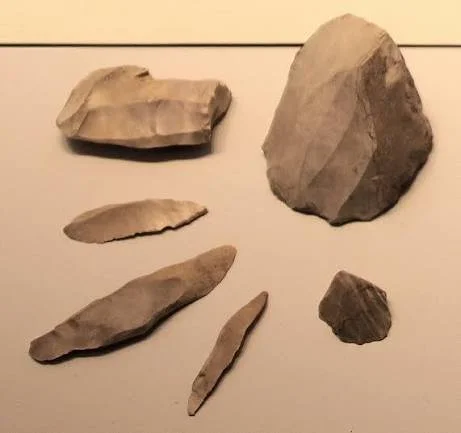
Differences in pottery styles, stone tools, burial practices, and architecture may occur on opposite sides of a river.
If these differences remain consistent across several archaeological sites, they may indicate distinct cultural traditions.
However, a river should not automatically be treated as the cause.
Communities may have developed different practices for other reasons, including chronology, resource access, or social relationships.
Crossing Points and Interaction
Small rivers could become important meeting places.
Shallow crossings, natural stepping stones, and stable banks might support repeated movement.
Archaeologists may identify crossing points through paths, trackways, bridges, or concentrations of artifacts.
A crossing could become a location for exchange between neighboring communities.
It might also serve as a boundary marker where access was regulated or negotiated.
Rivers and Territorial Organization
Prehistoric territorial systems are difficult to reconstruct because boundaries were rarely marked with permanent structures.
Communities may have understood territory through repeated use rather than formal lines.
Fishing locations, grazing areas, hunting grounds, and water sources could be shared or contested.
A river might represent a boundary during one season and a shared resource during another.
This flexibility is important when interpreting prehistoric landscapes.
Environmental Change
Small rivers can change course, dry up, flood, or become buried by sediment.
A modern stream may not follow the same channel used by prehistoric communities.
Researchers reconstruct ancient river systems through sediment cores, geological mapping, and analysis of floodplain deposits.
Environmental changes may also alter settlement patterns.
A river that once supported a village could become less reliable, encouraging people to move elsewhere.
River Archaeology and Material Evidence
Artifacts found near riverbanks can reveal how people used these environments.
Fishing equipment, animal remains, stone tools, pottery, and settlement features may indicate different activities.
Organic materials can sometimes survive in waterlogged deposits.
However, rivers also transport artifacts away from their original locations.
Flooding may redeposit objects from distant settlements, making their archaeological context difficult to interpret.
Rivers and Cultural Identity
Natural features can become part of community identity.
A river may appear in place names, oral traditions, ritual practices, and stories about ancestral territories.
Archaeological evidence alone cannot fully reconstruct these meanings.
However, the repeated placement of settlements, burials, or ritual sites near a river may suggest that it held significance beyond its practical value.
Comparisons with later traditions may offer context, but they should not be used as direct proof of prehistoric beliefs.
Conclusion
Small rivers could influence prehistoric social organization by separating territories, guiding movement, and providing shared resources.
Their importance depended on local geography, seasonal conditions, and the relationships between neighboring communities.
Archaeological differences across a river may indicate cultural boundaries, but these patterns must be interpreted alongside chronology, settlement evidence, and environmental change.
Rather than viewing small rivers only as barriers, researchers should consider them dynamic spaces where communities met, exchanged goods, negotiated access, and shaped their relationships with the surrounding landscape.