Introduction
Coffee has become one of the world's most recognizable beverages, but its historical development is closely connected to the cultures and landscapes of East Africa. Ethiopia, in particular, is widely associated with coffee's botanical origins and with traditions that eventually developed into elaborate forms of social hospitality.
Coffee ceremonies are important cultural practices involving preparation, roasting, brewing, serving, and conversation. They demonstrate how an everyday agricultural product can become central to social relationships, identity, and community life.
Studying the earliest history of coffee ceremonies presents an archaeological challenge. Coffee residues are not always easy to distinguish from other plant materials, and many ceremonial practices were transmitted orally rather than recorded in written documents.
This article examines the historical background, archaeological potential, and social significance of coffee traditions in East Africa while distinguishing documented history from claims that remain difficult to verify.
1. Coffee's Botanical Origins in East Africa
The coffee plant, particularly Coffea arabica, is native to the highland forests of southwestern Ethiopia.
These landscapes provided environmental conditions suitable for the growth of wild coffee populations. Local communities had access to the plant long before coffee became an international commercial commodity.
The exact date when people first began deliberately processing coffee seeds as a beverage remains uncertain. Botanical origins, early human use, and the development of recognizable coffee-drinking traditions are separate historical questions.
This distinction is important because the existence of wild coffee does not automatically establish the presence of an organized coffee ceremony.
2. Early Uses of Coffee Plants
The earliest uses of coffee in East Africa may have included activities beyond preparing the familiar roasted beverage.
Ethnobotanical research has documented diverse traditional uses of plants, including the preparation of leaves, fruits, and seeds. Some historical accounts describe coffee-related foods or mixtures that differ from modern brewing practices.
However, reconstructing the earliest coffee consumption practices is difficult because direct archaeological evidence is limited.
Researchers must therefore distinguish between documented later traditions, historical descriptions, and hypotheses about earlier forms of use.
3. The Development of Coffee Drinking Traditions
Coffee drinking became increasingly important in the wider Red Sea and Indian Ocean world over the medieval and early modern periods.
Historical accounts connect the development of established coffee-drinking traditions with Yemen, where coffee cultivation and preparation became important before spreading into other regions.
Trade networks helped move coffee between East Africa, the Arabian Peninsula, and other commercial centers.
The movement of coffee across these routes illustrates how agricultural knowledge, consumption habits, and social practices could develop through sustained contact between communities.
4. The Ethiopian Coffee Ceremony
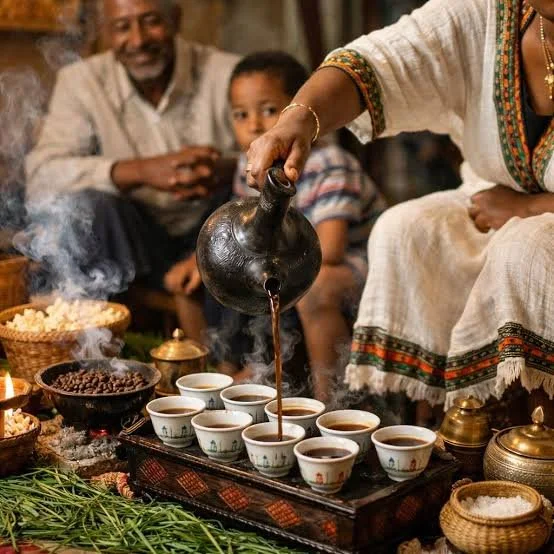
The Ethiopian coffee ceremony is a structured social practice involving several stages.
Green coffee beans are commonly washed, roasted in a pan, and ground before being brewed. The prepared coffee is traditionally served in small cups, often across multiple rounds.
The ceremony may be accompanied by conversation, hospitality, and the sharing of food. In many settings, its preparation is an important social activity rather than simply a method of producing a drink.
Practices vary between communities and households. There is no single uniform ceremony that represents every Ethiopian region or cultural group.
5. The Social Meaning of Coffee Preparation
Coffee ceremonies can provide opportunities for conversation, reconciliation, hospitality, and the strengthening of relationships.
The preparation process often requires time and participation, creating a shared experience among hosts and guests.
In some contexts, coffee gatherings may also mark important family events, community discussions, or informal negotiations.
These social functions demonstrate that coffee's significance extends beyond its chemical or nutritional properties.
6. What Archaeologists Can Learn from Coffee Residues
Archaeologists may investigate the history of coffee through botanical remains, residues on vessels, roasting equipment, and evidence of trade.
Plant remains can include seeds, fragments, and other materials preserved through charring or waterlogged conditions.
Chemical residue analysis may identify compounds associated with particular plant products, although distinguishing coffee from related substances requires careful laboratory validation.
Researchers also examine pottery and metal vessels for patterns of heating, staining, and repeated use. Such evidence may indicate beverage preparation, but it cannot establish a coffee ceremony on its own.
7. The Challenges of Dating Early Coffee Practices
Dating the development of coffee drinking is difficult because direct evidence is relatively scarce.
Written accounts can establish that coffee was consumed in particular places by certain historical periods, but they do not necessarily reveal when the practice first began.
Radiocarbon dating may help establish the age of preserved plant remains. However, a dated coffee-related object does not automatically prove that it was used in a ceremonial setting.
Archaeologists must combine botanical identification, chemical analysis, historical documentation, and contextual evidence.
8. Coffee and Regional Trade Networks
Coffee's movement beyond its African origins depended on commercial connections across the Red Sea and the Indian Ocean.
Ports, merchants, agricultural communities, and urban markets played roles in its distribution.
The expansion of coffee cultivation and consumption eventually transformed it into a major international commodity.
Archaeological research into coffee trade may examine imported vessels, commercial buildings, botanical remains, and written records. These sources can help reconstruct how coffee moved between producing regions and consumer markets.
9. Preserving Living Coffee Traditions
Traditional coffee ceremonies remain important cultural practices in parts of Ethiopia and neighboring regions.
Their continued performance provides an opportunity to study techniques, terminology, objects, and social meanings that may have historical depth.
Ethnographic research can document how coffee is prepared and how ceremonial objects are used. However, modern practices should not be treated as unchanged survivals from antiquity.
Communities adapt traditions over time, and historical research must recognize both continuity and change.
Conclusion
East African coffee traditions reveal the close relationship between plants, trade, hospitality, and social identity. Ethiopia's connection to the coffee plant is well established, while the precise origins and chronology of formal coffee ceremonies remain more difficult to reconstruct.
Archaeological research can contribute through botanical identification, residue analysis, vessel studies, and investigation of regional trade networks. Yet the social meaning of coffee is also preserved through living cultural practices and historical documentation.
Together, these sources provide a richer understanding of how coffee developed from a regional plant resource into a major element of social and cultural life.