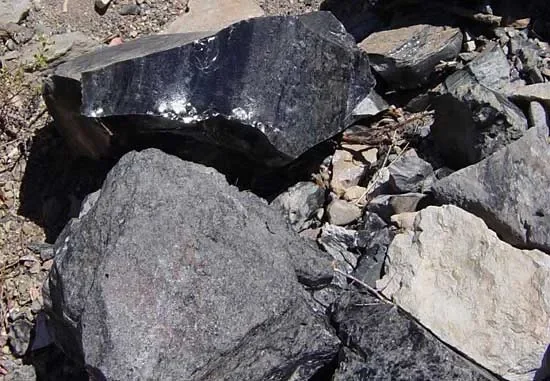
Volcanic glass, commonly known as obsidian, is a naturally occurring material formed when lava cools rapidly without developing a fully crystalline structure. Its smooth surface, sharp edges, and distinctive colors have made it valuable to many communities throughout human history. Although obsidian is often associated with the manufacture of cutting tools, its visual qualities also made it suitable for ornaments, decorative objects, and other forms of artistic expression. Across the Pacific, the study of volcanic glass offers an opportunity to investigate how communities obtained unusual materials, developed specialized craft traditions, and expressed social relationships through objects.
The Pacific region contains a wide variety of geological environments, including volcanic islands where obsidian can occur naturally. However, the distribution of suitable deposits is uneven. Some communities lived close to sources of volcanic glass, while others would have needed to obtain it through exchange, travel, or contact with neighboring groups. This uneven distribution is archaeologically important because the presence of obsidian at a site does not automatically indicate that the material was locally available. Geological sourcing can help researchers identify the origins of recovered specimens and reconstruct possible pathways through which materials moved across islands and coastal settlements.
Identifying decorative use requires careful examination of the archaeological objects themselves. Obsidian artifacts may display polished surfaces, carefully shaped edges, deliberate color arrangements, or placement within another material. Microscopic analysis can reveal whether an object's surface was modified through grinding, polishing, or repeated handling. Researchers must distinguish these characteristics from marks produced during tool manufacture, accidental breakage, or natural weathering. In some cases, a fragment that appears decorative may originally have belonged to a functional implement, making its original purpose difficult to establish without contextual evidence.
Decorative inlays are particularly challenging to identify because they may survive only as small fragments. A piece of volcanic glass could have been inserted into wood, bone, shell, stone, or another material that has since deteriorated. Archaeologists may encounter traces of adhesives, grooves, sockets, or surrounding materials that suggest the fragment once formed part of a composite object. The preservation conditions of tropical and coastal environments can complicate this investigation because organic materials often decay more rapidly than stone. Consequently, the absence of a complete decorated object does not necessarily mean that composite craftsmanship was absent from a community.
The movement of obsidian across the Pacific also raises questions about exchange and social relationships. Geochemical techniques, including elemental analysis, can compare archaeological specimens with known geological sources. When the source of an artifact lies far from the place where it was discovered, researchers can investigate the routes through which the material may have traveled. Nevertheless, long-distance movement does not automatically prove the existence of a formal trade network. Materials might have passed through several communities by gift exchange, marriage relationships, ceremonial obligations, individual journeys, or repeated small-scale transactions.
The meaning of volcanic glass depended on the cultural setting in which it was used. Its reflective surface, dark appearance, or unusual origin may have contributed to its appeal, but these qualities should not be treated as universal symbols. A material considered prestigious in one community might have served a practical purpose in another. Archaeologists therefore need to examine the context of discovery, the quality of workmanship, the frequency of similar objects, and any available evidence from burials, ceremonial spaces, or domestic settlements. Comparisons with living cultural traditions may provide useful perspectives, although these must be developed collaboratively and without assuming that present-day meanings remained unchanged throughout the past.
Craft specialization is another important issue. If decorative obsidian objects display consistent shapes, carefully controlled dimensions, and repeated production techniques, they may indicate shared manufacturing knowledge. Concentrations of unfinished pieces, fragments, polishing materials, and production waste could suggest that particular locations were used for crafting. However, a standardized appearance alone does not prove that a full-time specialist workshop existed. Skilled production may have occurred within households, during particular seasons, or as an activity undertaken by people who also performed other work.
Studying volcanic glass as a decorative material broadens the archaeological understanding of Pacific societies beyond subsistence, technology, and migration. It highlights the importance of visual design, craftsmanship, and the movement of valued materials between communities. By combining geological sourcing, microscopic examination, archaeological context, and culturally informed interpretation, researchers can investigate how volcanic glass was acquired, transformed, displayed, and valued. The evidence may ultimately reveal that even small fragments of a striking natural material can preserve important clues about creativity, social connection, and the cultural significance of objects in the Pacific past.