Basketry and cordage were essential technologies in many ancient societies. Woven containers could be used for gathering food, carrying materials, storing goods, and transporting objects, while cords and ropes supported fishing, construction, fastening, and a wide range of domestic activities. Because baskets, fibers, and ropes are usually made from perishable materials, they often disappear from archaeological deposits. However, their shapes and textures can sometimes survive as impressions in clay, mud, plaster, and other materials that hardened around them. These impressions provide valuable evidence of technologies that would otherwise remain largely invisible.
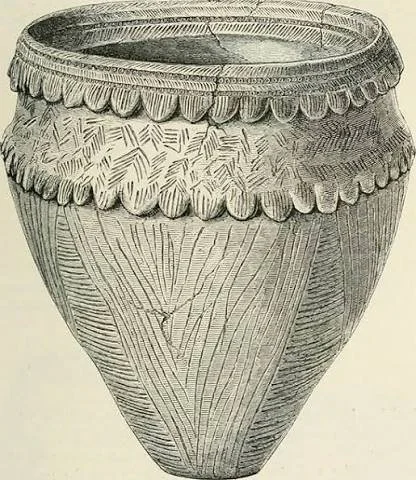
A clay impression forms when a soft surface comes into contact with a textured object and preserves part of that object's pattern. If wet clay is pressed against a woven basket, the weave may leave a recognizable mark. Similar impressions can form when cordage is pressed into clay during pottery manufacture, construction, or the preparation of other objects. Once the clay dries or is fired, the surface pattern may survive long after the original plant fibers have decayed.
The study of these impressions begins with careful documentation. Archaeologists record the shape, dimensions, orientation, and location of the mark before attempting to interpret it. High-resolution photography, microscopic examination, and three-dimensional scanning can preserve fine details that may be difficult to see under ordinary lighting. These methods allow researchers to compare the spacing and direction of the marks and investigate how the original woven object or cord may have been constructed.
Basketry impressions can reveal different weaving techniques. The arrangement of crossing fibers may indicate whether a container was made using simple interlacing, coiling, twining, or another method. The spacing between the strands can provide information about the thickness and flexibility of the original materials. Repeated patterns may also suggest the use of a particular construction tradition, although similar techniques can develop independently in different communities.
Cordage impressions can preserve clues about how fibers were twisted together. A cord made from several strands may leave a pattern reflecting the direction of the twist and the number of components. These details can help researchers reconstruct how the cord was produced and what kinds of fibers might have been used. However, the impression may not preserve enough information to identify the original plant species, particularly if the fibers were soft, degraded, or compressed during manufacture.
One important question is how the basketry or cordage was used. A woven impression on the base of a clay object may indicate that a basket or mat supported the clay while it was being shaped or dried. In pottery production, woven materials could serve as temporary supports, liners, or surfaces that helped prevent clay from sticking to a working area. Cord impressions might result from binding, fastening, or reinforcing a structure. The precise function depends on the object's form and the location of the impression.
Impressions can also help researchers investigate the relationship between basketry and pottery. In some manufacturing traditions, clay vessels were shaped over baskets or other woven supports. If the clay retained the weave pattern, the impression could preserve evidence of the basket's structure even when no basket fragments survived. Such findings can illuminate the interaction between different craft technologies and show how one material was used to assist in the production of another.
However, an impression does not necessarily mean that the original woven object was designed for the purpose represented by the clay. A basket used in everyday life might have been repurposed as a support during pottery manufacture. A cord could have left a mark because it was tied around an object rather than deliberately pressed into the surface. Researchers must distinguish the function of the original object from the reason its impression was preserved.
Experimental archaeology offers an effective way to investigate these possibilities. Researchers can make baskets and cords using different materials and techniques, then press them into clay under controlled conditions. By comparing the resulting impressions with archaeological examples, they can determine which methods produce similar patterns. Experiments may also explore how pressure, moisture, and the drying process affect the clarity of the impression. These comparisons help narrow the range of possible explanations, although they do not prove that ancient craftspeople followed an identical procedure.
The materials used for basketry and cordage varied according to local ecology. Communities might work with reeds, grasses, bark, roots, willow branches, animal hair, or other available fibers. Wetland environments can preserve plant materials particularly well when oxygen levels are low, while dry caves and arid deposits may preserve other types of organic remains. In many settings, however, impressions are the main evidence available for reconstructing weaving techniques.
The study of impressions can also contribute to understanding the transmission of craft knowledge. Similar weaving patterns at several sites may indicate shared techniques, contact between communities, or the movement of craftspeople. Differences in the construction of baskets and cords may reflect local preferences, available materials, or specialized purposes. Yet a shared technique does not necessarily prove direct cultural contact, because practical solutions can emerge independently when people work with similar materials.
Clay impressions also have implications for understanding the development of early technology. They show that basketry and cordage were not simply secondary crafts but could be integrated into other production processes. Woven supports, bindings, and containers helped people handle clay, transport resources, and construct objects. The impressions therefore provide evidence of relationships between crafts rather than documenting isolated technologies.
The archaeology of clay impressions from basketry and cordage demonstrates how delicate and perishable technologies can survive indirectly. By examining the texture, structure, and context of impressions, researchers can reconstruct weaving methods, investigate manufacturing processes, and explore how communities used plant fibers and cords in daily life. When combined with preserved organic remains, experimental studies, and broader archaeological evidence, these impressions offer a valuable record of practical knowledge that might otherwise have disappeared entirely.