Scientists uncover a human population that thrived in Argentina for 8,000 years
At an archaeological site in central Argentina, scientists have discovered signs of a human lineage that had remained unknown for thousands of years.
A new study published in Nature reveals that a distinct population of early humans lived in this region for at least 8,000 years, preserving their genetic identity despite major cultural and environmental shifts. This lineage—unique to central Argentina—survived largely in isolation and still contributes to the ancestry of Indigenous communities today.
“It’s a major episode in the continent’s history that we simply didn’t know about,” said Javier Maravall López, an evolutionary biologist at Harvard University and lead author of the study.
A Blank Spot on the Map
As humans migrated out of Africa, the far southern tip of South America was among the last places they reached. Archaeological evidence suggests that people arrived around 14,000 years ago, settling early sites such as Arroyo Seco in Argentina’s Pampas region. But the identity of those first settlers—and what ultimately happened to them—has long been unclear.
“This part of the world was almost a blank spot on the map,” said David Reich, a geneticist at Harvard Medical School and senior author of the paper. Most ancient DNA research has focused on Europe and Asia, where colder climates preserve human remains more easily.
To address this gap, the team analyzed genetic material from the bones and teeth of 238 ancient individuals—some up to 10,000 years old—found across Argentina, Chile, and Uruguay. They created the largest ancient DNA dataset ever assembled from this region, increasing the number of available samples more than tenfold.
The researchers compared these genomes with DNA from 588 other ancient individuals across the Americas, spanning 12,000 years. By examining about two million genetic markers where human DNA commonly varies, they uncovered patterns of ancestry and divergence that had previously gone unnoticed.
Hidden in Plain Sight
The results were striking. Around 8,500 years ago, a genetically distinct population emerged in what is now central Argentina. This lineage first identified in a man from the site of Jesús María remained the dominant ancestry of the region for millennia, through the rise of agriculture, the spread of languages, and even the arrival of Europeans.
“We found a new lineage, a new group of people we didn’t know existed, that has persisted as the main ancestry component for at least the last 8,000 years up to today,” said Maravall López.
Genetically, this group was unlike any other known South American populations. They were clearly different from the Andean populations to the northwest and from the forest peoples of Brazil. Even after thousands of years living near other communities, they show surprisingly little evidence of interbreeding.
“People with the same ancestry, in something like an archipelago pattern, were developing distinct cultures and languages while remaining biologically isolated,” Maravall López explained.
Continuity and Change
The study also traces the limited interactions this ancient Argentine lineage had with nearby populations. Around 3,300 years ago, they began mixing with communities in the southern Pampas, eventually becoming the dominant ancestry there. Other contacts linked them to Andean groups in the northwest and to forest populations from the Gran Chaco lowlands.
In the Pampas, these genetic shifts coincided with a population boom and the introduction of new technologies such as ceramics and the bow and arrow. Archaeological evidence from that era—denser settlements and more artifacts—supports the idea of expanded trade networks.
By examining stretches of identical DNA, researchers found that people in northwestern Argentina practiced close-kin marriage more frequently than those in central or southern regions. This likely reflects the development of kin-based social structures similar to the Andean ayllu system, where extended families formed close economic and political units.
Rewriting the Map
Scientists once believed that after humans entered South America, populations mixed freely as they moved southward. But the new evidence shows that at least some groups maintained distinct regional identities for thousands of years. Such patterns now appear to have been far more common than previously realized.
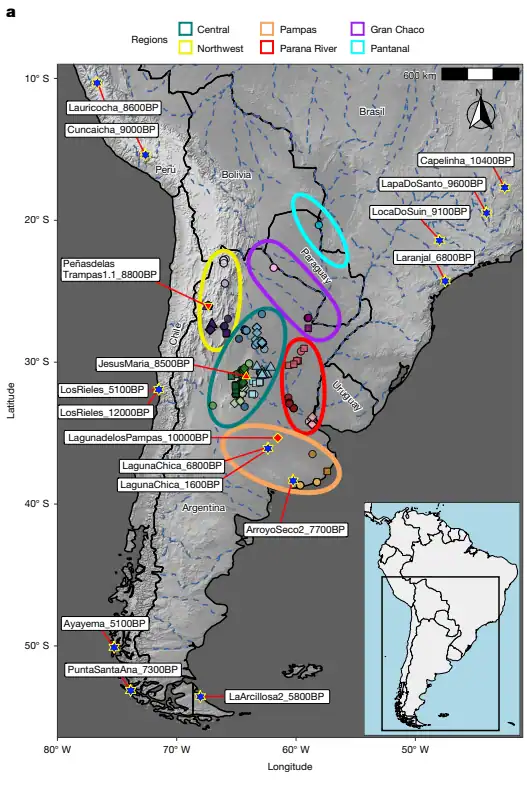
A map published in Nature illustrates how ancient individuals from sites such as Jesús María, Arroyo Seco, and the Córdoba Hills cluster together genetically, while neighboring groups form separate branches. Each region’s people seem to have followed their own evolutionary path for millennia.
The genetic continuity found in Argentina is comparable to what has been observed in the Middle East and East Asia, where ancient DNA also shows long-term stability of local populations. This raises new questions: What allowed these groups to remain so isolated for such extended periods? What natural or cultural barriers kept them apart? And in what ways did they adjust to the environmental and lifestyle changes that occurred throughout the Holocene?
The researchers hope that future work will broaden the ancient DNA record across South America, helping fill the gaps between the Andes and the Atlantic.