Rare runes and Roman hoards: five treasures discovered in UK last year

The British Museum has recorded more than 50,000 archaeological finds, of which 1,000 were treasure, made by members of the general public in 2020. Here are some of the highlights.

A record-breaking pendant

The millionth record logged on the Portable Antiquities Scheme (PAS) database was a copper alloy medieval harness pendant found in Binbrook, Lincolnshire.

A seal belonging to a woman of status

An unusual silver seal matrix dating to the early 13th century inscribed in Latin with the name Matilda de Cornhill was found at Hollingbourne, Kent. It depicts a kneeling female figure, assumed to be a representation of Matilda herself, praying to the enthroned virgin and child, a well-known motif of the medieval period. The find is unusual because seal matrices from this period were more commonly owned by men, and were usually made of copper alloy or lead alloy, leading archaeologists to suspect that Matilda was a person of status in her own right. The owner may be Maud de Cornhill, the steward of St Augustine’s Abbey, Canterbury, whose husband was Reginald de Cornhill – active 1189–1215 – the high sheriff of Kent and constable of Rochester Castle.

Rare runes

A rare and mysterious early medieval gold pendant with a rare runic inscription was found in the north of England. The pendant, in the form of a cross, dates to about AD700-900 and was found near Berwick-upon-Tweed, Northumberland. Runic inscriptions often provide the name of a person associated with the object, such as its maker or owner. This one can be translated as Eadruf, suspected to be a previously unknown name, potentially making it a new addition to recorded early medieval names.

A Roman hoard

A hoard of Roman coins was found in three pots at Wickwar, Gloucestershire, by the metal detectorists Mark Lovell and Mark Wilcox. They contacted the British Museum, which block-lifted the hoard to keep it intact and brought to labs where it was X-rayed and carefully micro-excavated. Conservation work revealed more than 6,500 coins that dated to the 4th century AD, which seem to have been put in the ground at different times. During this period, Romans commonly buried hoards for safekeeping, making this potentially a previously unknown Roman site.

Roman piping

In September 2020, Steven Scott and David Taylor were metal detecting at Rudston, east Yorkshire, when they found an unusual shallow cylindrical lead object about 30cm deep. Subsequent archaeological excavation revealed the object had been placed in a circular pit cut into chalk subsoil beside a pre-existing wall. They found pottery shards, burnt animal bones and sandstone quern fragments around the container, which is thought to be the base of a Roman cistern. It is the first to be found in Yorkshire and has an unusual form, possibly used to collect water running from the roof of a building to supply water to the home.

Source: https://www.theguardian.com/science/2021/d...

Mummies With Gold Tongues Found Inside 2,500-Year-Old Tombs in Egypt

Archaeologists have unearthed two tombs, containing the mummified remains of a man and woman who died about 2,500 years ago, in the ruins of the ancient Egyptian city of Oxyrhynchus, in what is now El Bahnasa.

During the excavation, the team stumbled upon a unique find: three gold-foil tongues. Adding to the surprise, one of the tombs had never been opened.

“This is very important, because it’s rare to find a tomb that is totally sealed,” Esther Pons Mellado, co-director of the archaeological mission from the University of Barcelona, tells Nada El Sawy of The National.

The sealed tomb, a male sarcophagus made of limestone, held mummified remains and an array of items, including a scarab amulet, four canopic jars that were used in the mummification process, and more than 400 pieces of faience, in the form of small funerary figures made of glazed earthenware. The mummy’s face was also well preserved with a golden tongue still inside his mouth, reports Sebastian Kettley of the Daily Express.

“We are still studying the inscriptions on the vessels that, we assume, will reveal the identity of the buried person,” Maite Mascort, mission co-director with Mellado, tells Sílvia Colomé of La Vanguardia.

In ancient Egypt, embalmers sometimes crafted tongues from gold foil and placed them inside the mouths of the dead to enable them to speak with Osiris, the god of the underworld.

Earlier this year, archaeologists working in Alexandria discovered a mummy with a similar gold tongue dating to around 2,000 years ago, as reported by Isis Davis-Marks for Smithsonian magazine at the time.
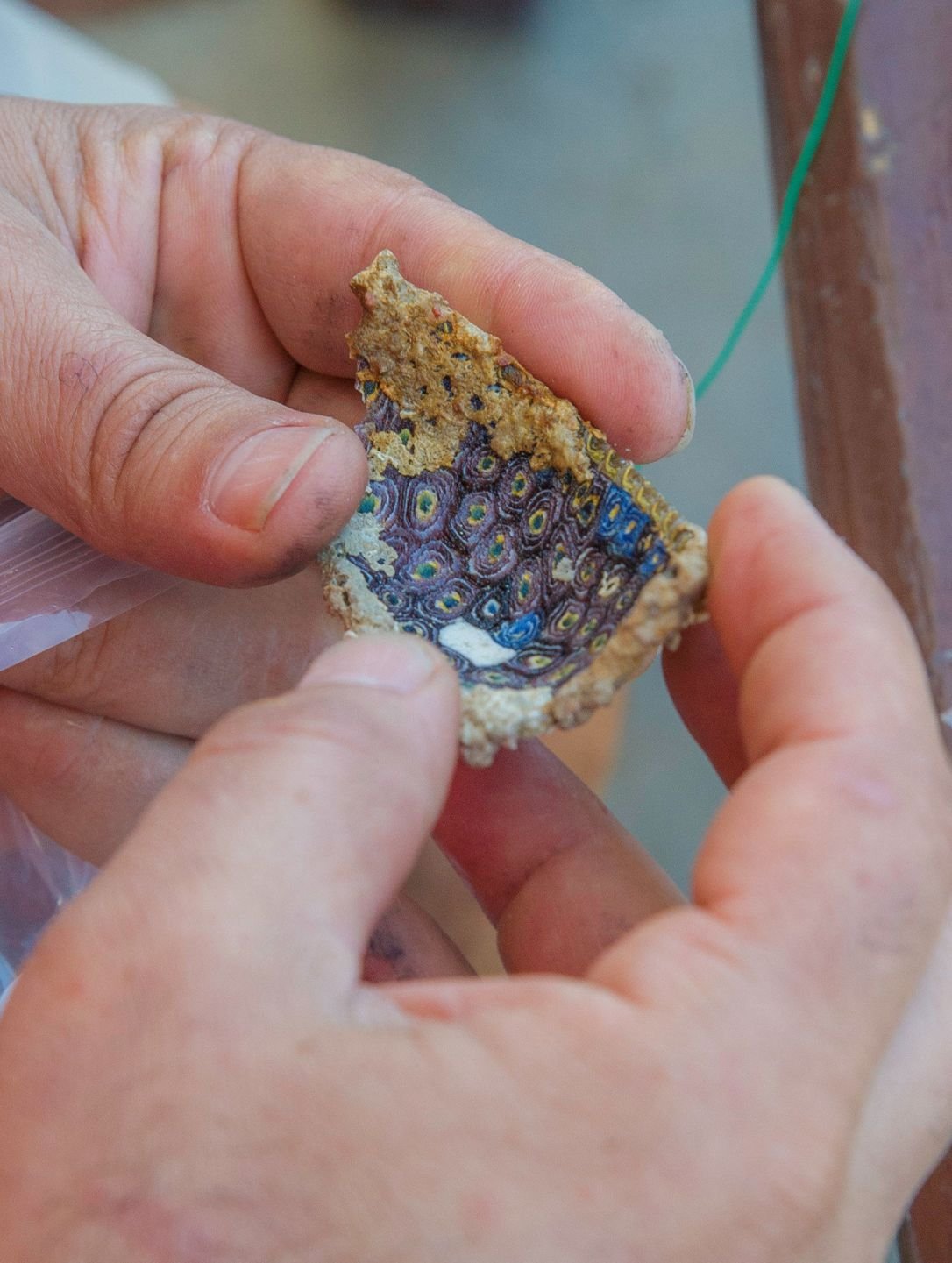
The three gold tongues found in the two tombs date to the Roman period that began in 30 B.C.E., reports The National.

Mellado tells The National that gold tongues have only been found at archaeological sites in Alexandria and El Bahnasa.

The other tomb, which had already been raided by grave robbers around the time of burial, held a sarcophagus in the shape of a woman, but the mummified remains were in poor shape, per the Daily Express. Buried alongside the body were beads, a stone headrest amulet and a figure of the falcon-headed god Horus. Two more gold tongues were also found; one inside the woman’s mouth, and another believed to have been placed in the mouth of a child’s remains.

The tombs date to the Saite dynasty, a period that lasted from about 664 to 332 B.C.E.

Prior to the conquest of Egypt by Alexander the Great in 332 B.C.E., Oxyrhynchus was known as Per-Medjed. Located about 140 miles south of Cairo at the site of the modern town of El Bahnasa, it was an important Egyptian hub during the Saite dynasty, according to the University of Barcelona’s website.

The city connected caravan routes from the west to a port on the Bahr Yussef waterway, allowing the flow of people and goods to the Mediterranean Sea. When Alexander arrived, the city became home to large numbers of Greek colonists and enjoyed a close relationship with Alexandria.

In 640 C.E., Per-Medjed fell into a decline after Arab occupation of the area. More than 1,000 years later, during Napoleon Bonaparte’s Egyptian campaign of 1799-1802 C.E., French scholars identified the ruins, and the first excavations began in 1897. At that time, the archaeologists discovered a huge collection of ancient documents known as the Oxyrhynchus Papyri.

Per a translated statement released by the Egyptian Ministry of Tourism and Antiquities earlier this month, Jamal Samastawi, director general of the Architects of Central Egypt, commended the mission’s work in the area over the past 30 years. During this time, archaeologists have found many graves that date back to the Sawi, Roman and Coptic era that have been of great importance to the El Bahnasa region, he says, in the statement.

The current excavations, led by the University of Barcelona in cooperation with the Egyptian Antiquities Organization, began in 1992. Scientists hope these new discoveries will allow them to better understand the funerary rights observed during this time period.

Source: https://www.smithsonianmag.com/smart-news/...

World's Biggest Dinosaur Arrives in UK Museum: 115-Feet-Long Titanosaur Is Thrice the Size of T.Rex

After its rough transportation through two British Airway crafts, the world's biggest dinosaur has now reportedly landed in the UK.

World's Biggest Dinosaur

According to the Daily Mail, this titanosaur replica skeleton has been transported from Argentina all the way to London for a special showcase at the Natural History Museum.

Interesting Engineering reports that, due to this titanosaur's massive size, the diplodocus, or dippy, is bound to be "dethroned." This Patagotitan mayorum titanosaur has four times the weight of Dippy. It is also among the largest creatures to have ever stepped foot on the earth's surface.

This close-to-complete dinosaur has a length of around 115 feet, from its nose all the way to its tail, making it around 40 feet longer compared to the blue whale that is currently on display at the museum. It also tripled the size of the T. rex. The titanosaur could have also weighed around 60 to 70 tons.

The Daily Mail reports that the huge exhibit was disassembled and kept in over 40 crates last November. This was before it was kept in two aircraft bellyholds. It will reportedly fit just right inside the huge Warehouse Gallery, which is around 30 feet high, in the prominent tourist spot.

The historic exhibit was brought all the way to the UK for the special "Titanosaur: Life as the Biggest Dinosaur" exhibit that will start on March 31. This marks its first display in Europe after being loaned by Argentina's MEF (Museo Paleontológico Egidio Feruglio).

Exhibition science lead professor, Paul Barret, states that this Patagotitan mayorum is a remarkable specimen that has shed light on these huge titanosaurs. Its weight compares to that of over nine African elephants. With this, the remarkable exhibit will inspire the audience to look out for creatures that are huge and vulnerable.

Titanosaurs

According to Brittanica, titanosaurus lived from the late Jurassic Epoch all the way to the Cretaceous period's end. Fossils of these creatures were found on every continent except Antarctica. There are around 40 species included. Brittanica reports that this group of creatures is the largest group of land animals that have ever walked over the earth.

The Daily Mail reports that titanosaurs were herbivores, just like sauropods. They also had long necks and tails, as well as small heads.

However, compared to other sauropod species, these titanosaurs had stockier bodies. They also had a wider stance due to their limbs.

The sizes of titanosaurs are widely varied. One of the smallest species was the Neuquensaurus, which had an estimated length of 7 meters and a weight of 10,000 kilograms.

Some species with full remains were from the Dreadnoughtus, which covers around 70% of the skeleton. Such findings enable paleontologists to come up with estimates regarding the weight and length of these creatures.

Source: https://www.sciencetimes.com/articles/4227...

One of the World’s Oldest Cities is 4,000 Years Older Than the Pyramids

There’s an ancient city in Syria that is said to be one of the oldest cities globally, so old that it even predates the Egyptian pyramids. Called Tell Brak, this ancient city dates back to when history itself was not being written.

It is older than old, so ancient that it predates the most ancient Egyptian pyramids by around 4,000 years. The city known today as Tell Brak remains shrouded in mystery.

Although we don’t know what the settlement was called more than 8,000 years ago, evidence suggests that people referred to the city as Nagar at one point in history.

Despite being one of the most ancient cities on the planet’s surface, its history, evolution, and fall have been anything but clear for historians. In fact, we didn’t even know the city existed until old Spy satellites from the US snapped images of the desert in the middle east, revealed the faint remnants of an ancient city. This ancient site is one of the best examples of archeology aided by aerial photography.

Tell Brak; an ancient city older than the pyramids

Imagine all the treasures that remain hidden beneath the surface, waiting to be spotted, uncovered, and revealed to the world.

The remnants of the ancient city were photographed by a US spy satellite and located in 50-year-old imagery by Dartmouth College anthropology professor Jesse Casana.

Professor Casana spent years studying and analyzing Corona Spy photographs of the Middle East.

These images are of great importance because 50 years ago when the images were snapped, the countryside was much less industrialized than today. The researcher and his colleagues documented around 10,000 previously unknown archeological sites thanks to the Corona Spy images.

The U.S. ran the CORONA spy satellite program between 1959 and 1972. During this time, the spy planes crisscrossed the skies snapping countless images o military infrastructure and innumerable archaeological sites.

A city buried by sand and history

The remnants of the city are located in the Khabur plain, a region in northeastern Syria, not far from the borders of Turkey and Iraq.

Considered one of the largest ancient sites in what is known as northern Mesopotamia, an ancient settlement predating the city is known to have existed as far back as 6,000 BC. This means that more than 8,000 years ago, people already settled in the area.

Erected in a strategic position, Tell Brak is was built on a major route from the Tigris Valley northwards to the mines of Anatolia and westwards to the Euphrates and the Mediterranean. The city was likely highly regarded and acknowledged as an important commercial center, evidence of numerous workshops found at the site.

Excavations have also revealed evidence of mass production of bowls and other items made of obsidian and white marble. Stamp seals and sling bullets have also been excavated from the ancient city layers.

It suggests the cities inhabitants engaged in numerous craft activities, including basalt grinding, flint-working, and weapon making.

Archeological excavations also suggest that the urban-based society was based on rain-fed agriculture.

Seals recovered at the site have been dated to the pre-Akkadian kingdom and revealed the use of four-wheeled wagons and war carriages.

Although much of the city’s history remains shrouded in mystery, Contemporary cuneiform tablets excavated from Ebla suggest that during the third millennium Nagar was one of the dominant cities in this part of northern Mesopotamia. Moreover, scholars argue the city was also a major point of contact at the interface between the cities of the Levant in the west and those of Mesopotamia.

The earliest levels of the city that have been excavated are thought to date back to the mid-fifth millennium BC and include some of the most massive buildings of the site, some of which date back as far as the end of the Ubaid Period.

Nagar’s importance reflects its position at the western margins of Mesopotamia itself and controlling routes to the West and the Tigris and the south.

Although the city was of great importance and evolved greatly during the fourth millennium BC, it shrank in size at the beginning of the third millennium BC, just at the end of the so-called Uruk period, only to expand again around 2,600, precisely when it became known among people as Nagar.

Eventually, the ancient city became the capital of a regional kingdom that controlled much of the Khabur valley.

Today, the archeological settlement consists of a large—40 meter-high—central mound and various smaller “orbiting” mounds around it. The site covers a total area of nearly 300 hectares.

Archaeological excavations suggest a settlement of unknown—perhaps of a much smaller—dimension at the site before 4,200 BC. It was positioned at the center of the complex. However, its oldest remnants are buried deep beneath layers of buildings erected on top of it during later periods.

Although not many excavations have taken place at Tell Brak, the discoveries made by experts are nonetheless more than rewarding.

One of the most prominent discoveries made at the site is a non-residential structure that, according to experts, must have been gigantic. Although only a small part of the structure has been excavated, the building is thought to have had a large entrance with large towers covering its sides. Built with red mud bricks wall 1.85 meters thick, the remnants of the construction stand 1.5 meters today.

Radiocarbon dating of the structure suggests it existed around 4,400 BC.

The first excavations at the site took place in the 1930s by Max Mallowan, husband of Agatha Christie, who accompanied her husband in various excavations both in Syria and Iraq.

Mallowan’s central discoveries were the “Eye Temple” believed to date back to the 4th millennium BC, with its deposits of hundreds of small stone “idols,” and the “Naram-Sin Palace,” a discovery which confirmed that Mesopotamian political power was already there in the north during the 3rd millennium BC. The Naram-Sin palace was a huge storage and administrative building located at the southern edge of the city.

The ancient city was destroyed by the Assyrian empire around 1,300 BC, failing to regain its importance. As a result, it disappeared from history records during the early Abbasid era.

Source: https://curiosmos.com/one-of-the-worlds-ol...

Jimmy Corsetti Shares New Evidence for ancient Atlantis Theory

As the world continues to be fascinated by the mystery surrounding the lost city of Atlantis, renowned archaeologist Jimmy Corsetti has recently announced groundbreaking new evidence that could shed light on this ancient civilization.

Today we will uncover the secrets of this elusive city and explore the evidence that could finally bring it to light.

When Professors Pored Through Ancient Texts In Oxford, They Made A Huge Discovery About Jesus

At the University of Oxford, two biblical scholars are hard at work investigating ancient fragments of scripture. And one particular find stands out during the course of the academics’ efforts: a piece of text that at first they believe to be a “lost Gospel” of the New Testament. But while this isn’t quite the case, the duo have still uncovered something special. Astonishingly, they have found an ancient copy of the heretical First Apocalypse of James – an account of Jesus’ lessons to his brother.

12 Most Incredible Archaeological Finds

The collection of places and artefacts you're about to see comes from long ago and far away. We've found ancient treasures for you from all around the world and from every fascinating period in history. They all have one thing in common; they're incredible archaeological finds, and we're excited to show them to you. Let's get started.

What They Discovered Underwater Will Shock You

Lost cities, abandoned merchant navy ships, and the Devil's Triangle, the deep blue ocean is more mysterious than we give it credit for. This vast body of water has been a major part of our planet for millennials, and the mysteries it holds are as deep as the ocean itself.

It is mind-blowing to think that at some time in history, creatures like the megalodon dwelled in our oceans, but that's only a scratch on the surface. The waters have so much more. Scientists are constantly learning new things about the oceans and their inhabitants, and there is still much that is not known about these vast bodies of water.

In today's video we look at What They Discovered Underwater Will Shock You...., and keep watching to see underwater discoveries and the underwater and mysterious and the mysterious discoveries and mysterious underwater discoveries that are found underwater and most mysterious underwater discoveries and mysterious underwater which are underwater finds and mysterious things and mysterious underwater discoveries that can't be explained and discoveries made underwater and underwater mysteries and amazing underwater discoveries and bizarre underwater discoveries and most incredible underwater discoveries which are mysterious finds and scientists discovered and lost city discovered.

Medieval Middle East and the Arab Empires: A Complete Overview

The Medieval Middle East video goes through the post-classical Middle East and the emergence of the Arab Empires.

It begins with the early Bedouin culture and the rise of Islam. It follows the early Rashidun Caliphate and its expansion under the early caliphs, before delving into the Umayyad expansions into Western and Eastern Europe. We then discuss the third major caliphate, the Abbasids, and the Golden Age through the Seljuk migrations and the Crusades, ending with the Mongol invasions. Society and culture during the Umayyad and Abbasid rule is also discussed.

India's Temple Island

Srirangam Island, at the confluence of the Kaveri and Kollidam Rivers in Bharat’s state of Tamil Nadu, is home to a 2,000-year-old temple complex, major parts of which are still in use today. However, much of the complex is hidden or damaged. Many older sections are buried under sediment as a result of centuries of flooding, and the complex was ransacked in the fourteenth century by the Muslim general Ulugh Khan (who later took the title Muhammad bin Tughluq and ruled as Sultan of Delhi from 1325-51).

Recent excavations at the site, guided by geologists with knowledge of flood sediment layers, have begun to reveal what was presumed to have been lost. Researchers including geologist Mu Ramkumar of Periyar University have uncovered parts of the temple destroyed by Ulugh Khan and unearthed artifacts such as pendant lamps and statues of the deity Gopalakrishnan with his consorts.

Using geophysical surveying techniques, they have also identified what they believe to be the tomb of religious scholar and teacher Sri Manavala Mamunigal, who restored the temple complex in the fifteenth century. The tomb has been left unexcavated for religious reasons.

Source: https://hindupost.in/history/bharats-templ...

Turkey's underground city of 20,000 people

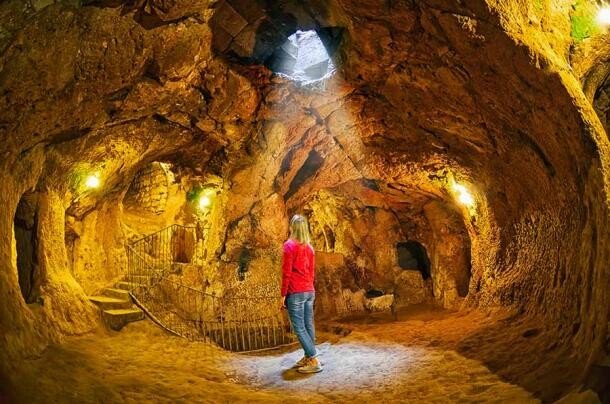
More than 85m beneath the famous fairy chimneys of Cappadocia lies a massive subterranean city that was in near-constant use for thousands of years.

Violent gusts whipped loose soil into the air as I hiked through Cappadocia's Love Valley. Pink- and yellow-hued hillsides coloured the rolling landscape scarred with deep red canyons, and chimneystack rock formations loomed in the distance. It was arid, hot, windy and devastatingly beautiful. Millennia ago, this volatile, volcanic environment naturally sculpted the spires surrounding me into their conical, mushroom-capped shapes, which now draw millions of visitors to hike or hot-air balloon in the central Turkish region.

But beneath Cappadocia's crumbling surface, a marvel of equally gargantuan proportions lay hidden away for centuries; a subterranean city that could conceal the whereabouts of up to 20,000 inhabitants for months at a time.

The ancient city of Elengubu, known today as Derinkuyu, burrows more than 85m below the Earth's surface, encompassing 18 levels of tunnels. The largest excavated underground city in the world, it was in near-constant use for thousands of years, changing hands from the Phrygians to the Persians to the Christians of the Byzantine Era. It was finally abandoned in the 1920s by the Cappadocian Greeks when they faced defeat during the Greco-Turkish war and fled abruptly en masse to Greece. Not only do its cave-like rooms stretch on for hundreds of miles, but it's thought the more than 200 small, separate underground cities that have also been discovered in the region may be connected to these tunnels, creating a massive subterranean network.

According to my guide, Suleman, Derinkuyu was only "rediscovered" in 1963 by an anonymous local who kept losing his chickens. While he was renovating his home, the poultry would disappear into a small crevasse created during the remodel, never to be seen again. Upon closer investigation and some digging, the Turk unearthed a dark passageway. It was the first of more than 600 entrances found within private homes leading to the subterrestrial city of Derinkuyu.

Excavation began immediately, revealing a tangled network of underground dwellings, dry food storage, cattle stables, schools, wineries and even a chapel. It was an entire civilisation tucked safely underground. The cave city was soon spelunked by thousands of Türkiye's least claustrophobic tourists and, in 1985, the region was added to the Unesco World Heritage list.

The city's exact date of construction remains contested, but Anabasis, written by Xenophon of Athens circa 370 BCE, is the oldest written work that seems to reference Derinkuyu. In the book, he mentions Anatolian people, in or near the region of Cappadocia, living underground in excavated homes rather than the more popular cliffside cave-dwellings that are well known in the area.

According to Andrea De Giorgi, associate professor of classical studies at Florida State University, Cappadocia is uniquely suited to this kind of underground construction due to the lack of water in the soil and its malleable, easily mouldable rock. "The geomorphology of the region is conducive to the digging of underground spaces," he said, explaining that the local tuff rock would have been fairly easy to carve with simple tools like shovels and pickaxes. This same pyroclastic material was naturally forged into the fairy-tale chimneys and phallic spires jutting from the earth above ground.

But whom to credit with Derinkuyu's creation remains a partial mystery. The groundwork for the sprawling network of subterranean caves is often attributed to the Hittites, "who may have excavated the first few levels in the rock when they came under attack from the Phrygians around 1200 BCE", according to A Bertini, an expert in Mediterranean cave dwellings, in his essay on regional cave architecture. Adding weight to this hypothesis, Hittite artefacts were found inside Derinkuyu.

However, the bulk of the city was likely built by the Phrygians, highly skilled Iron-age architects who had the means to construct elaborate underground facilities. "The Phrygians were one of Anatolia's most prominent early empires," explained De Giorgi. "They developed across western Anatolia around the end of the first millennium BCE and had a bent for monumentalising rock formations and creating remarkable rock-cut facades. Though elusive, their kingdom spread to include most of western and central Anatolia, including the area of Derinkuyu."

Originally, Derinkuyu was likely used for the storage of goods, but its primary purpose was as a temporary haven from foreign invaders, with Cappadocia seeing a constant flux of dominant empires throughout the centuries. "The succession of empires and their impact on the landscapes of Anatolia explain the recourse to underground shelters like Derinkuyu," De Giorgi explained. "It was at the time of the [7th-Century] Islamic raids [on the predominantly Christian Byzantine Empire], however, that these dwellings were used to the fullest." While the Phrygians, Persians and Seljuks, among others, all inhabited the region and expanded upon the underground city in subsequent centuries, Derinkuyu's population swelled to its peak during the Byzantine Era, with nearly 20,000 residents living underground.

Today, you can experience the harrowing reality of life underground for just 60 Turkish lira (£2.80). As I descended into the musty, narrow tunnels, the walls blackened with soot from centuries of torch lighting, the unfamiliar sensation of claustrophobia began to set in. However, the ingenuity of the various empires that expanded upon Derinkuyu soon became apparent. Intentionally narrow, short hallways forced visitors to navigate the labyrinth of corridors and dwellings while stooped over and single file – obviously an inopportune position for intruders. Dimly lit by lamplight, half-ton circular boulders blocked doors between each of the 18 levels and were only moveable from the inside. Small, perfectly round holes in the centre of these hefty doors would have allowed residents to spear invaders while maintaining a secure perimeter.

"Life underground was probably very difficult," my guide Suleman added. "The residents relieved themselves in sealed clay jars, lived by torchlight and disposed of dead bodies in [designated] areas."

Each level of the city was carefully engineered for specific uses. Livestock was kept in stables nearest to the surface to reduce the smell and toxic gases produced by cattle, as well as provide a warm layer of living insulation for the cold months. The inner layers of the city contained dwellings, cellars, schools and meeting spaces. Identifiable by its unique barrel-vaulted ceilings, a traditional Byzantine missionary school, complete with adjacent rooms for study, is located on the second floor. According to De Giorgi, "the evidence for winemaking is grounded in the presence of cellars, vats for pressing and amphoras [tall, two-handled jars with a narrow neck]." These specialised rooms indicate that inhabitants of Derinkuyu were prepared to spend months beneath the surface.

But most impressive is a complex ventilation system and protected well that would have supplied the entire city with fresh air and clean water. In fact, it's thought that the early construction of Derinkuyu centred around these two essential elements. More than 50 ventilation shafts, which allowed for natural airflow between the city's many dwellings and hallways, were distributed throughout the city to avoid a potentially fatal attack on their air supply. The well was dug more than 55m deep and could be easily cut off from below by the city inhabitants.

While Derinkuyu's construction was indeed ingenious, it's not the only underground city in Cappadocia. At 445 sq km, it's merely the largest of the 200 and counting underground cities beneath the Anatolian Plains. More than 40 of these smaller cities are three or more levels deep beneath the surface. Many are connected to Derinkuyu via carefully dug tunnels, some stretching as long as 9km. All of them are equipped with emergency escape routes in case an immediate return to the surface was necessary. But Cappadocia's subterranean secrets have not yet all been excavated. In 2014, a new and potentially even larger underground city was unearthed beneath the Nevsehir region.

Derinkuyu's living story came to a close in 1923 when the Cappadocian Greeks evacuated. More than 2,000 years after the city's likely creation, Derinkuyu was abandoned for the last time. Its existence was all but forgotten to the modern world until some errant chickens brought the subterranean city back into the light.

Source: https://www.bbc.com/travel/article/2022081...