Floodwater "flows from Jerusalem into the Dead Sea," fulfilling a biblical prophecy

Incredibly, a video purportedly showing rivers flowing from Jerusalem to the Dead Sea has apparently "fulfilled" a Bible prophecy, giving rise to the strange assertion.

Stunned witnesses saw a new river carve out its path in front of them.

Over 40 cm of rain fell north of Jerusalem, shattering a 51-year record, as Israel experienced record-breaking rainfall totals.

One young couple in Tel Aviv has already perished due to deadly flash floods that have affected the entire country.

But some have sensationally claimed that a biblical prophecy is being fulfilled after seeing a new horrifying video of a torrent of water bursting forth and flooding a road.

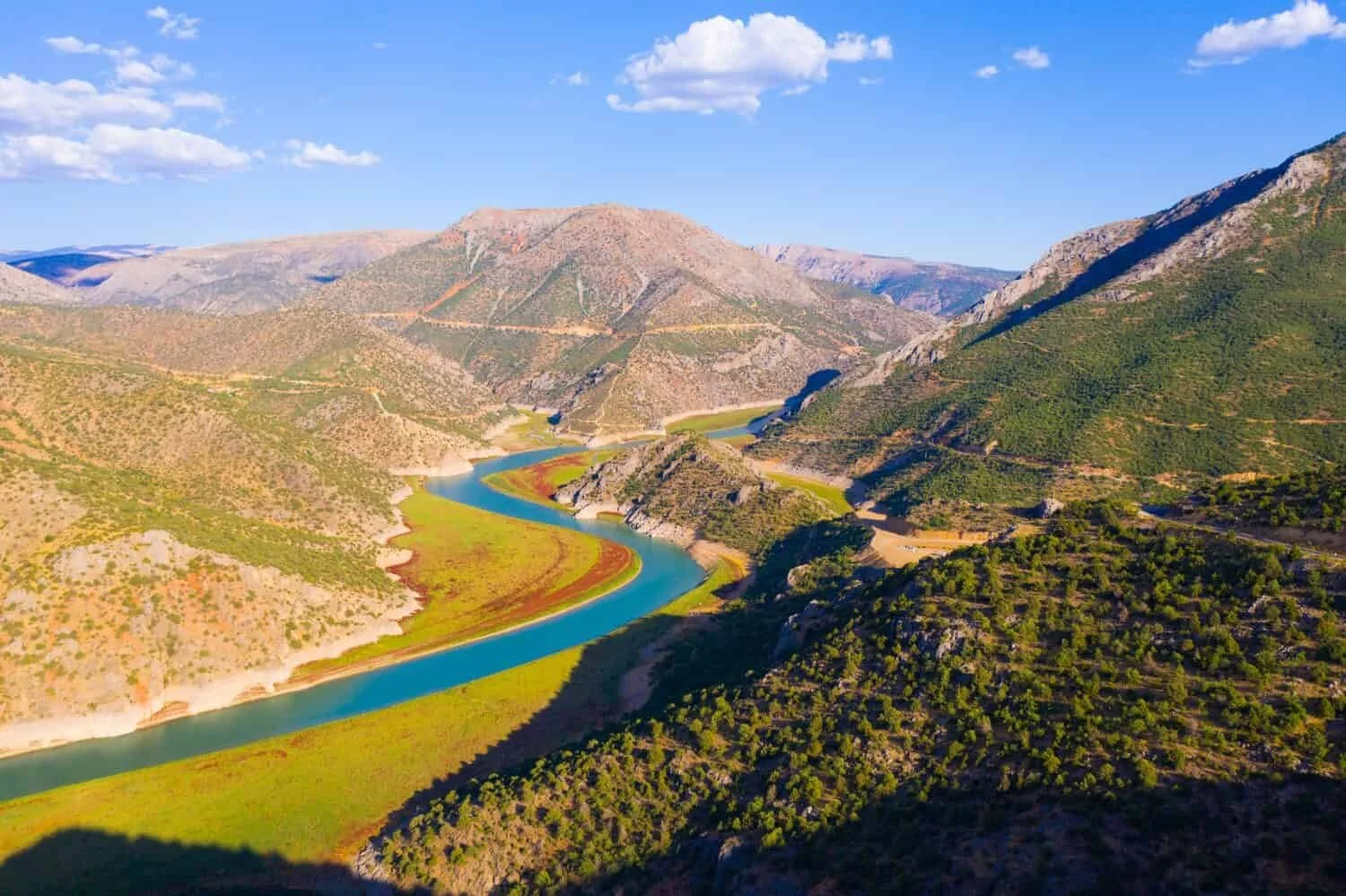
Approximately 18 miles south of Jerusalem, the film is reported to have been shot close to the Arugot River.

A motorist that was about to cross the street is forced to stop as stunned bystanders freeze in their tracks.

Following that, the river rushes eastward toward the Dead Sea before vanishing from view beneath the hill's summit.

After discovering the video, Breaking Israel News connected it to verses from Genesis and Ezekiel in the Bible.

The Bible claims that before being destroyed alongside Sodom and Gomorrah, the valley where the Dead Sea currently exists was a "well-watered" area.

"Lot lifted up his eyes, and beheld all the plain of the Jordan, that it was well-watered everywhere before Hashem destroyed Sodom and Gomorrah," Genesis 13:10 says.

The religious news source then draws attention to a prophecy in Ezekiel 47:8–9 predicting that the "eastern region" will one day undergo a transformation.

Then, he told me, "These waters issue forth toward the eastern region and shall descend down into the Arabah (a dry basin near the Dead Sea), and when they shall enter into the sea of the rotten waters, the waters shall be healed.

"And it shall be that wherever the rivers shall come, every living thing wherewith it swarmeth shall live, and there shall be a very great multitude of fish, for these waters are come unto them that all things may be healed and may live wherever the river cometh."

This occurs at the same time as religious archaeologists assert to have discovered the Ark of the Covenant in a 3,000-year-old Israeli temple.

Another shocking find is a location praised as the location where Moses allegedly broke the Ten Commandments and demolished the Golden Calf, according to the Bible.
Source: https://www.dailystar.co.uk/news/weird-new...

Learn about the historic ruins found beneath the Euphrates River

Iraq has been particularly hard-hit, despite the fact that climate change and global warming affect nations all around the world. As a result of annual rainfall declining and temperatures rising twice as quickly, the nation is experiencing numerous catastrophic droughts. However, during these droughts, the Euphrates River's decreased water levels made it possible for the secrets of a vanished civilization to come to light. Join us as we set off on a remarkable expedition to explore the historic sites located beneath the Euphrates River!

Finding a Forgotten City Again

The water levels of the Euphrates and Tigris Rivers were dangerously low in 2018 as a result of a devastating drought in Iraq. The Mosul Dam Reservoir in the Kurdistan area was drained in an effort to aid the nation, delivering much needed water to withering crops. But as the water level in the reservoir dropped, an old city's ruins suddenly became visible!

Archaeologists labored feverishly in a race against time to investigate and sketch out the recently exposed ancient ruins before the water again submerged them. They came across the remnants of a sizable palace, some of whose walls were 6 feet thick and 22 feet tall! Additionally, numerous walls were decorated with wall paintings that had been well-preserved and shone brightly with blue and red tones. The palace, which was constructed in two independent stages and had been in use for a very long time, might contain many of the secrets of the mighty Mitanni Empire. However, the palace and the remainder of the city retreated into the Euphrates River before they could further assess it, leaving their questions unsolved for the following four years.

Iraq once more had one of the worst droughts in recent memory in 2022. As a result, the reservoir was once more drained, revealing the submerged vanished city. Kurdish and German archaeologists who were sponsored by the University of Tübingen arrived right away to survey and map out the city as much as they could. The team was able to map out many of the major buildings and unearth hundreds of different artifacts after they had a better understanding of what they were looking for and because of how quickly they came together and worked.

The Euphrates River is one of the oldest and most important rivers in the world.

What did they discover when they explored the ancient city beneath the Euphrates River?

The bustling metropolis of Zakhiku, a significant city in the Mitanni Empire, once stood beneath the Euphrates River in the amazing ancient city that is today known as Kemune. From roughly 1600 BCE to 1260 BCE, this ancient empire stood mighty alongside other important nations like Babylonia and Egypt. However, the Assyrians assumed control as the empire started to crumble, and the Mitanni people were forgotten.

Researchers found a large fortification with towers, an industrial complex, and a massive storage facility with numerous levels during their face-paced digs. The immense scale of the storage building suggests that it originally housed a staggering amount of things, indicating the potential size and status of the ancient city and its inhabitants.

But what really stood out was how well-kept the structures are. The almost 3,000-year-old walls were built from sun-dried mud, which should have long since disintegrated beneath the Euphrates River's waters. The higher portions of the walls were devastated and reduced to rubble, however, by an earthquake that occurred approximately 1350 BCE. The lowest portions of the walls were covered in debris, which shielded them from the water.

A number of pottery vessels were also discovered and recovered by the archaeology team in addition to the walls and substantial buildings. These had more than 100 cuneiform-written tablets inside of them, which is the world's earliest writing format. Some of the clay-encased tablets were still there and ready for reading. These old clay tablets, which have been miraculously preserved across thousands of years and even decades underwater, should help us learn more about the inhabitants who previously called this ancient city home.

Cuneiform is the first writing system ever developed. It was created in Mesopotamia by the Sumerians around 3400 BCE.

Who Belonged to the Mitanni Empire?

The Mitanni Empire, which was one of the most powerful states of its era, was established in Mesopotamia and Syria somewhere between 1500 and 1600 BCE. It began in northern Iraq, traveled into Syria, and ended up in Turkey. The distance between the Zagros Mountains and the glistening Mediterranean Sea was more than 600 miles. The term "Mitanni" may have originated from the fact that the empire was ruled by warriors going by the name Maryannu. The Hittites referred to the kingdom as "the land of the Huri" because the inhabitants were Hurrian. Maryannu, however, was rendered as Naharin and Metani by the Egyptians.

Between 1500 and 1240 BCE, the Mitanni Empire flourished and ruled the northern Euphrates-Tigris region. Along with the headwaters at Nineveh and the upper Tigris River, it also controlled significant trade routes up the Euphrates to Carchemish and down the Habur to Mari.

Map of the near east circa 1400 BCE. The Mitanni Empire had powerful neighbors on all sides, from Assyria to the Egpyt, Hatti, and Babylonia.

However, you might be perplexed as to why so few people can recall this formidable and impressive empire. Well, the majority of the Mitanni cities and their antiquities were destroyed when the Assyrians conquered in the fourteenth century. Unfortunately, the Mitanni people's own documents were largely destroyed. In actuality, there were only three primary sources of Mitanni history before the recent discovery beneath the Euphrates River:

  • The Letters of Amarna

  • a pact between the Hittites and the Mitanni Empire

  • a historical horse handbook

Archival material from the Mitanni Empire

First off, the Amarna letters are largely responsible for the knowledge we have on the Mitanni Empire. These prehistoric letters were sent and received by the monarchs of Egypt and Assyria, as well as the Mitanni. In addition, a pact was forged between the Mitanni and the Hittites. These two sources demonstrate the great power and prosperity of the Mitanni Empire. Even the "Great Powers' Club" included it, along with nations like Egypt, Assyria, Babylonia, and Hatti.

The third document from the Mitanni Empire academics is a horse handbook, which makes it quite distinctive and one-of-a-kind. But this isn't just any old textbook on how to ride a horse—it's the oldest horse training manual ever discovered! The guidebook was created in 1345 BCE by the Mitanni horse trainer Kikkuli on four tablets. The 1,080 lines of this extremely thorough text cover every facet of horse training, from what foods horses should eat to how they should be exercised.

According to Hittite records, the Mitanni people were excellent horsemen and innovators. The Hittites copied the new spoked wheel design and spread it to other neighboring kingdoms.

The guidebook also showed that the inhabitants of the Mitanni Empire were expert riders. In reality, the Matanni people created a brand-new class of chariot with spoked wheels. Compared to chariots with solid wood wheels, these were a lot faster and simpler to steer. The Mitanni were adept charioteers and horsemen who successfully expanded their empire.

The Mitanni Empire: How Did It Fall?

Like so many other ancient civilizations, the Mitanni Empire was formed by a variety of influences, which ultimately caused it to fall. For instance, vassals and tributes were used to manage the complicated political and social system of the empire. The stability of the empire was frequently broken by a tremendous degree of strife and power conflicts between numerous kings and factions.

The Matanni Empire was also surrounded by a number of strong and fearsome foes. The empire was frequently assaulted by the Assyrians, Hittites, and Kassites who lived nearby. The Matanni Empire and its economy were severely weakened by these repeated invasions, which frequently disrupted trade routes. The Assyrian invasions continued into the fourteenth century BCE, battering the already failing empire until they finally gained total control.

Source: https://a-z-animals.com/blog/discover-the-...

Before archaeologists revealed a fresh find, it was thought that the first ivory work of art retrieved from the World Heritage cave Hohle Fels was a horse

Until researchers uncovered a startling finding, the first ivory work of art unearthed from the World Heritage cave Hohle Fels was thought to be a horse for more than 20 years.

Archaeologists recently discovered a fragment of a finely carved ivory figurine during work in the Swabian Jura near Schelklingen, a World Heritage cave. The figurine fragment revealed itself to be a piece of a body that was perfectly adapted to an animal figurehead discovered more than 20 years earlier. This gives one of the most famous Ice Age works of art a new look. The head, discovered in 1999, was first thought to be a piece of a horse sculpture and gained notoriety as the first ivory figurine discovered in Hohle Fels.

The group led by Professor Nicholas Conard at the University of Tübingen's Department of Prehistory and Quaternary Ecology is currently disputing this conclusion: At a press briefing on the "Find of the Year" on Thursday, Professor Conard said, "We still cannot definitively identify the animal species depicted, but it could be a cave lion or a cave bear." The current issue of the journal Archaeological Excavations in Baden-Württemberg, which is published by the Baden-Württemberg State Office for the Preservation of Monuments, contains a scholarly article on the figure, portions of which were discovered in layers of the Aurignacian Palaeolithic culture and carved 35,000 years ago.

Hohle Fels – animal figure from the right front. Photo: © University of Tübingen, Ria Litzenberg

The Upper Paleolithic artwork, in the opinion of Professor Conard, resembles a bear: "The figurine now has a massive body, shows the typical pronounced bear hump at shoulder height and presents itself in a posture that could imitate the trotting gait of a bear." It is by no means always simple to determine Ice Age depictions with precision, especially since they are kept in such fragmentary form, Professor Conard concedes. However, even those who assigned the figure the morphological and physiognomic qualities of a cave lion did so. Therefore, it makes sense to search especially carefully for this animal's missing pieces in the years to come.

In actuality, the animal form is currently made up of five discovery fragments that were located during various excavation years: Soon after, a tiny piece of the cheek that had been broken off in the neck region of the skull discovered in 1999 was located among the ivory discoveries. This is how the item was preserved and displayed for about twenty years in the Prehistoric Museum in Blaubeuren (urmu).

Hohle Fels 2022 – figure fragment in find location. Photo: © University of Tübingen, Alexander Janas

The new piece

The right shoulder and thorax of the animal were quickly identified and related to the current ivory discovery, which measures 3.99 centimeters in length, 2.49 centimeters in height, and 0.55 millimeters in thickness on one side. This prompted the researchers to explore among the many pieces of ivory recovered from Hohle Fels for other figurine components. With success: Using the engravings on the part, another tiny piece of the right side of the body could be located. This tiny section of the figure's torso, like the other pieces, has very fine lines with the same finish, which amply show the works' unity. It is quite possible that the figure also consists of another fragment, which cannot be clearly related to the rest of the body but may represent a piece of the left front leg.

Source: https://arkeonews.net/the-first-ivory-work...

Before the dinosaurs, there were octopuses: The oldest fossilized octopus is 330 million years old

Octopus fossils dating back 330 million years were discovered in Montana by scientists, proving that octopuses predate dinosaurs.

The fossil of Syllipsimopodi from the Bear Gulch Limestone of Montana. The fossil is incredibly well-preserved, especially given that it’s made up of mostly soft tissue. The fossil is from the Invertebrate Paleontology collections of the Royal Ontario Museum. © Christopher Whalen via NPR.ORG / Fair Use

One of the many mysteries surrounding marine life has recently been solved by a team of hardworking researchers. We now know more about the amazing ancestry of these fascinating creatures thanks to the finding of the oldest known octopus fossil. This 330 million-year-old fossil from Montana refutes earlier theories about how these soft-bodied invertebrates evolved and shows that octopuses existed before dinosaurs.

The Montana fossil is a historical window

The study emphasizes the importance of this ground-breaking discovery and was published in the esteemed journal Nature Communications. The ancient octopus fossil, which was found in Montana's Bear Gulch limestone formation, was 4.7 inches (12 centimeters) long. The preserved species shows that the ancestors of current octopuses had more appendages than their contemporary counterparts, with 10 limbs, each with two rows of suckers.

A diagram of the octopus fossil found in Montana. © K. Whalen via ATI / Fair Use

The prehistoric octopus may have lived in a bay of a shallow tropical ocean, providing researchers with a window into the aquatic life of that time. This discovery is especially noteworthy because soft-bodied creatures are frequently poorly preserved in the fossil record and soft tissue fossils are extremely rare.

Long-forgotten treasure

Although the octopus fossil was discovered in Montana and given to the Royal Ontario Museum in Canada in 1988, it was overshadowed by other exciting fossil discoveries from the Bear Gulch site for many years and eventually went unnoticed. The significance of this item was not fully understood until recent years, when paleontologists found the 10 small limbs trapped in limestone.

Figuring out the enigma of the ancient octopus

The well-preserved fossil of an octopus also revealed signs of an ink sac, similar to those found in living octopuses. To protect themselves from predators, these organisms employ ink to produce a black cloud in the water. This remarkable parallelism shows that the octopus of the distant past had already evolved sophisticated survival techniques millions of years ago.

Syllipsimopodi bideni: a presidential tribute

In honor of Vice President Joe Biden, the researchers that investigated the octopus fossil gave it the name Syllipsimopodi bideni. They wanted to underline the significance of such discoveries in comprehending the evolution of marine life and to show their gratitude for the president's dedication to science and research.

An artistic reconstruction of Syllipsimopodi. © K. Whalen / Christopher Whalen via NPR.ORG / Fair Use

Vampyropods: a historical ancestry

The mysterious vampire squid and modern octopuses are both members of the mollusk family known as vampyropods, which also includes the ancient octopus. The vampire squid, despite its name, is more closely linked to octopuses than squids, which heightens the mystery surrounding these fascinating animals.

The earliest known definitive vampyropod, which was discovered in Montana, dates back to about 240 million years. Therefore, the discovery of Syllipsimopodi bideni moves the origins of this clade back by around 100 million years, providing important new information on the earliest phases of vampyropod evolution.

The importance of the finding

For the scientific community, the discovery of the earliest known octopus fossil is of utmost importance. It disproves earlier theories regarding the progression of octopus evolution by showing that these extinct organisms were already thriving at the time of the dinosaurs. The potential to examine the early evolution of soft-bodied invertebrates, which are frequently underrepresented in the fossil record, is also a particular benefit of this.

Consequences for the investigation of octopus ancestry

The 330 million-year-old octopus fossil's discovery has significant ramifications for the investigation of octopus ancestry. Scientists can better appreciate the special adaptations that have allowed octopuses to survive and flourish in their aquatic settings by knowing the evolutionary history of these species. The results also highlight the value of continuing to study the fossil record because even long-ignored specimens can provide ground-breaking information.

Paleontology's role in revealing the past's secrets

The tale of the extinct octopus fossil emphasizes how important paleontology is to our comprehension of the evolution of life on Earth. Researchers can shed light on the intricate web of evolutionary relationships that have molded the world we live in by methodically inspecting and analyzing fossil specimens. These discoveries about long-extinct species help us understand how the world evolved.

The mysterious world of prehistoric octopuses

With its tantalizing insight into a world that existed hundreds of millions of years ago, the Montana fossil find has opened a new chapter in the study of ancient octopuses. Our admiration for the diverse web of life that has molded Earth's past grows as we continue to unravel the mysteries of these amazing species.

Future-focused: What else can we discover?

The fascinating tale of the extinct octopus fossil serves as a reminder of the pervasive force of scientific curiosity and the possibility of further discoveries. We can expect to learn more about the fascinating world of ancient octopuses and their amazing evolutionary path as researchers continue to delve into the fossil record and unearth new examples.

In conclusion, the discovery of the earliest known octopus fossil in Montana has both clarified the history of these mysterious organisms and shown the value of ongoing historical research. We can better grasp the intricate web of life that has molded our globe and appreciate the remarkable adaptations that have allowed these species to live over the millennia by solving the secrets of ancient octopuses.

Source: https://mysteriesrunsolved.com/2022/03/oct...

Ancient DNA research provides information about South America's early settlers

The Americas were the final continent to see human habitation. An expanding corpus of archaeological and genetic data suggests a complicated process of colonisation. This is particularly true for South America, where unforeseen ancestral signals have sparked puzzling hypotheses about the first migrations into various parts of the continent.

The figure depicts the deep ancestries of the ancient individuals of the Americas and archaic ancestry in ancient South America and Panama. The pie chart radius reflects the proportion of shared archaic ancestry in the individual. Credit: Florida Atlantic University

There are still many outstanding questions, such as whether or not the early humans moved south down the Pacific coast. While there is archeological proof of a north-to-south migration by ancient Indigenous peoples during the original settlement of the Americas, it is still unclear where these ancient humans went once they arrived.

Researchers from Florida Atlantic University and Emory University have unlocked the rich demographic history of South America at the regional level using DNA from two ancient human individuals discovered in two separate archaeological sites in northeast Brazil—Pedra do Tubaro and Alcobaça—as well as powerful algorithms and genomic analyses, with some unexpected and surprising results.

Researchers have identified migrations going in the opposite direction along the Atlantic coast for the first time, in addition to providing new genetic evidence to support the already-existing archaeological data of the north-to-south movement toward South America. The study offers the most thorough genetic support there has been for intricate prehistoric migration routes through Central and South America.

The significant findings include the identification of Neanderthal ancestry in the DNA of prehistoric people from South America. An extinct group of primitive humans known as the Neanderthals lived throughout Eurasia throughout the Lower and Middle Paleolithic.

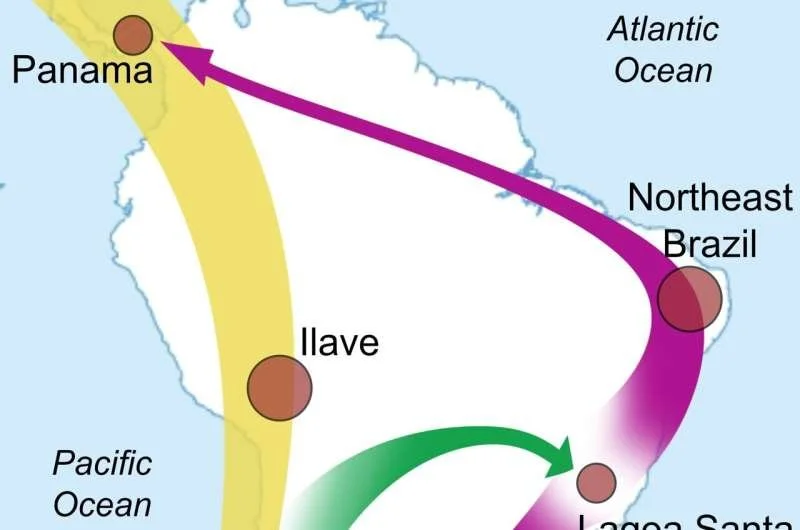
The first southern North American groups entered South America and spread through the Pacific coast settling the Andes (yellow arrow). At least one population split occurred soon after, branching the first groups that settled the Atlantic coast (green arrow) from the groups that gave rise to the ancient populations of Southern Cone. New Migrations may have then emerged along the Atlantic Coast, with a possible origin around Lagoa Santa, heading north toward Northeast Brazil and Panama, and south to Uruguay. Eventually, Uruguay and Panama were linked by a south-to-north migration route closer to the Atlantic coast (purple double-headed arrow). Credit: Florida Atlantic University

The study's findings, which were published in the journal Proceedings of the Royal Society B: Biological Sciences, indicate that ancient Uruguay and Panama—which are 5,277 kilometers (3,270 miles) apart—were eventually connected by human migrations closer to the Atlantic coast. Based on the ages of the ancient people, it is estimated that this unusual migration trend started about 1,000 years ago.

The ancient genomes from northeast Brazil, Lagoa Santa (southeast Brazil), Uruguay, and Panama are found to have a distinct association. According to this new concept, the majority of the Pacific coast and the Andes were mostly populated before the Atlantic coast was settled.

Michael DeGiorgio, Ph.D., co-corresponding author and associate professor in the Department of Electrical Engineering and Computer Science at FAU's College of Engineering and Computer Science, said: "Our study provides key genomic evidence for ancient migration events at the regional scale along South America's Atlantic coast." These localized episodes most likely resulted from early South American Indigenous peoples migrating in waves along the Pacific coast.

Researchers used teeth from ancient samples collected in archeological sites in northeast Brazil. Teeth are especially important in ancient DNA analysis because of the excellent preservation of biomaterials within the tooth. Credit: Laboratório de Arqueologia Biológica e Forense, Universidade Federal de Pernambuco

Strong genetic markers from Australia and Papua New Guinea were also discovered in the ancient genome of Panama.

Andre Luiz Campelo dos Santos, Ph.D., first author, an archaeologist and postdoctoral fellow in FAU's Department of Electrical Engineering and Computer Science, said, "We still don't know how these ancestral genomic signals appeared in Central and South America without leaving traces in North America. There is an entire Pacific Ocean between Australasia and the Americas.

Researchers found that ancient people from Uruguay and Panama had more Denisovan heritage than Neanderthal ancestry, which further complicated the situation. A group of extinct humans known as denisovans was originally discovered in 2008 using DNA sequences from the tip of a finger bone.

John Lindo, Ph.D., an assistant professor in the Department of Anthropology at Emory University and a co-corresponding author of the research who specializes in ancient DNA analysis, calls it "phenomenal" that Denisovan heritage made it all the way to South America. "The admixture must have taken place a very long time ago, possibly 40,000 years. It is likely that there was significant human-Denisovan hybridization because the Denisovan lineage survived and its genetic fingerprint was found in an ancient Uruguayan person who is barely 1,500 years old.

The Alcobaça archaeological site, in which the skeletal remains of Brazil-12 (northeast Brazil) were unearthed. Credit: Henry Lavalle, Universidade Federal de Pernambuco and Ana Nascimento, Universidade Federal Rural de Pernambuco

The two ancient human remains from northeast Brazil, which date back to at least 1,000 years before the present, were previously discovered by dos Santos and colleagues at the Federal University of Pernambuco in Recife, Brazil. They were sent to Lindo for DNA extraction and subsequent genomic sequencing and analyses. After that, raw data for the entire genome sequences from northeast Brazil were transmitted to FAU for computer processing.

The two recently sequenced ancient whole genomes from northeast Brazil were compared to other ancient whole genomes from the Americas as well as the current global genome. According to Lindo, only a handful of ancient entire genomes from South America have been sequenced and published as of the article's publishing date, compared to hundreds from Europe.

Source: https://phys.org/news/2022-11-ancient-dna-...

Top 200 Mythical Creatures and Monsters from Around the World

This video is a complete bestiary of top 200 mythical creatures and monsters from around the world.

You will see in this list mythological animals, monsters and creatures from the fantasy world and different mythologies like: Greek, Celtic, Norse, Slavic, Roman, Romanian, Calabrian and other European mythologies. Japanese, Hindu, Chinese and other Asian Folklore, Egyptian and other African mythologies, and of course creatures from Mayan, Aztec and other mythologies from North, Central and South America.

Why Did Modern Humans Take So Long to Leave Africa?

In this video, we'll explore the question of why modern humans took so long to leave Africa. We'll look at the different theories and discuss the evidence, before coming to a conclusion about what really happened. Enjoy!

Units of History - The Spartan Royal Guard Documentary

In this history documentary we explore the best of the best that the Spartan Army had to offer, the hippeis or 300 Royal Guard.

The video begins with a history of Sparta starting with its slow development during the Bronze Age and its emergence as a regional power in the early Archaic. At this point, its armies featured bands of elite armored warriors accompanied by their lightly armed retinues. Using these forces, Sparta was able to gain control of the communities to its south in Laconia and to its west in Messenia. These wars made Sparta the largest polis in all of Greece.

However, such vast territories were difficult to manage and were subject to frequent uprisings. Historians now believe that around the 6th century, the Spartan government and society were thus reformed to better deal with their domestic issues. This meant grouping its subjects into the classes of Helots or Perioikoi while more strictly controlling what it meant to be Spartan. Through these changes the army was reformed into one of a massed militia, whereby the whole army would fight on foot.

Thus, Sparta's previously mounted forces of the Hippeis dismounted to join their comrades and became the Royal Guard, which defended the King of Sparta in battle.

Jason & The Argonauts - The Epic Quest for the Golden Fleece (Greek Mythology)

The Epic of the Argonauts, often simply referred to as the "Argonautica," is an ancient Greek epic poem penned by Apollonius of Rhodes in the 3rd century BCE. The narrative chronicles the adventures of Jason and his band of heroes, known as the Argonauts, as they embark on a perilous journey to the distant land of Colchis in search of the Golden Fleece, a symbol of authority and kinship. Along the way, they face numerous challenges, from navigating treacherous waters and confronting daunting beasts to solving riddles and resisting temptations. The epic stands out in Greek literature not just for its thrilling adventures but also for its exploration of love, particularly the romance between Jason and the Colchian princess, Medea, who becomes an integral part of the quest.

The motivations driving Jason's pursuit of the Golden Fleece are deeply rooted in Greek myth and the political intrigues of Iolcus, his homeland. King Pelias, having usurped the throne from Jason's father, promises to relinquish his claim if Jason can retrieve the coveted Fleece. Assembling a crew of Greece's finest heroes, including Heracles, Orpheus, and the twins Castor and Pollux, Jason sets sail aboard the ship Argo, lending the name to the group as the Argonauts. While the story is one of heroism and grand adventure, the narrative also delves into the complexities of human emotion, relationships, and the price one pays for ambition. Medea's love for Jason and her eventual betrayal by him highlight the tragic undertones that often accompany quests for power and glory.

In today’s video, we explore the story behind the Greek hero Jason and his crew of Argonauts as they embark on an epic and perilous quest to recover the golden fleece and reclaim the kingdom that was stolen from him. Enjoy!

Pyrrhus and Pyrrhic War

Pyrrhus life was remarkable as he fought almost everyone in Central Mediterranean - from Romans to Carthaginians to Greeks. This documentary covers all the major battles of the Pyrrhic Wars, among them Heraclea, Asculum, Sparta, Argos. Watch the video for more!

A Scholar Studying This Ancient Crypt Has Reason To Believe It’s The Long Lost Home Of Jesus Christ

Have archaeologists found Jesus's childhood home in Nazareth?

It's a warm afternoon in Nazareth in 2006, and British archeologist Ken Dark is working in the depths of a crypt. A thought then strikes him as he rummages through the remains of what appears to be a dwelling. And if he’s correct, it will revolutionize biblical archeology and answer a question that has been asked for 2,000 years.

The Lost City of Machu Picchu: The Mysterious Legacy of the Inca Civilization

Situated 2,430 m above sea level in Peru, Machu Picchu is the greatest legacy of the Inca civilization with its sophisticated walls, terraces, and ramps. Although the exact role of the complex is still a mystery, it was probably a religious, astronomical, and agricultural center.

The Inca Empire had to abandon this fifteenth-century complex following the Spanish conquest in the sixteenth century. Machu Pichu remained hidden until 1911 when Hiram Bingham from Yale University discovered the site.

Swazi Royal Family Tree

In the video below we will analyze the Swazi royal family tree. Watch the video to find out more!