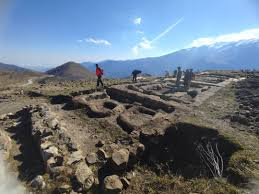
From towering mountains to pebbles along a river, the Earth is made of a huge variety of rocks. In today's video, we're going to follow the rock cycle of a piece of granite in the Himalayan mountains, and as you'll see, every rock has a far-reaching story to tell often millions of years in the making.
The Man Who Fell in Love with a Statue - Pygmalion and Galatea
In the following video we will be talking about Pygmalion, the man who fell in love with a statue named Galatea. Watch the video to find out more about their story!
Isle of Skye Discovers a Vast Repository of Dinosaur Footprints
Numerous traces found along Scotland's coast demonstrate that enormous, long-necked dinosaurs formerly roamed this area.

The footprints constitute the biggest dinosaur skeleton yet discovered in Scotland. They also demonstrate that sauropods, which were among the biggest dinosaurs ever, were at home near the water.
Long-standing controversy surrounds the enormous dinosaurs' relationship to water. Paleontologists believed sauropods had to wallow in swamps where the water could support their enormous heft throughout much of the 20th century. The "Dinosaur Renaissance" of the 1970s and 1980s, however, removed this outdated vision thanks to discoveries. For their size, sauropods found out to be surprisingly light, more likely to float than to sink to the bottom of a lake. Instead of sweltering wetlands, a new perspective showed sauropods traversing woods.
The new footprints discovered on the Isle of Skye now add to the mounting evidence that some sauropod dinosaurs frequented ancient coastlines and lagoon borders. The Isle of Skye site's geology provided unmistakable proof that the dinosaurs were roaming a brackish lagoon.
A Huge Find
The University of Edinburgh paleontologist Stephen Brusatte examined the Isle of Skye location after a geologist found bones there. "We had gone out to a lonely stretch of coast on the far northeastern tip of the island," he recalls. According to Brusatte, he and fossil fish expert Tom Challands found what appeared to be a pothole after spending the day largely hunting shark teeth and other small fossils. It was the imprint of a dinosaur.

Hundreds of dinosaur tracks cover a newly discovered site on the Isle of Skye.
This first discovery led to the discovery of a series of tracks that covered an area measuring roughly 49 feet (15 meters) by 82 feet (25 meters).
But the tracksite's vastness isn't the only impressive aspect. The Middle Jurassic period, more than 161 million years ago, is when the Isle of Skye footprints were created. This is "one of the least understood periods in dinosaur evolution," according to Brusatte. The traces provide a fresh look at the types of dinosaurs that inhabited the region and their behavior throughout this enigmatic period.
Anthony Martin, a paleontologist at Emory University, adds that dinosaur bones are uncommon in Middle Jurassic rocks, and even fossil skeletons can be moved from the site of the animal's demise. But tracks are a another matter. Martin asserts that the study of footprints "is extremely valuable for filling in gaps in our understanding of dinosaur evolution."
It is unclear exactly which dinosaurs left the footprints. It's typically impossible to link a skeleton foot to a footprint unless a dinosaur actually perishes in its footsteps.
However, the tracks still include enough information for Brusatte and his coauthors to classify them as sauropod dinosaurs, which moved with their legs very close to one another along the midline and included the controversial Brontosaurus and its relatives. A Middle Jurassic dinosaur named Cetiosaurus, which also happens to be one of the first dinosaurs ever named, is an excellent candidate for this kind of trackmaker, according to Brusatte.
Animals in the Lagoon
Another surprise was the old ecosystem in which these dinosaurs roamed.

A sauropod footprint from the new site in Scotland shows the outline of the dinosaur's toes.
Why sauropods consistently avoided the edges of seas, lagoons, and wetlands at the prehistoric Isle of Skye and other places across the world is still a mystery to paleontologists. According to Brusatte, it's possible that the lagoons and beaches offered a food source, safety from predators, or some other allure.
Martin concurs, pointing out that the discovery of sauropod tracks in coastal habitats is not particularly surprising given that these areas "provided paths of least resistance for sauropods moving from one place to another" because of their flat, accessible shorelines, where predatory dinosaurs would have had more difficulty ambushing prey due to the absence of cover.
So, even though sauropods were primarily land creatures, some of them were at least ok with getting their feet a little wet. As Brusatte points out, "Dinosaurs were probably capable of doing a lot more and living in a lot more places than we give them credit for."

Mayan Child - Photo: Ricardo Carreon
100 Mayan Names and Their Profound Meanings
In the heart of the Mesoamerican rainforests, the Maya civilization thrived, leaving behind a legacy that continues to captivate our imagination. Among their cultural treasures, Mayan names stand as a testament to their deep connection with nature, the cosmos, and their spiritual beliefs. Join us as we delve into the profound meanings behind Mayan names.
here's a list of 100 Mayan names along with their meanings:
Ixchel - "Rainbow Lady," Moon Goddess.
Kukulkan - Feathered Serpent deity.
Itzel - "Rainbow Lady," inspiration from rainbows.
Balam - "Jaguar," strength and power.
Hunahpu - "One Blowgunner," mythical hero.
Ahau - "Lord" or "Ruler," spiritual leadership.
Ix - "Jaguar," inspired by the Jaguar day sign.
Aj - "Cane," resilience and growth.
Coh - "Cloud," connection to the sky.
Ek - "Star," celestial inspiration.
Chaac - Rain deity.
Ixtab - Goddess of suicide and hangings.
K'an - "Snake," connection to the serpent symbolism.
Pakal - Sun King, powerful ruler.
Nohoch - "Large," greatness and significance.
Yum - "Lord," divine connection.
K'awiil - God of lightning and rainbows.
Muluc - "Water," connection to aquatic symbolism.
Uxmal - Ancient city's name, meaning "Built Three Times."
Zipacna - Earthquake deity.
Tz'ikin - "Bird," symbolic of freedom and elevation.
Ixpiyacoc - Goddess of midwives and childbirth.
Kame - "Death," representing the cycle of life.
Xaman - "North Star," guidance and direction.
Yaluk - "Green," tied to nature and renewal.
Chun - "Dune," earthy and grounded.
Akbal - "Night," associated with mystery and introspection.
Ixquic - Mother of Hero Twins in mythology.
Uk'ix - "Honey," sweetness and nourishment.
Mol - "Jade," precious and revered.
Lahun - "Dancer," celebration and joy.
Tun - "Stone," strength and permanence.
Ixkik - Wife of Hunahpu in mythology.
Tepoz - Mountain deity.
Kakaw - "Cocoa," symbol of sustenance and richness.
Nikte - "Flower," delicate beauty.
Popol - "Mat," comfort and support.
Zamná - Legendary high priest and culture bringer.
Xamanek - "Morning Star," hope and new beginnings.
Ukit - "Resin," preservation and protection.
Akech - "Turtle," symbol of longevity and wisdom.
Ee - "Wood," growth and flexibility.
Imox - "Water," fluidity and adaptability.
K'inich - "Sun," life-giving force.
Lakin - "Seashell," connection to the ocean's mysteries.
Yaxha - Ancient city's name, "Green Water."
Xolotl - Dog-headed deity, symbolizing transformation.
Yumka - "Chief of Chiefs," authority and leadership.
Ixkakaw - "Rainbow Maiden," link to celestial beauty.
Kotot - "Obsidian," strength through transformation.
Pich - "Crocodile," primal power and danger.
Xochitl - "Flower," natural beauty and grace.
Cham - "West," connection to sunset and closure.
Oxlahun - "Thirteen," completion of cycles.
Tul - "Wind," dynamic and ever-changing.
Xulon - "Endless," infinite possibilities.
Yaluk - "Green," growth and renewal.
Uchben - "Cedar," durability and strength.
Yaluk - "Green," symbol of flourishing life.
Kuxan - "Amulet," protective energy.
Lahun - "Dancer," celebration and joy.
Chak - "Fire," transformative power.
Zac - "White," purity and illumination.
Nik - "Flower," natural beauty and growth.
Ahkin - "Sun," radiant and life-affirming.
Ixchab - "Dew of the Sky," celestial connection.
Tz'i' - "Dog," loyalty and companionship.
Imix - "Crocodile," primordial energy.
Yumka - "Chief of Chiefs," authoritative leadership.
Bolon - "Nine," spiritual enlightenment.
K'awiil - God of lightning and creativity.
Yax - "Green," connection to nature's vitality.
Yaluk - "Green," growth and rejuvenation.
Xaman - "North Star," guiding light.
Lahun - "Dancer," celebration and happiness.
Chun - "Dune," solid and stable.
Kakaw - "Cocoa," richness and nourishment.
Muluc - "Water," flowing and adaptable.
Popol - "Mat," comfort and support.
Zamná - Legendary high priest and culture bringer.
Uk'ix - "Honey," sweetness and sustenance.
Nikte - "Flower," delicate beauty.
Ixpiyacoc - Goddess of midwives and childbirth.
Akbal - "Night," mysterious and introspective.
Uxmal - Ancient city's name, "Built Three Times."
Xochitl - "Flower," natural beauty and grace.
Yum - "Lord," divine connection.
Yaluk - "Green," renewal and vitality.
Ixchel - "Rainbow Lady," Moon Goddess.
Chaac - Rain deity.
Balam - "Jaguar," strength and power.
Hunahpu - "One Blowgunner," mythological hero.
Ahau - "Lord" or "Ruler," spiritual leader.
Ix - "Jaguar," tied to the Jaguar day sign.
Aj - "Cane," symbol of resilience and growth.
Tz'ikin - "Bird," freedom and elevation.
Ixquic - Mother of Hero Twins in mythology.
Kukulkan - Feathered Serpent deity.
Itzel - "Rainbow Lady," inspiration from rainbows.
Coh - "Cloud," connection to the sky.
Each of these names carries the echoes of a civilization that celebrated the natural world, revered celestial entities, and embraced spiritual beliefs. As you explore these names, you glimpse into the wisdom and beauty of the Mayan culture, a legacy that endures in the tapestry of history.
Which Civilization Invented Numbers? Unveiling the Origins of Numerical Systems
In the intricate tapestry of human history, the concept of numbers stands as a fundamental pillar that has shaped the way we perceive and interact with the world. The journey to inventing numbers was not a solitary path; instead, it emerged independently across diverse ancient civilizations, each weaving its own unique numerical tapestry.
Babylonian Numerals: Foundations in Mesopotamia
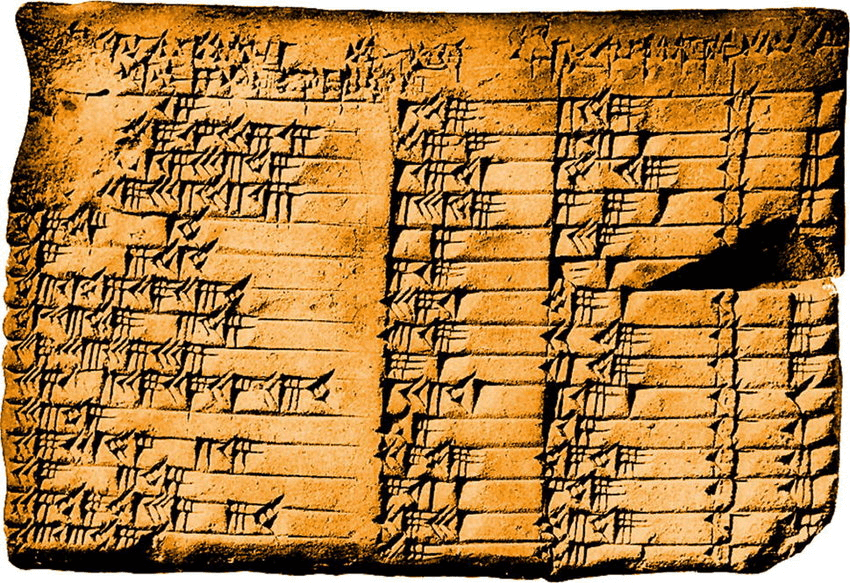
Mathematical cuneiform tablet with four columns and fifteen rows of numbers. Larsa, Mesopotamia (modern Tell Senkereh, Iraq), circa 1820–1762 BC.
Around 2000 BC, in the fertile lands of Mesopotamia (modern-day Iraq), the Babylonians were laying the foundations of numerical systems. Their base-60 numerical system left an indelible mark on human culture. This system, influenced by the cycles of the moon and their calculations of time, paved the way for the divisions of time we use today. Their ingenious combination of symbols and positional notation enabled the representation of a wide range of numbers and remains a testament to ancient mathematical creativity.
Egyptian Numerals: Hieroglyphic Representations

1,333,330 in Egyptian hieroglyphs from the Edfu Temple (237–57 BC) in Egypt.
The hieroglyph on the left is the Egyptian god Heh (chaos or infinity), representing one million. Next, a tadpole hieroglyph represents 100,000. The bent finger hieroglyph is 10,000; the lotus flower is 1000; the coil of rope is 100; and the hobble (used for cattle and missing the crossbar) is 10. Reading from left to right, the hieroglyph number is 1,333,330. The one missing numeric hieroglyph symbol in the photo is the stroke or tally mark for 1.
Contemporary with the Babylonians, the ancient Egyptians developed their own numerical system. Rooted in a base-10 system, the Egyptians created symbols to represent multiples of powers of 10. This unique numerical system, while not possessing the concept of zero, exemplified the practical nature of ancient mathematics. The legacy of their numerical prowess lives on in the grand structures they built, which bear witness to their advanced mathematical understanding.
Indus Valley Civilization: Traces of Early Numerical Notation

Indus Valley Civilization: Traces of Early Numerical Notation
During the period of 3300–1300 BC, the enigmatic Indus Valley Civilization played a role in the earliest development of numerical notation. While the specifics of their system remain elusive, their contributions paved the way for the numerical innovations that followed.
Hindu-Arabic Numerals: India's Gift to the World
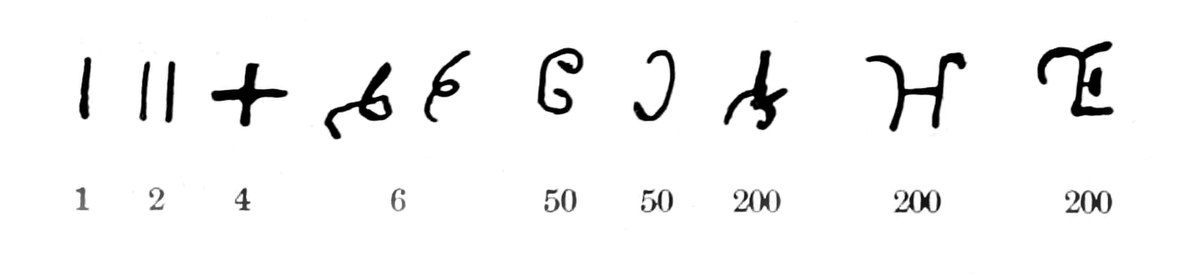
The first Brahmi numerals, ancestors of Hindu-Arabic numerals, used by Ashoka in his Edicts of Ashoka c. 250 BC
Around the 6th to 9th centuries AD, in the cultural crucible of India, a revolutionary leap was made with the introduction of the Hindu-Arabic numeral system. A base-10 system with the inclusion of zero as a placeholder, this innovation transformed the landscape of mathematics and commerce. The adoption of zero allowed for more efficient calculations and laid the groundwork for the intricate mathematical tapestries woven by future generations.
Each of these ancient civilizations crafted its own numerical story, contributing threads that continue to shape our mathematical understanding today. The diversity of these systems, emerging independently across the globe, highlights the universality of human curiosity and the ingenuity with which we have sought to quantify and comprehend our surroundings.
As we traverse through history, it becomes evident that the invention of numbers was not a linear progression but a mosaic of innovation. From Babylon's base-60 system to India's gift of zero, the ancient civilizations have given us a legacy that continues to influence the very foundations of our modern world. In celebrating these origins, we honor the diverse tapestry of human intellect and the quest for knowledge that unites us across time and space.
12 Most Mysterious Ancient Technologies Scientists Still Can't Explain
If you could travel back to the 1950s and stop somebody in the street of your hometown to show them your mobile phone, they would be fascinated and terrified. The fact that such technology could possibly exist would blow their minds. You’d assume that this time-travelling trick could only work in one direction, but we sometimes come across ancient technology that blows our minds here in the present day. In fact, we’re going to show some to you now.
What Happened to the Anglo-Saxons After the Norman Conquest? Documentary
In the following video we will be talking about the Anglo-Saxons and what happened to them in the aftermath of the battle of Hastings and Norman invasion of William. Watch the video to find out more!
Perucetus: The Largest Whale Ever?
In the following video we will analyze whether Perucetus is the largest whale ever. Watch the video to find out!
The Bronze Age Relics Hidden Under The Black Sea | Dark Secrets of the Black Sea
Delving into the depths of the Black Sea, an international team of experts investigates the enigma surrounding a forgotten ancient civilization. Join them as they explore the evidence and uncover the secrets of this intriguing Bronze Age society and beyond.
The Entire History of Human Civilizations | Ancient to Modern (4K Documentary)
The history of our story began long ago. At one point in time, around three billion years ago, we were floating around as little, tiny atoms in the little Petri dish of the world.
Around 6 million years ago, and we see the emergence of the first hominoids - the family of primates that includes humans. 1.9 Million years ago, Homo Erectus was the first species to leave Africa and colonize other parts of the world. They had larger brains than their primate ancestors.
Around 400,000 years ago, the first evidence of the Neanderthals. Their bodies were adapted to the cold environments of Europe and Western Asia. Their distinctive facial features were some of the most human-like ever seen. They are famous for their massive body weight and big facial hair. These prehistoric ancestors were made for the cold.
Then came us; 300,000 years ago, the first Homo Sapiens roamed the earth. The Only surviving species of the Homo Genus. But how did Homo Sapiens rise into a global dominance through the mechanism of civilization?
Why were the Mongols so successful?
Why were the Mongols so successful? In today’s video we will analyze Mongol military history and battle tactics. Enjoy!
How dangerous was it to be a jester?
Explore the history of court jesters, from 7th century China to medieval Europe, and how they were able to speak truth to power.
Contrary to common belief, jesters weren’t just a medieval European phenomenon but flourished in other times and cultures. The first reliably recorded jester is thought to be You Shi, of 7th century BCE China. Jesters had unique relationships to power: they could be viewed as objects of mockery or as entertainers and trusted companions. Beatrice K. Otto digs into history's most infamous jokers.
Inside One of London's Oldest Medieval Crypts
If you imagine a Catholic military order from the Middle Ages, it’s likely to be the Knights Templar - popularised by Dan Brown’s fictional thriller, The Da Vinci Code
But in Medieval Europe, there was another, equally powerful religious society, which also had its English headquarters here in London. It was the Order of St John of Jerusalem. Better known, as the Knights Hospitaller.
In today’s video we will explore the history of the Order of St John, visiting their base of operations here in Clerkenwell, London. The priory is one of the city’s hidden gems, with surprises around every corner.
Formed in Jerusalem in the 11th century to care for pilgrims, the order went on to become an ambitious military organisation, owning lands and wielding influence across Europe.
How did Caesar Conquer Gaul and Destroy the Republic?
Caesar had been appointed as dictator back in Rome despite being in and out of Italy as a whole to engage in campaigns in the Middle East and Africa as well as his endeavors in Asia. He was also repeatedly named consul and his dictatorship renewed multiple times, having pardoned his enemies in the Senate and thus laying claim to very few opponents at home. Once he finally returned to Rome again in the 40s BC, Caesar began to roll out new legal reforms, even changing the Roman calendar. He was essentially the sole authority in the crumbling Roman Republic if one could even still call it that, holding the titles of dictator, tribune, and consul.
The Most Accurate Dinosaur Ever Reconstructed?
Have palaeontologists made the most accurate dinosaur reconstruction ever? Well, thanks to an incredible fossil of Psittacosaurus they very well may have, as this specimen preserves almost all of the animal's skin and colours - plus some surprising bits of anatomy you wouldn't think could ever be reconstructed.
Workers Digging Near A Medieval Monastery Just Uncovered A Mysterious Network Of Tunnels
It’s early spring 2021, and a team of electrical engineers are working amidst the picturesque scenery of Wales’ Wye Valley. Their task involves digging a trench, but soon they find themselves breaking into a strange tunnel hidden beneath the ground. This structure isn’t on any of their maps or plans, meaning it’s taken the workers totally by surprise. It seems that this eerie tunnel has been forgotten for untold centuries.
The Most Powerful and Important Gods of Mayan Mythology
The Mayan Civilization has influenced many aspects of culture, with its beliefs and religions that gave an explanation to the universe. According to studies, there are more than 200 gods in the Mayan culture, however, the Mayan gods manage to be unique and fascinating.
In this video we will see some of the most important and powerful Mayan Gods. Enjoy!

List of Pharaohs of Egypt: From 3100 BC until Roman Era
BY THE ARCHAEOLOGIST EDITOR GROUP
The ancient land of Egypt, adorned with colossal pyramids and enigmatic hieroglyphs, is steeped in a history that spans millennia. At the heart of this grand civilization were the pharaohs, the revered rulers who held dominion over the Nile Valley for over three thousand years. Here is a comprehensive list of the known Egyptian pharaohs, organized chronologically by dynasties:
First Dynasty (c. 3100–2890 BC):
Narmer (Menes)
Hor-Aha
Djer
Djet
Den
Anedjib
Semerkhet
Qa'a
Second Dynasty (c. 2890–2686 BC):
Hotepsekhemwy
Raneb (Nynetjer)
Peribsen
Khasekhemwy
Third Dynasty (c. 2686–2613 BC):
Djoser (Netjerikhet)
Sekhemkhet
Sanakht
Khaba
Huni
Fourth Dynasty (c. 2613–2494 BC):
Sneferu
Khufu (Cheops)
Djedefre
Khafre (Chephren)
Menkaure
Shepseskaf
Fifth Dynasty (c. 2494–2345 BC):
Userkaf
Sahure
Neferirkare Kakai
Shepseskare
Neferefre
Nyuserre Ini
Menkauhor Kaiu
Djedkare Isesi
Unas
Sixth Dynasty (c. 2345–2181 BC):
Teti
Userkare
Pepi I
Merenre Nemtyemsaf I
Pepi II
Merenre Nemtyemsaf II
Netjerkare Siptah
Menkare
Neferkare II
Neferkare Neby
First Intermediate Period (c. 2181–2055 BC): A time of fragmented rule and uncertain history.
Middle Kingdom (c. 2055–1650 BC):
Mentuhotep II (11th Dynasty)
Mentuhotep III (11th Dynasty)
Amenemhat I (12th Dynasty)
Senusret I (12th Dynasty)
Amenemhat II (12th Dynasty)
Senusret II (12th Dynasty)
Senusret III (12th Dynasty)
Amenemhat III (12th Dynasty)
Amenemhat IV (12th Dynasty)
Sobekneferu (12th Dynasty)
Second Intermediate Period (c. 1650–1550 BC): Another era of fragmented rule and foreign influence.
New Kingdom (c. 1550–1070 BC):
Ahmose I (18th Dynasty)
Amenhotep I (18th Dynasty)
Thutmose I (18th Dynasty)
Thutmose II (18th Dynasty)
Hatshepsut (18th Dynasty)
Thutmose III (18th Dynasty)
Amenhotep II (18th Dynasty)
Thutmose IV (18th Dynasty)
Amenhotep III (18th Dynasty)
Akhenaten (18th Dynasty)
Smenkhkare (18th Dynasty)
Tutankhamun (18th Dynasty)
Ay (18th Dynasty)
Horemheb (18th Dynasty)
Third Intermediate Period (c. 1070–664 BC): A period marked by regional fragmentation and foreign domination.
Late Period (c. 664–332 BC):
Necho I (26th Dynasty)
Psamtik I (26th Dynasty)
Necho II (26th Dynasty)
Psamtik II (26th Dynasty)
Apries (26th Dynasty)
Amasis II (26th Dynasty)
Psamtik III (26th Dynasty)
Cambyses II (Persian ruler)
Darius I (Persian ruler)
Xerxes I (Persian ruler)
Artaxerxes I (Persian ruler)
Darius II (Persian ruler)
Artaxerxes III (Persian ruler)
Late Period (cont.):
14. Darius III (Persian ruler)
Alexander the Great (Greek ruler)
Ptolemy I (Ptolemaic Dynasty)
Ptolemy II (Ptolemaic Dynasty)
Ptolemy III (Ptolemaic Dynasty)
Ptolemy IV (Ptolemaic Dynasty)
Ptolemy V (Ptolemaic Dynasty)
Ptolemy VI (Ptolemaic Dynasty)
Ptolemy VII (Ptolemaic Dynasty)
Ptolemy VIII (Ptolemaic Dynasty)
Cleopatra VII (Ptolemaic Dynasty)
Roman Period (30 BC–395 AD): Egypt became a province of the Roman Empire.
The above list provides a general overview of the pharaohs who ruled ancient Egypt across its long and storied history.

Replica of the Tutankhamun's funeral mask | Shutterstock
Who were the most famous pharaohs of Egypt?
BY THE ARCHAEOLOGIST EDITOR GROUP
The annals of ancient Egyptian history are replete with the tales of remarkable rulers who adorned the throne of the Nile Valley. These pharaohs, enshrined in the sands of time, shaped the destiny of a civilization that continues to awe and inspire. Embark on a journey through the corridors of history as we explore the names and legacies of each of these remarkable pharaohs.
1. Narmer (c. 3100 BCE)
Narmer, also known as Menes, stands as a towering figure in the Egyptian chronicles. The founder of the First Dynasty, he unified the two lands of Upper and Lower Egypt, setting the stage for the dynastic rule that would endure for centuries.
2. Djoser (c. 2670 BCE)
Under the reign of Djoser, the Third Dynasty ushered in a new era of architectural innovation. The Step Pyramid at Saqqara, his enduring legacy, stands as a testament to his vision and the skilled craftsmanship of his time.
3. Sneferu (c. 2613–2589 BCE)
The Fourth Dynasty bore witness to the rule of Sneferu, whose insatiable ambition led to the construction of three pyramids. These pyramids, from the Bent Pyramid to the Red Pyramid, marked the evolution of pyramid building techniques.
4. Khufu (c. 2589–2566 BCE)
Known to the world as the architect of the Great Pyramid of Giza, Khufu, or Cheops, of the Fourth Dynasty left an indelible mark on the landscape of Egypt. His pyramid, a marvel of engineering, remains a testament to human ingenuity.
5. Hatshepsut (c. 1473–1458 BCE)
Hatshepsut, a remarkable pharaoh of the Eighteenth Dynasty, defied conventions by ruling as a woman. Her reign saw a flourishing of trade and culture, while her architectural marvels continue to inspire awe.
6. Akhenaten (c. 1353–1336 BCE)
A radical departure from tradition, Akhenaten's reign introduced the worship of the sun disk, Aten. His revolutionary religious reform reshaped Egypt's cultural landscape and continues to intrigue scholars and enthusiasts alike.
7. Tutankhamun (c. 1332–1323 BCE)
King Tut, the boy pharaoh, captured the world's imagination when his virtually intact tomb was discovered. His rule, albeit brief, provided a window into the opulence and rituals of ancient Egyptian royalty.
8. Ramses II (c. 1279–1213 BCE)
Ramses II, also known as Ramses the Great, is a colossus among pharaohs. His 66-year reign saw the construction of monumental temples and statues, with the Abu Simbel temples serving as his enduring legacy.
9. Seti I (c. 1294–1279 BCE)
The father of Ramses II, Seti I's reign marked a period of stability after the tumultuous times of Akhenaten. His contributions to architecture and the restoration of Egypt's grandeur are etched in stone.
10. Cleopatra VII (51–30 BCE)
The last of the pharaohs, Cleopatra VII's name resonates with intrigue and power. Her alliances with Julius Caesar and Mark Antony are woven into the fabric of history, forever preserving her as a symbol of ancient Egypt's last days.
Each of these pharaohs, their names echoing across the centuries, represents a chapter in the epic saga of ancient Egypt. Through their reigns, the world gains insights into the culture, art, architecture, and spirituality that defined this awe-inspiring civilization. Their names serve as windows into a world of grandeur and mystery, inviting us to explore the depths of a past that continues to captivate our imagination.
Philosophy of Aristotle: Top 5 Teachings
Discover the profound wisdom of one of history's greatest philosophers, Aristotle. In this video, we explore the top 5 teachings that shaped the foundation of Aristotle's philosophical legacy. From ethics and metaphysics to politics and virtue, Aristotle's ideas continue to inspire and influence modern thought.