For decades, divers working in Alexandria’s submerged ancient port have uncovered remnants of the world once walked by Cleopatra, Julius Caesar, and Mark Antony. The city’s royal harbors were legendary in antiquity, but each new discovery reminds scholars just how much of ancient Egypt’s capital still lies hidden beneath the Mediterranean.
Now, a recent underwater mission in the Port of the Royal Island of Antirhodos, part of the vast Portus Magnus of Alexandria, has brought to light one of the most remarkable finds in years: a luxury shipwreck dating to the first century A.D., astonishingly well preserved after nearly 2,000 years underwater. The mission was carried out by the Institut Européen d’Archéologie Sous-Marine (IEASM), the same team responsible for many of Alexandria’s most iconic underwater discoveries.
A First-Century Luxury Vessel Frozen in Time
The newly uncovered vessel is identified as a thalamagos, a ceremonial or pleasure barge used by the elite of Roman Egypt. These ships were known for their elegance rather than speed, designed to glide through Alexandria’s canals and lagoons while hosting prominent figures, royal guests, or religious delegations.
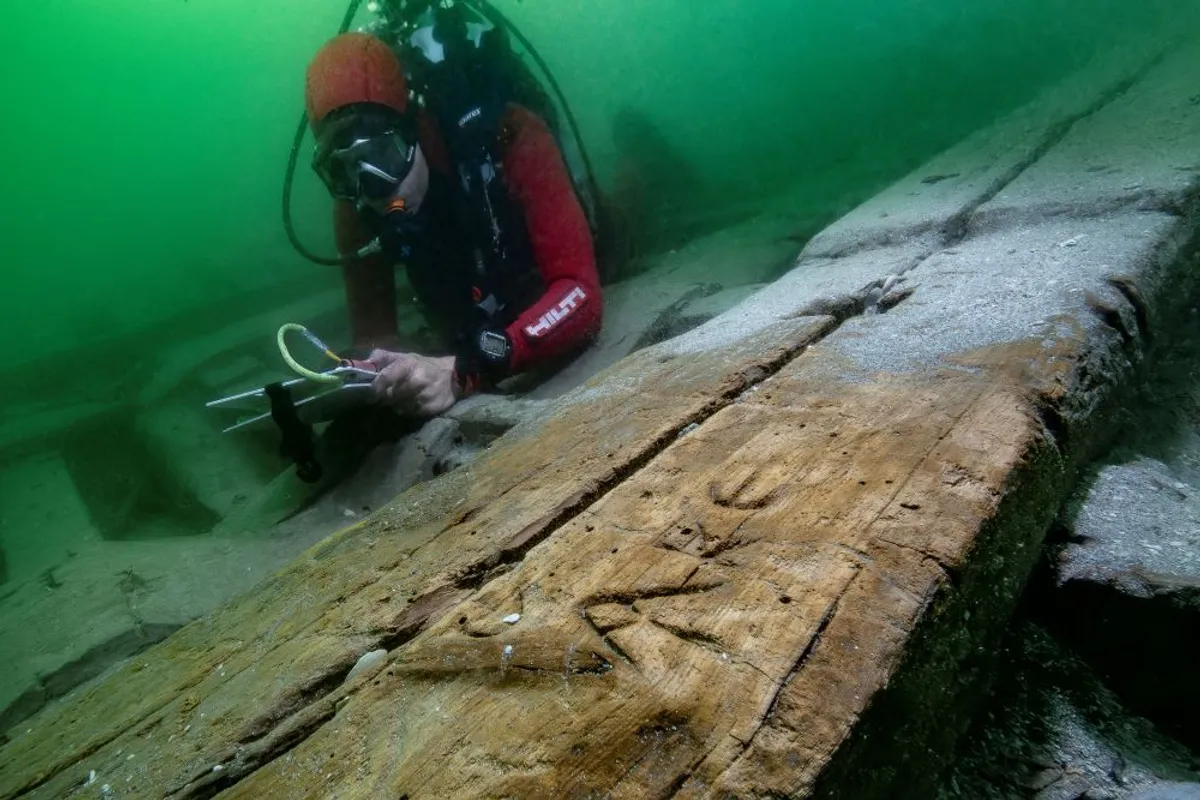
Archaeologists documented around 90 feet of intact wooden timbers, allowing them to reconstruct a ship that once measured approximately 115 feet in length and 23 feet across. Its broad beam supported a covered cabin where passengers could relax, dine, or attend ceremonial gatherings while drifting through the waterways that connected Alexandria’s districts.
Built with a flat-bottomed hull, the barge was engineered specifically for sheltered inland waters—not for open-sea voyages. This design speaks to its purpose: peaceful excursions through the city rather than long-distance travel. A piece of Greek graffiti carved into the ship’s central beam provided a helpful timestamp, placing its construction in the first half of the first century A.D., shortly after Egypt became part of the Roman Empire.
Similar thalamagoi were well known among the Ptolemaic rulers. The most famous example belonged to Cleopatra VII, who—according to ancient accounts—used a lavish barge to guide Julius Caesar on a tour of Egypt in 47 B.C.E. These vessels, rich with ornamentation, carried political symbolism as much as luxury, showcasing wealth, power, and divine association.
More Than a Pleasure Craft? A Ritual Role Emerges
While the barge’s graceful design marks it as a luxury craft, archaeologists believe it may also have played a role in religious ceremonies. Its construction techniques strongly suggest an Alexandrian shipyard, and the elaborate cabin points to a vessel used during ritual events.
IEASM director Franck Goddio proposed that the ship might have been associated with a nearby temple of Isis on Antirhodos Island. If so, it could have sunk during the destruction of the temple around 50 A.D., a turbulent period when parts of the island’s religious architecture suffered catastrophic damage.
This possibility opens the door to a fascinating interpretation: the barge may have been part of the navigatio Isidis, a ceremonial procession held in honor of Isis, one of the most venerated deities in the Mediterranean. As Goddio explains, the ritual used a decorated vessel that symbolized the solar barque of Isis, “mistress of the sea.” Once each year, this sacred ship was carried across the waters from Alexandria’s harbor to the sanctuary of Osiris at Canopus.
If the newly discovered barge participated in this rite, it would not just be a luxury craft but an object of profound spiritual significance.
Alexandria’s Port: Where Empires Met the Sea
The find also underscores the incredible importance of ancient Alexandria’s harbor system. What began as a modest fishing village transformed, under the Ptolemies and Romans, into the largest trading port in the ancient world a hub of commerce, politics, and cultural exchange.
From here, Egypt shipped grain to feed the Roman Empire. Exotic goods from Africa and Arabia passed through its docks. Philosophers, generals, and diplomats walked its quays. It was a crossroads of the ancient Mediterranean, marked by monumental architecture and bustling maritime traffic.
For more than three decades, IEASM has systematically mapped the submerged remains of Portus Magnus, uncovering:
palace complexes tied to the Ptolemies,
temples dedicated to Isis and other deities,
ceremonial docks,
administrative buildings,
and the drowned neighborhoods of Antirhodos Island and the Poseidium Peninsula.
These are the very places where Cleopatra negotiated with Caesar, where Mark Antony stayed during his final years, and where the political pulse of Egypt once beat strongest.