Ancient Pompeii Construction Site Reveals the Real Secret of Rome’s Long-Lasting Concrete
A recently excavated construction site in Pompeii dating back nearly 2,000 years has shed remarkable new light on how the Romans crafted their famously long-lasting concrete. The site, sealed beneath volcanic ash since the eruption of Mount Vesuvius in 79 CE, offers an extraordinarily rare and vivid glimpse into Roman building practices at the exact moment they were being carried out.
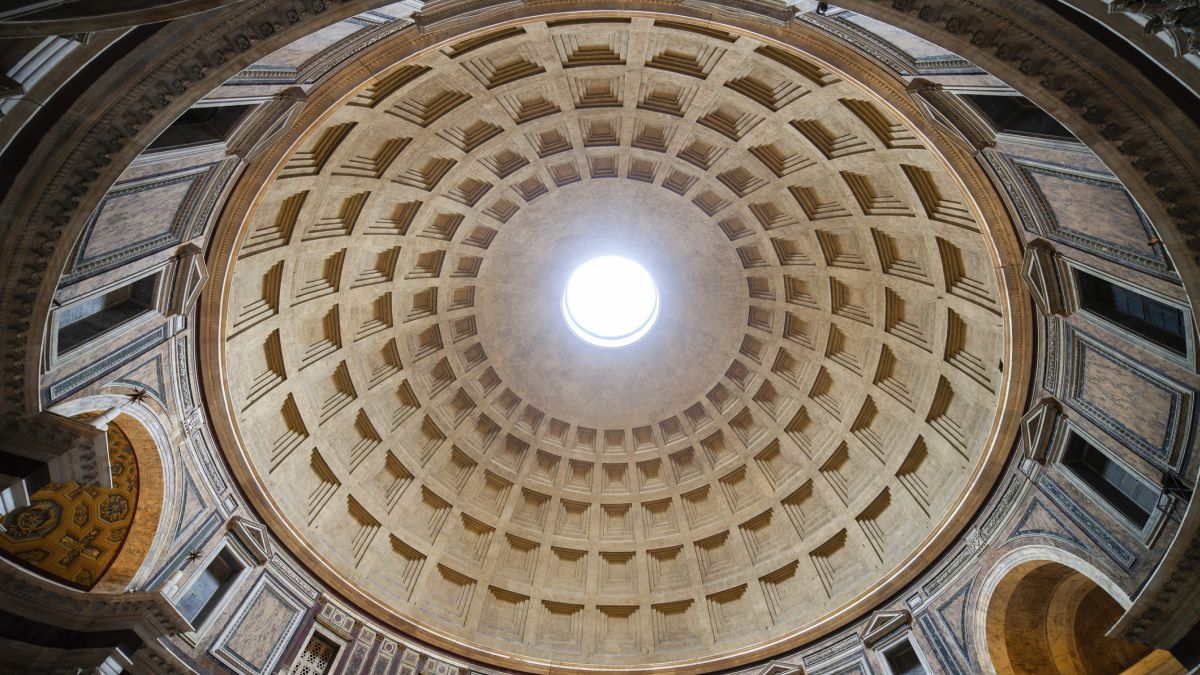
The discovery stunned archaeologists. Instead of scattered remnants or fragmentary tools, the team uncovered a fully intact construction area, complete with piles of raw materials arranged with care, as if the workers had simply stepped away for a short break. Among these materials were the precise ingredients that the Romans used to produce structures like the Pantheon—whose massive, unreinforced concrete dome still stands today as the largest of its kind.
A New Analysis Points to the Real Secret: “Hot Mixing”
A fresh scientific analysis of the materials collected from the Pompeii site reveals a technique that may finally explain why Roman concrete has survived for thousands of years while modern concrete often deteriorates within decades. Materials scientist Admir Masic of the Massachusetts Institute of Technology (MIT) has identified this method as “hot mixing.”
Hot mixing involves directly combining the key ingredients of Roman concrete:
Pozzolan, a volcanic ash blend named after the nearby village of Pozzuoli, and
Quicklime (calcium oxide), a highly reactive substance that releases intense heat when exposed to water.
Unlike the commonly assumed approach using slaked lime, in which the lime is pre-mixed with water before use, the Romans added quicklime directly to the dry mixture. When water was introduced, the chemical reaction generated substantial heat from inside the concrete.
Why Hot Mixing Made Roman Concrete So Exceptional
In earlier comments published in 2023, Masic explained that the benefits of hot mixing extend far beyond simply warming the mixture. The elevated internal temperature triggers chemical processes that cannot occur under cooler conditions.
He noted two major advantages:
Formation of unique, high-temperature compounds
Heating the concrete from within allows rare minerals to form—minerals that strengthen the material and are absent in mixtures made only with slaked lime. These compounds enhance the overall durability and long-term stability of the structure.Dramatically faster curing and setting times
Higher temperatures accelerate chemical reactions, causing the concrete to harden more quickly. This would have allowed Roman builders to work efficiently, completing major construction projects at a pace that would impress even modern engineers.
A Third Benefit: Built-In Self-Healing Power
Perhaps the most compelling revelation is the discovery of a self-healing mechanism embedded within the concrete itself—something modern engineers have long tried to replicate.
Even after the concrete hardens, small fragments of quicklime, known as lime clasts, remain inside the final mixture. These clasts turn out to be essential for the concrete’s extraordinary resilience.
Here’s how the process works:
Over time, small cracks naturally form within a structure due to stress or environmental changes.
Instead of spreading randomly, these cracks tend to move toward the lime clasts because of their physical and chemical properties.
When rainwater or moisture enters the crack, it reacts with the lime, forming a calcium-rich fluid.
As this fluid dries, it solidifies into calcium carbonate, effectively sealing the crack.
The repaired area becomes strong again, preventing further structural damage.
This automatic repair cycle may be the primary reason why Roman buildings—from towering aqueducts to seawalls and massive domes—have survived earthquakes, climate changes, and centuries of erosion.
A Construction Legacy That Endured for Millennia
The findings from Pompeii not only illuminate the ingenuity of Roman builders but also challenge long-held assumptions in modern engineering. The Romans were not simply mixing basic ingredients; they were applying a highly sophisticated construction technique that used chemistry, heat, and natural materials to create concrete capable of withstanding the test of time.
The newly uncovered construction site serves as a powerful reminder that ancient technology was often far more advanced than previously believed. It also offers modern researchers a chance to study ancient methods that could inspire stronger, more sustainable building materials today materials that might finally rival the enduring strength of Rome’s architectural masterpieces.
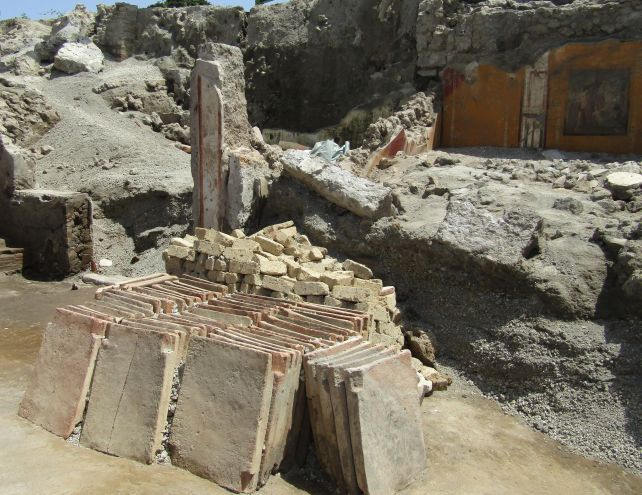
Some of the neatly organized building materials found at the site
Masic emphasizes that Roman concrete deserves attention not only because of its historical significance but also because of its remarkable scientific and technological properties. “This material can heal itself over thousands of years,” he explains. “It stays chemically active, constantly reacting with its environment. It’s incredibly dynamic. It has survived earthquakes, volcanoes, centuries of weathering even long-term exposure to seawater.” The extraordinary longevity of Roman concrete makes it one of the most durable construction materials ever created.
But while the hot-mixing discovery answered many questions, it also reopened an old scientific puzzle: the ancient recipe described by the Roman architect Vitruvius in his 1st-century BCE treatise De architectura did not match the evidence found in real Roman structures.
Vitruvius’ account describes a very different process. According to him, builders first created slaked lime by mixing quicklime with water, and only then combined this slaked lime with pozzolan. This method long accepted as accurate cannot produce the distinctive lime clasts found in actual Roman concrete. Those clasts are key indicators of hot mixing.
For decades, this contradiction left scholars confused. Vitruvius remains the most complete surviving source on Roman architecture, and his description of opus caementicium, the Roman concrete technique, seemed authoritative. Yet the physical samples pulled from aqueducts, seawalls, and temples simply didn’t align with the ancient instructions.
The newly uncovered workshop at Pompeii has effectively solved this long-standing mystery. Masic and his team conducted isotope analysis on five of the carefully arranged piles of raw materials preserved at the construction site. The results clearly identified the components: pumice-rich pozzolan, lithic ash, quicklime, and even the same lime clasts found in surviving Roman structures.
This direct, untouched evidence frozen in time by the eruption confirms that hot mixing was the real method used by Roman builders, regardless of what Vitruvius recorded. The Pompeii site provides the missing link between historical texts and physical archaeology, finally allowing researchers to reconcile ancient writings with the undeniable chemical signatures hidden within Rome’s enduring monuments.

A wall at the site in Pompeii with the compositional analysis overlaid on the right.
The most revealing evidence came from the dry piles of material themselves. They were already pre-mixed a detail that archaeologists consider a true “smoking gun.” This single observation confirmed that Roman builders were not slaking lime first, but blending it directly with volcanic ash before water was added, exactly as the hot-mixing technique requires.
Once the team examined the mortar samples under the microscope, the visual proof became undeniable. The samples contained the classic markers of hot mixing:
• Fractured lime clasts, formed when quicklime reacts violently with water and expands while the concrete sets.
• Calcium-rich reaction rims, which showed lime minerals penetrating and bonding with volcanic ash particles.
• New crystals of calcite and aragonite, growing inside the natural bubbles or vesicles of pumice grains, further strengthening the material from within.
Advanced testing methods backed up these observations. Raman spectroscopy identified the minerals created by high-temperature reactions, while isotope analysis traced how carbonation progressed inside the mortar over centuries. “Through these stable isotope studies,” Masic explains, “we could follow the carbonation reactions step-by-step and finally distinguish between lime produced by hot mixing and the slaked lime Vitruvius originally described.”
With these results, the team reconstructed the true Roman method: they fired limestone to create quicklime, ground it to a specific size, mixed it dry with volcanic ash, and only then added water to form the cementing matrix that hardened into concrete. This discovery shows that the strength and longevity of Roman concrete came directly from this hot-mixing approach.
This doesn’t necessarily imply that Vitruvius was incorrect. He may have documented another recipe used for different purposes, or later interpretations of his work may have misunderstood certain steps. But the physical evidence makes one thing clear: the most durable version of Roman concrete—the kind that still supports aqueducts, harbors, and temples after two millennia—was created using hot mixing.
For today’s world, that knowledge is more than historical trivia. Modern concrete, despite being one of the most widely used materials on the planet, is notoriously short-lived. Many structures begin deteriorating in just a few decades. Its production also demands vast amounts of energy and contributes heavily to global carbon emissions. Increasing the durability of concrete could significantly reduce environmental impact, slow material waste, and extend the lifespan of infrastructure.
Masic stresses that the goal isn’t to recreate Roman concrete in its ancient form. “We don’t want to completely copy Roman concrete today,” he says. “We want to translate a few key ideas from this ancient knowledge into modern engineering.” To push this innovation forward, he founded a company called DMAT, dedicated to developing next-generation building materials inspired by ancient techniques.
“The way volcanic pores naturally fill through recrystallization is exactly the kind of process we want modern materials to achieve,” Masic explains. “We want materials that can repair themselves, adapt over time, and grow stronger rather than crumble.”