Introduction
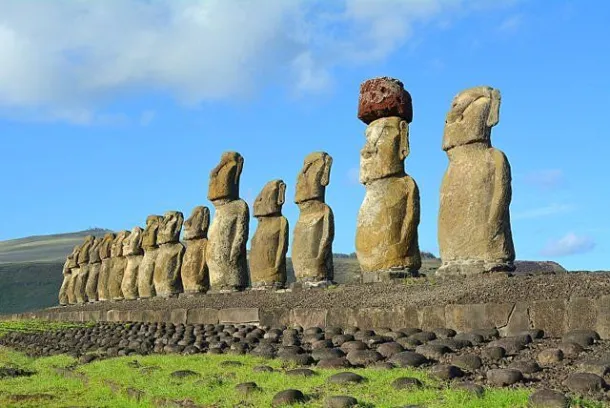
Sweeping along the dramatic, wave-battered southeastern coast of Rapa Nui (Easter Island), Ahu Tongariki represents the undisputed zenith of megalithic ceremonial architecture in Remote Oceania. Constructing this colossal platform between the 14th and 17th centuries CE, the eastern island clans engineered a monumental ancestral sanctuary that stands as the largest intact ahu ever raised in the Pacific. For centuries, the site stood as a tragic symbol of cultural collapse and environmental disaster; its original moai were toppled face-down during 18th-century tribal conflicts, and in 1960, a cataclysmic 9.5 magnitude earthquake off Chile triggered a massive tsunami that scattered the multi-ton statues hundreds of meters inland. The systematic, multi-national restoration of the site in the 1990s stands as a triumph of modern forensic archaeology, completely unmasking the advanced structural mechanics used by ancient Rapanui engineers.
Megalithic Infrastructure, Forensics, and Astronomical Engineering
The sheer scale of Ahu Tongariki requires a radical rethinking of precolonial Pacific labor organization. The main basalt-faced platform stretches over 100 meters in length and supports 15 towering moai, carved from the volcanic tuff of the nearby Rano Raraku quarry, with weights ranging from 30 to over 80 metric tons. Excavations during the restoration project uncovered the highly complex internal foundation engineering: the ancient masons laid a deep pavement of tightly packed vesicular basalt boulders over a leveled volcanic clay surface, creating a flexible, earthquake-resistant foundation capable of bearing the immense vertical load.
Archaeological analysis of the platform's facade revealed a sophisticated solar design. The main axis of Ahu Tongariki is engineered with highly precise astronomical intent, oriented exactly to face the rising sun during the summer solstice. During this celestial event, the 15 ancestors stood with their backs to the Pacific Ocean, casting immense, elongated shadows directly across the expansive, paved ceremonial plaza (marae) in front of them. This deliberate design physically and visually unified the ruling elite, the ancestral spirits, and the cosmic order at the exact moment the seasons turned.
Conclusion
The archaeological resurrection of Ahu Tongariki provides an irreplaceable baseline for understanding the limits of non-industrial human engineering. It proves that Rapanui society possessed an extraordinarily sophisticated command of structural logistics, geometry, and astronomical observation, allowing them to coordinate thousands of workers across generations. The massive platform and its 15 re-erected guardians stand as an enduring monument to indigenous resilience, showing that even after centuries of warfare and natural disasters, the material record of human genius remains written indelibly into the landscape.