Introduction
Deep within the dense, tropical rainforests of Hiva Oa in the Marquesas Islands (Te Henua 'Enana), the sacred ceremonial site of Lipona near Atuona preserves one of the most spectacular collections of monumental stone sculpture and rock art in all of East Polynesia. Flourishing around 1000 CE to 1300 CE, Lipona served as the spiritual and political heart of a wealthy chiefdom, defined by its massive stone platforms (me'ae) and towering anthropomorphic stone carvings known as tiki.
For a long time, early European travelogues treated these carvings as crude tribal idols; modern iconographic analysis and landscape archaeology have completely revised this perspective, revealing Lipona as a highly structured, sacred landscape where stone engineering was deployed to materialize divine ancestral power (mana) and solidify the line of ruling chiefs.
Megalithic Sculpture, Iconography, and Sacred Space
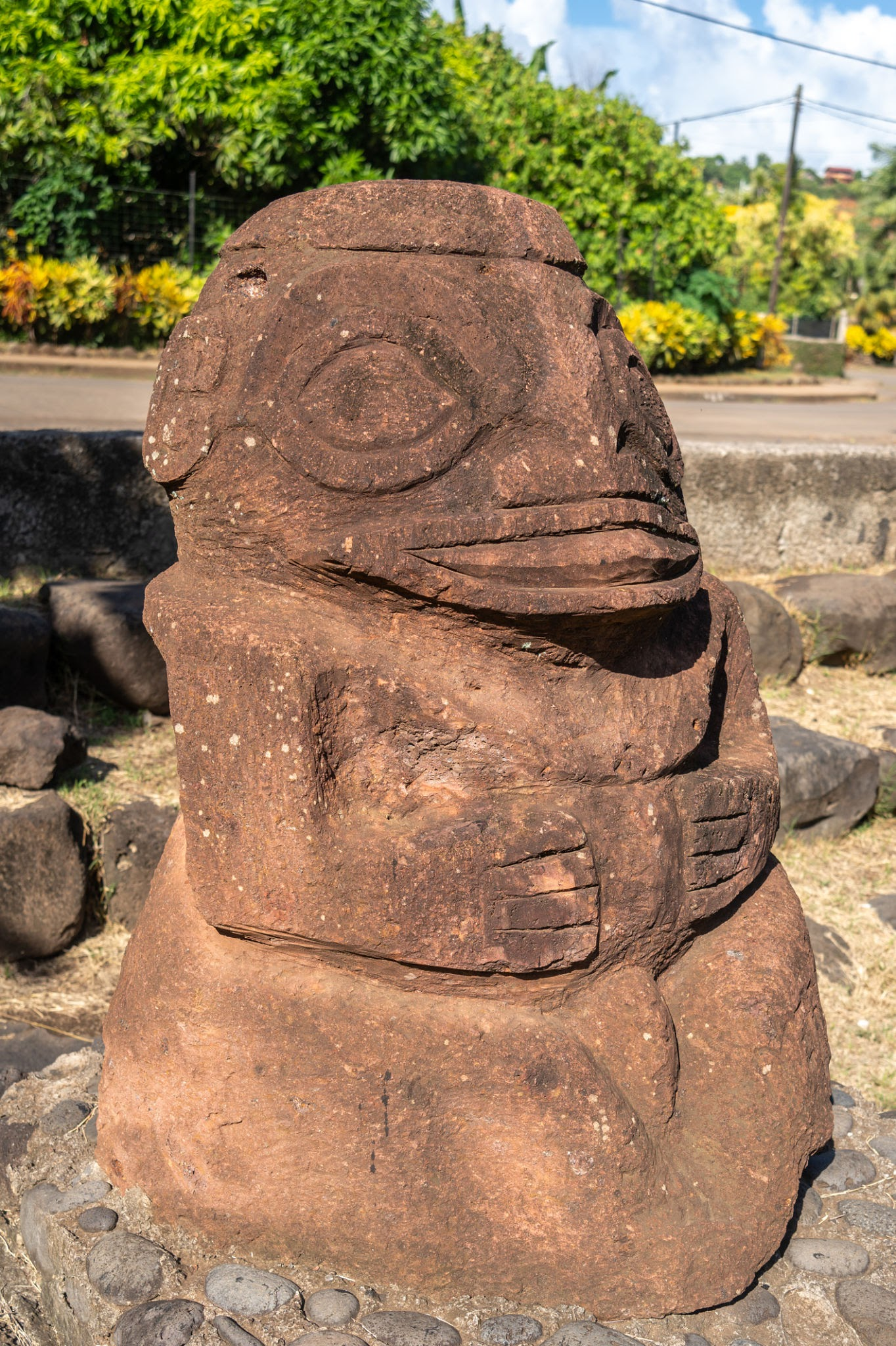
The architectural power of Lipona is centered around a massive, multi-tiered stone terrace constructed from huge blocks of unmortared basalt rock. Standing proudly upon these terraces are several larger-than-life tiki statues carved out of soft red volcanic tuff—a material chosen specifically for its sacred symbolic associations. The most famous statue, Takaii, stands over 2.5 meters tall and features an imposing posture with wide, deeply carved eyes, a broad mouth, and hands resting firmly on its stomach, representing a powerful deified ancestor or chief.
Excavations around the stone bases have revealed specialized offering pits containing polished pearl shell scrapers, bone ornaments, and deep caches of basalt adzes. Surrounding the statues, the flat faces of the natural rock formations are covered in hundreds of complex petroglyphs.
Iconographic mapping of these rock carvings has identified diverse motifs, including stylized turtles, stick-figure humans, concentric circles, and the rare moko (lizard) design, which served as a protective guardian symbol for the elite. The complex relationship between the towering statues, the stone terraces, and the surrounding petroglyphs demonstrates an advanced layout designed to direct the flow of sacred rituals, control access to elite spaces, and visually assert the divine authority of the chiefs over the island's population.
Conclusion
The systematic archaeological unmasking of the Hiva Oa petroglyphs and tiki structures provides an invaluable window into the complex religious and political systems of East Polynesia. It proves that Marquesan society possessed independent artistic and engineering traditions capable of transforming natural stone landscapes into highly structured centers of political and religious power.
The unique sculptural style and sacred spatial planning documented at Lipona demonstrate a highly resilient society with a profound artistic identity. Today, the enigmatic stone giants of Hiva Oa stand as an enduring monument to Polynesian.