Introduction
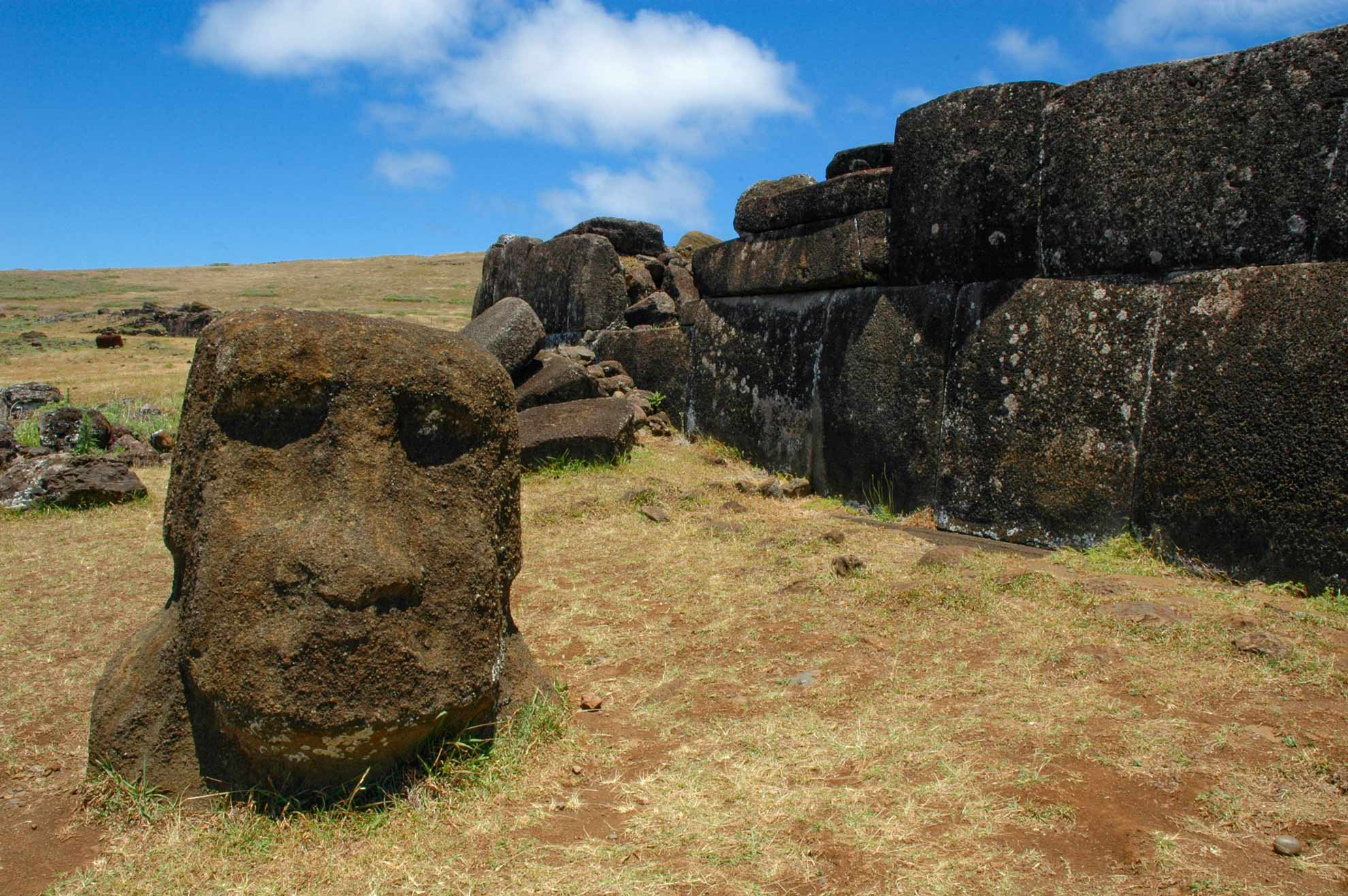
Located on the windswept southeastern coast of Rapa Nui, the archaeological complex of Vinapū preserves one of the most structurally unique and intensely debated examples of megalithic masonry in the entire Pacific. While the island is renowned for its iconic moai statues, Vinapū stands out because of the extraordinary architectural refinement of its stone platforms (ahu). The rear wall of Ahu Tahiri (Vinapū I) displays a level of precision-cut, interlocking stone fitting that is completely distinct from the standard masonry techniques utilized across the rest of the island.
For nearly a century, this striking visual parallel led diffusionist explorers to claim that the site was constructed by pre-Columbian architects from South America. Modern landscape archaeology, stratigraphy, and architectural forensics have thoroughly dismantled these colonial theories, unmasking Vinapū as a brilliant, fully indigenous evolution of Polynesian engineering that pushed stone-cutting technology to its absolute limit.
Architectural Forensics and the Trans-Pacific Debate
The exceptional engineering of Vinapū is centered on the facade of Ahu Tahiri. Unlike standard ahu platforms, which typically feature rough volcanic boulders or flat slabs filled with loose rubble, the rear wall of Ahu Tahiri is faced with massive, multi-ton basalt blocks that have been meticulously shaped, smoothed, and fitted together without mortar. The joints are so tight that a knife blade cannot be inserted between them. The corners of the blocks are precisely rounded, and the stones interlock along irregular, curvilinear lines—a technique that visually mirrors the imperial Inca masonry of the Peruvian Andes, such as the walls of Sacsayhuamán or Cusco.
This uncanny similarity was the cornerstone of Thor Heyerdahl’s Kon-Tiki theory, which argued that South American voyagers colonized the island and introduced megalithic engineering. However, systematic excavations and structural comparisons have revealed fundamental differences that prove independent indigenous development:
Internal Structural Engineering: Imperial Inca walls are solid throughout, relying on three-dimensional interlocking blocks to withstand seismic activity. In contrast, the Rapanui engineers utilized these precision-cut basalt blocks as a highly refined exterior veneer or facade. The massive blocks form a retaining wall designed to anchor a core composed of heavy, unshaped volcanic rubble and earth filler.
Chronological Mismatch: Radiocarbon dating of organic materials buried beneath the foundation layers places the initial construction phase of Vinapū around 700 to 800 CE, with the advanced masonry work completed by approximately 1200 CE. This timeline predates the rise of the classic imperial Inca masonry style in Peru by several centuries.
Tools and Material Procurement: Mineralogical testing confirms the blocks were quarried locally from nearby basalt outcroppings. The ancient masons relied entirely on heavy basalt picks (toki) and abrasive water-and-sand grinding techniques to smooth the faces, adapting traditional Polynesian woodworking adze techniques to the medium of hard volcanic stone.
Celestial Mechanics and the Red Column
Beyond its structural veneer, Vinapū was engineered as a sophisticated astronomical instrument. The front facade of the main platform is oriented with geographic precision, aligned to face the exact point of the horizon where the sun rises during the winter solstice. This architectural alignment unified the ancestral spirits represented by the moai with the annual solar cycle, regulating seasonal fishing bans (tapu) and agricultural planning.
Directly adjacent to the primary wall sits Ahu Vinapū II, which exhibits an older, less refined construction style. In front of this second platform stands a singular, highly eroded column carved from the red volcanic scoria of Puna Pau quarry. Discovered half-buried and re-erected during modern excavations, iconographic analysis suggests this rare monument is a female moai—originally carved with two distinct heads—which likely functioned as a sacred mortuary pillar used to support wooden scaffolding during traditional funerary rituals.
Conclusion
The meticulous unmasking of the Vinapū walls provides a profound lesson in the capacity for independent human innovation. It demonstrates that under similar environmental pressures and societal complexities, isolated human groups can independently develop strikingly similar engineering solutions. The seamless basalt walls of Vinapū stand as an enduring monument to Rapanui craftsmanship, proving that the ancient master builders possessed a mathematical and material sophistication that rivaled the greatest megalithic cultures of the ancient world.