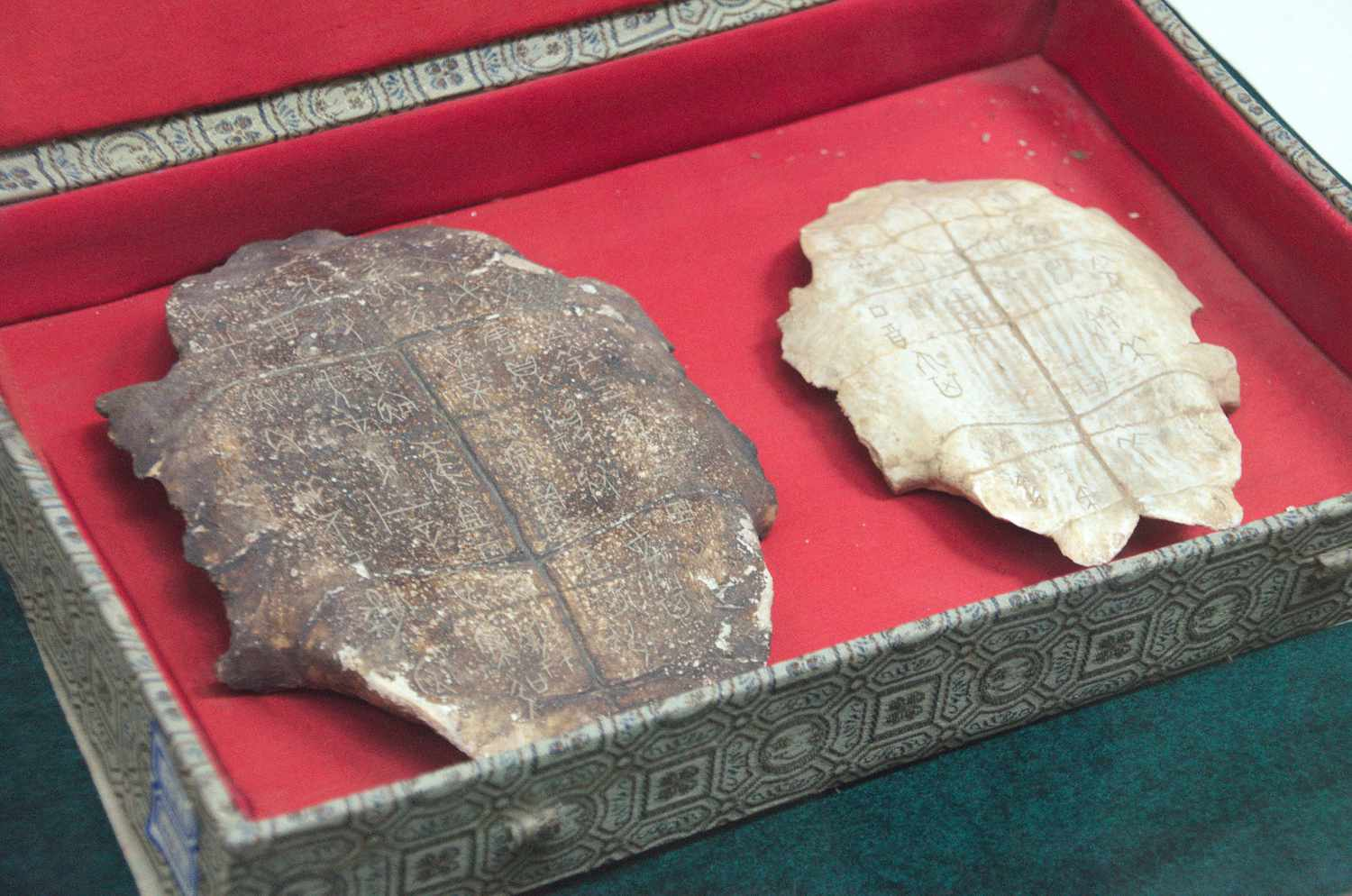
Oracle Bones (jiaguwen) represent the earliest systematic writing system in East Asia and are the direct ancestors of modern Chinese characters. Used primarily during the late Shang Dynasty (c. 1250–1046 BCE), these artifacts were not meant for public reading or literature, but for a high-stakes ritual of communication with the spirit world.
The discovery of these bones at the turn of the 20th century transformed our understanding of ancient Chinese history from legend into archaeological fact.
1. The Materials: Scapulae and Plastrons
The term "oracle bones" refers to the specific animal parts used in the divination process.
Ox Scapulae: The shoulder blades of oxen were favored for their flat, broad surfaces.
Turtle Plastrons: The flat underside of a turtle's shell was also used. Turtles were seen as sacred creatures that bridged the gap between the earthly and spiritual realms.
Preparation: Before use, the bones were cleaned and thinned. Small "pits" or hollows were bored into the back of the bone to prepare it for the heat of the ritual.
2. The Ritual: Pyromancy and "Cracking"
The process of seeking answers from ancestors was known as pyromancy—divination by fire.
The Heat: A red-hot metal rod or a glowing coal was pressed into the prepared pits on the back of the bone.
The Sound: The intense localized heat caused the bone to crack with a sharp "popping" sound. The Shang kings believed this sound was the voice of their ancestors.
Interpretation: The resulting cracks—often shaped like the character 卜 (bǔ, meaning "to divine")—were read by the King or a professional diviner to determine the ancestors' answer.
3. Anatomy of an Inscription
After the ritual was complete, a scribe would carve a record of the event directly into the bone. A complete inscription typically followed a four-part structure:
Preface: The date and the name of the diviner.
Charge: The specific question being asked (e.g., "Will it rain tomorrow?" or "Should we go to war with the Zhou?").
Prognostication: The King's interpretation of the cracks.
Verification: A later note recording what actually happened (e.g., "On the day gui-si, it did indeed rain").
4. The Script: From Pictographs to Logic
Oracle bone script is remarkably sophisticated, featuring over 4,000 unique characters, about 1,500 of which are understood today.
Pictographs: Many characters were literal drawings, such as 日 (sun), 月 (moon), and 人 (person).
Ideograms: Abstract concepts were expressed through logic. For example, the character for "bright" (míng) combined the signs for the sun and the moon.
Verticality: Because of the narrow shape of the bones, the characters were written in vertical columns from top to bottom, a tradition that defined Chinese writing for the next 3,000 years.
[Image showing the evolution of Chinese characters from Oracle Bone Script to modern Hanzi]
5. The Discovery: From "Dragon Bones" to History
For centuries, farmers in Anyang, Henan Province, unearthed these bones and sold them to traditional medicine shops as "Dragon Bones" to be ground into powder for treating wounds and malaria.
1899 Breakthrough: The scholar Wang Yirong reportedly noticed characters on the bones in his medicine and recognized them as ancient writing.
Anyang Excavations: Systematic archaeology at Yinxu (the "Waste of Yin") confirmed this site was the last capital of the Shang. The bones provided a list of kings that perfectly matched the "legendary" genealogies written by later historians like Sima Qian.
6. What the Bones Reveal
The oracle bones provide a "private" history of the Shang elite that was never meant for human eyes.
Royal Concerns: They cover everything from toothaches and the dreams of the Queen to the timing of harvests and the outcome of childbirth.
Human Sacrifice: The bones grimly record the sacrifice of war captives and servants to appease the ancestors.
The Ancestor Cult: They reveal a world where the living and dead were in constant negotiation, and where the King’s primary role was as a high priest maintaining the cosmic balance.
The oracle bones are more than just archaeological curiosities; they are the "DNA" of Chinese civilization. They prove that the fundamental structure of Chinese thought—honoring ancestors, the importance of the written word, and the search for cosmic order—was already firmly in place over three millennia ago.