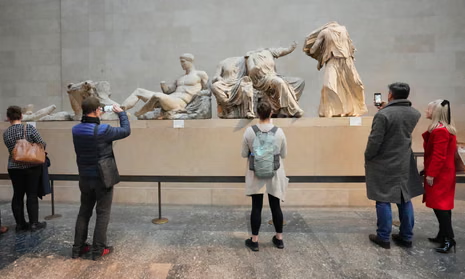
The debate over the Elgin Marbles (also known as the Parthenon Sculptures) is perhaps the most famous and enduring dispute in the world of cultural heritage. It involves a collection of Ancient Greek marble sculptures—metopes, pedimental figures, and a significant portion of the frieze—that once adorned the Parthenon on the Acropolis in Athens.
The journey of these marbles from the "Golden Age" of Pericles to the British Museum in London is a saga of war, diplomacy, and the shifting definitions of legal ownership.
1. The Creation: The High Classical Masterpiece
The sculptures were created between 447 and 432 BCE under the supervision of the master sculptor Phidias.
The Frieze: A 160-meter-long continuous relief depicting the Panathenaic Procession, a festival in honor of the goddess Athena.
The Metopes: High-relief panels showing the battle between the Centaurs and the Lapiths, symbolizing the triumph of civilization over barbarism.
The Pediments: Massive, three-dimensional figures occupying the triangular gables of the temple, depicting the birth of Athena and her contest with Poseidon.
2. Lord Elgin’s Intervention (1801–1812)
In the early 19th century, Thomas Bruce, the 7th Earl of Elgin, was serving as the British Ambassador to the Ottoman Empire, which had occupied Greece for centuries.
The Firman: Elgin claimed to have received an official decree (a firman) from the Ottoman authorities. The original document is lost, and the surviving Italian translation remains a point of intense legal contention.
The Removal: Between 1801 and 1812, Elgin’s agents sawed off and removed roughly half of the surviving sculptures from the Parthenon. The process was physically destructive, involving the hacking of marble blocks to reduce weight for transport.
The Shipwreck: During the journey to England, one of the ships carrying the marbles, the Mentor, sank in a storm. It took two years for divers to recover the sculptures from the seabed.
3. Sale to the British Museum (1816)
Lord Elgin originally intended to use the marbles to decorate his private estate in Scotland, but a costly divorce and mounting debts forced him to seek a buyer.
The Parliamentary Inquiry: In 1816, the British Parliament held a Select Committee to investigate the legality of Elgin’s acquisition. Despite some members expressing concern over the "vandalism" of the temple, the committee voted to purchase the collection for £35,000 (roughly half of what Elgin had spent to acquire them).
The Handover: The sculptures were transferred to the British Museum, where they have remained on public display for over 200 years.
4. The Greek Argument: Restitution and Context
Greece has officially requested the return of the sculptures since its independence in the 1830s, but the campaign gained global momentum in the 1980s under Culture Minister Melina Mercouri.
Unity of the Monument: Greece argues that the sculptures are not independent artworks but integral architectural components of the Parthenon. They contend that the collection is currently "mutilated," with half in Athens and half in London.
Legal Validity: Greek authorities argue that the Ottoman Empire was an occupying force and had no moral or legal right to grant permission for the removal of Greece's national heritage.
The Acropolis Museum: For years, a common counter-argument was that Athens lacked a suitable place to house the marbles. The opening of the state-of-the-art Acropolis Museum in 2009—which features a dedicated "Parthenon Gallery" with views of the temple—removed this hurdle.
5. The British Museum’s Defense: Preservation and Accessibility
The British Museum has consistently maintained its right to keep the sculptures, citing several key philosophies.
Legal Title: The Museum asserts that the 1816 Act of Parliament granted them legal ownership and that Elgin acted within the laws of the time.
The "Universal Museum": They argue that in London, the marbles can be seen for free by millions of global visitors in the context of other world civilizations (Egypt, Assyria, Rome), providing a "world history" perspective.
Rescue Mission: Some proponents of the Museum's position argue that if Elgin had not removed them, the sculptures might have been destroyed by later conflict or environmental pollution in 19th-century Athens.
6. Modern Diplomacy: A "Parthenon Partnership"?
In recent years, the tone of the debate has shifted from rigid refusal to potential compromise.
Digital Replication: Advances in 3D scanning and robotic carving have raised the possibility of creating perfect "robotic" replicas for the British Museum, allowing the originals to return to Athens.
Cultural Exchange: Discussions have emerged regarding a "loan" or "partnership" where the marbles would return to Greece in exchange for other rare Greek artifacts being sent to London for temporary exhibition.
The Elgin Marbles represent the ultimate case study in cultural property law. They raise a fundamental question: does a masterpiece belong to the soil on which it was created, or to the institution that preserved it for two centuries?
Since the sculptures were physically part of the building's architecture rather than standalone statues, do you think returning them is a matter of correcting a historical theft, or would it set a "slippery slope" precedent that might empty the world's great universal museums?