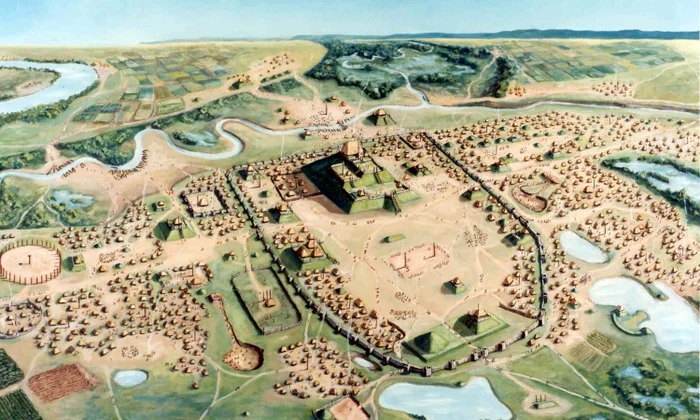
The Cahokia Mounds in modern-day Illinois represent the largest and most influential urban center of the Mississippian culture. At its peak around 1050–1150 CE, Cahokia was larger than London was at the same time, housing an estimated population of 10,000 to 20,000 people.
It was a city of monumental earthen architecture, sophisticated astronomical alignments, and a complex social hierarchy that dominated the American Bottom floodplain for centuries.
1. Monks Mound: The Heart of the City
The centerpiece of Cahokia is Monks Mound, a massive four-tiered platform that remains the largest prehistoric earthwork in the Americas north of Mexico.
Scale: It stands 100 feet (30 meters) high and covers 14 acres at its base—roughly the same footprint as the Great Pyramid of Giza.
Construction: It was built entirely by hand, using baskets to transport an estimated 22 million cubic feet of earth and clay.
The Summit: A massive wooden building once stood at the top, likely the residence of the "Great Sun," the city’s supreme ruler, allowing him to be physically and symbolically closer to the heavens than the commoners below.
2. Woodhenge: The Solar Calendar
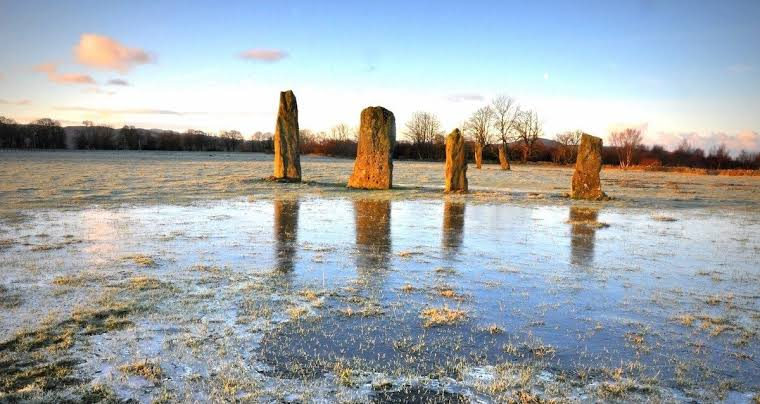
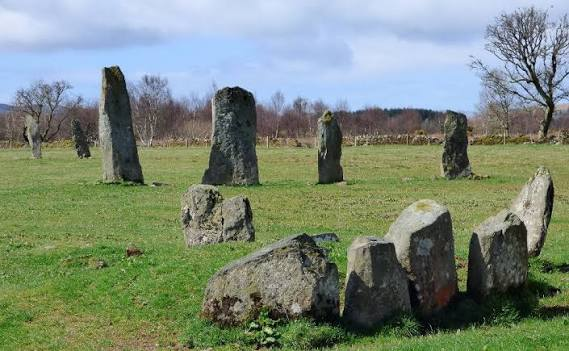
Just west of Monks Mound, archaeologists discovered a series of large post-holes arranged in a circle, which they dubbed "Woodhenge."
The Calendar: By standing at a central observation post, the Cahokians could track the rising sun. The posts align perfectly with the summer and winter solstices, as well as the spring and fall equinoxes.
Agricultural Vitality: This was not just for ritual; it was a critical tool for a society dependent on maize (corn). Knowing exactly when to plant and harvest was the key to sustaining such a massive urban population.
3. Social Stratification and Mound 72
Cahokia was a highly stratified society, and nowhere is this more evident than in Mound 72, a small ridge-top mound that served as a specialized burial site.
The "Beaded Burial": Excavations revealed a man in his 40s laid on a bed of 20,000 marine-shell beads arranged in the shape of a falcon (the "Birdman"), a recurring motif in Mississippian art.
Sacrifice: Surrounding the central figure were the remains of over 250 other people. Many appear to have been ritual sacrifices, including groups of young women and men, suggesting that Cahokia’s rulers possessed the power of life and death over their subjects.
4. The Grand Plaza and Urban Design
The city was meticulously planned around a 50-acre Grand Plaza, a massive leveled space used for public ceremonies, markets, and the popular game of Chunkey.
Chunkey: Players would throw spears at a rolling stone disk. Archaeologists have found these disks (called "discoids") across the Mississippian world, suggesting that Cahokia exported its culture and games to distant tribes.
The Palisade: Around 1175 CE, the central ceremonial district was enclosed by a massive wooden wall (palisade) with defensive bastions. This suggests that despite its power, the city began to face external threats or internal social unrest.
5. The "Big Bang" and Rapid Decline
Cahokia’s rise was a "Big Bang"—a sudden explosion of population and construction. Its decline, however, was a slow "fizzle" that began around 1250 CE.
Environmental Stress: Intensive farming and the clearing of forests for construction likely led to massive deforestation and soil erosion. This may have caused catastrophic flooding in the American Bottom.
The "Waste" Problem: Sustaining 20,000 people in a compact area without modern sanitation likely led to the spread of disease and contaminated water supplies.
Social Fracture: As resources dwindled, the centralized religious and political authority likely broke down, leading the population to abandon the city in favor of smaller, more sustainable villages.
6. Archaeology: Rediscovering the Metropolis
For a long time, early European settlers refused to believe that Indigenous Americans were capable of building such structures, often attributing them to "lost civilizations."
Modern Mapping: Today, LiDAR (Light Detection and Ranging) allows archaeologists to "see" through the vegetation and modern development, revealing hundreds of smaller mounds and residential districts that were previously invisible.
The Threat of Development: While the core of Cahokia is a State Historic Site, many outlying mounds were destroyed in the 20th century to build highways and housing for the St. Louis metropolitan area.
Cahokia reminds us that North America was home to thriving, complex urban centers long before European contact. It was a city built on corn, copper, and a deep connection to the cycles of the sun.