Zhang Heng’s seismoscope, invented in 132 AD during the Han Dynasty, was the world’s first instrument capable of detecting distant earthquakes. Known as the Houfeng Didong Yi (an "instrument for measuring the seasonal winds and the movements of the Earth"), it was a masterpiece of "Old Style" Chinese bronze-casting and mechanical engineering that operated centuries before similar technology appeared in the West.
1. The External Design: Dragons and Toads
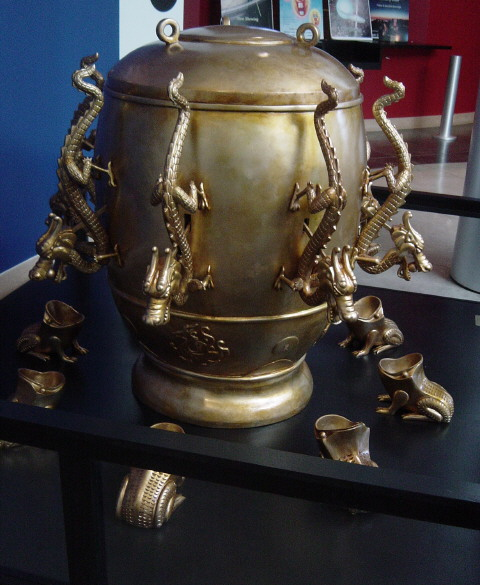
The device was a large bronze vessel, roughly six feet in diameter, resembling a wine jar or an ornate urn.
The Eight Dragons: Attached to the outside of the vessel were eight dragon heads, each facing a primary compass direction (North, South, East, West, NE, NW, SE, SW). Each dragon held a small bronze ball in its mouth.
The Eight Toads: Squatting at the base of the vessel, directly beneath each dragon, were eight bronze toads with their mouths wide open, waiting to catch the balls.
2. The Internal Mechanism: The Inverted Pendulum
The secret to the seismoscope lay inside the bronze casing, hidden from view. Zhang Heng utilized a high-sensitivity inverted pendulum system.
The Central Pillar (Du): A heavy copper pillar was suspended or balanced vertically in the center of the jar.
The Trigger: Because it was an inverted pendulum, even a slight tremor from a distant earthquake—too faint for humans to feel—would cause the pillar to tilt.
The Crank System: As the pillar tilted toward the direction of the seismic waves, it would hit a series of levers and "tooth-and-gear" mechanisms connected to the dragon on that side of the vessel.
3. The Signal: The "Clang" of the Ball
When the internal pillar struck the trigger, the dragon’s mouth would open, releasing the bronze ball.
The Sound: The ball would fall into the open mouth of the bronze toad below, creating a loud "clang" that alerted the imperial court.
Directional Detection: By observing which toad held the ball, the Han officials knew the direction from which the earthquake waves had originated, allowing them to send relief and messengers to that specific province immediately.
4. The Famous Test of 138 AD
Initially, many court officials were skeptical of the "Old Style" invention, especially when it was triggered one day despite no one in the capital of Luoyang feeling a tremor.
The Result: A few days later, a messenger arrived from the west (Longxi province) reporting that a major earthquake had occurred at the exact moment the dragon had dropped its ball.
The Validation: This event proved that the device was not a toy but a functional scientific instrument capable of sensing "the movement of the Earth" from hundreds of miles away.
5. Philosophical Context: Resonance and "Qi"
The invention was rooted in the Chinese philosophy of Ganying (resonance).
Earthly Harmony: Zhang Heng believed that the Earth was a living system and that vibrations in one area would create a sympathetic response in another.
Scientific Observation: While the explanation was philosophical, the execution was purely mechanical, showcasing a sophisticated understanding of inertia and kinetic energy.
6. The Modern Reconstruction
The original seismoscope was lost over time, but its design was preserved in historical records like the Book of the Later Han.
Modern Replicas: In 2005, a team of Chinese seismologists and mechanical engineers successfully built a working replica. They discovered that by using the "suspended pendulum" model described in the ancient texts, the device could accurately detect four different simulated earthquakes with the same precision as modern sensors.
Legacy: Zhang Heng’s invention remains a symbol of the Han Dynasty's "Golden Age" of science, proving that the ancient world possessed the tools to monitor the hidden forces of the natural world.