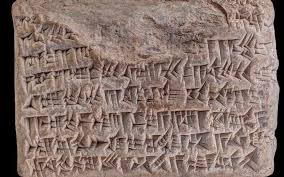
Cuneiform is not a language, but a revolutionary writing system developed by the Sumerians in Mesopotamia (modern-day Iraq) around 3200 BCE. It began as simple pictures used for accounting and evolved into a complex script capable of recording the world’s first epic poetry, legal codes, and scientific observations.
Reading these tablets today is a painstaking process of "3D linguistics" that involves physical archaeology, computer imaging, and an intimate knowledge of dead languages.
1. The Mechanics of the Script: Wedges in Clay
The name "cuneiform" comes from the Latin cuneus, meaning "wedge." This describes the shape made by the writing tool.
The Stylus: Scribes used a sharpened reed with a triangular tip. By pressing it into damp clay, they could create a variety of wedge shapes.
The Orientation: Initially, the script was written in vertical columns from top to bottom, but it later rotated 90 degrees to be read from left to right in horizontal rows.
The Complexity: Cuneiform is polyvalent, meaning a single sign could represent a whole word (logogram), a syllable (phonetic value), or even act as a "determinative" (a silent sign that tells you the category of the following word, like "god" or "wooden object").
2. The "Rosetta Stone" of the East: The Behistun Inscription
Cuneiform was used for over 3,000 years, but by the time of the Roman Empire, it was completely forgotten. It wasn't until the 19th century that it was decoded.
The Inscription: High on a cliff in modern-day Iran, the Persian King Darius the Great carved a massive monument. It featured the same text in three different cuneiform languages: Old Persian, Elamite, and Babylonian.
The Breakthrough: Sir Henry Rawlinson scaled the cliff to copy the text. By first decoding the simpler Old Persian (which had fewer signs), he was able to "unlock" the much more complex Babylonian script, opening the door to the entire history of the Ancient Near East.
3. How Experts Read Tablets Today
Reading a 5,000-year-old tablet is nothing like reading a printed book. It requires a combination of physical and digital skills.
Lighting is Everything: Because the signs are three-dimensional impressions, the direction of light is critical. Epigraphists (people who study inscriptions) traditionally use a single light source from the top-left corner to cast the shadows necessary to see the wedges clearly.
Autography: Even with high-res photos, scholars often create a hand-drawn "facsimile" or "autograph" of the tablet. Drawing each wedge helps the reader understand the "ductus" (the hand movement) of the original scribe.
Joining the Fragments: Most tablets are found as broken shards. Scholars spend years looking through museum drawers to find "joins"—shards that physically fit together to complete a missing sentence or story.
4. Digital Archaeology: The 3D Revolution
The biggest leap in reading cuneiform today comes from computational imaging.
Reflectance Transformation Imaging (RTI): This technology takes dozens of photos of a tablet from different angles. It creates a digital file where the user can move a "virtual light source" across the surface of the tablet, revealing signs that are invisible to the naked eye.
AI and OCR: Machine learning is now being used to recognize patterns in the wedges. The Cuneiform Digital Library Initiative (CDLI) and various AI projects are working to create "Optical Character Recognition" for cuneiform to help catalog the hundreds of thousands of untranslated tablets currently in museum storage.
5. What the Tablets Tell Us
The vast majority of cuneiform tablets are not "The Epic of Gilgamesh"; they are the mundane records of everyday life.
The Mundane: Receipts for beer, lists of sheep, and complaints about poor-quality copper (such as the famous Complaint Tablet to Ea-nasir).
The Scientific: Detailed observations of the planet Venus, medical prescriptions involving beer and herbs, and complex mathematical tables using a base-60 system (which is why we still have 60 seconds in a minute).
The Personal: Letters between long-distance merchants and their wives, discussing business deals and family drama.
Reading cuneiform is the closest thing we have to a time machine. It allows us to hear the voices of individuals who lived 5,000 years ago, complaining about their bosses, praying to their gods, and recording the first chapters of human history.