The Nile’s Rhythmic Gift
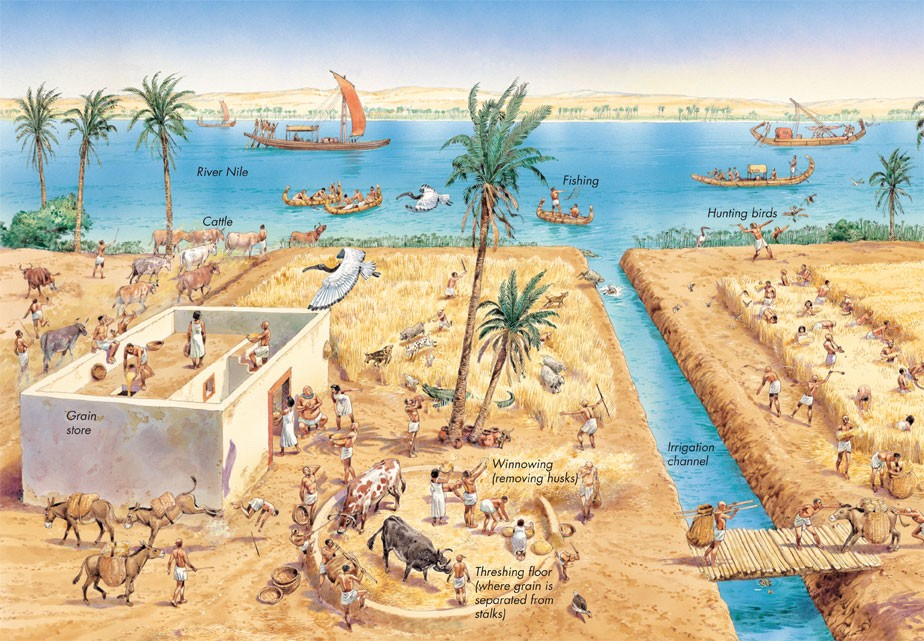
The civilization of Ancient Egypt was not merely "gifted" by the Nile; it was governed by it. Unlike the unpredictable and often destructive flooding of the Mesopotamian rivers, the Nile’s annual inundation—the Akhet—was remarkably consistent. Beginning in mid-summer, the river would crest, depositing a thick, nutrient-rich layer of black silt across the valley floor. This was the foundation of Egyptian survival, turning an otherwise arid desert into one of the most productive agricultural landscapes in the ancient world.
The agricultural year was divided into three distinct seasons based on this cycle:
Akhet (Inundation): The flood season, during which fields were submerged, and farmers often took on state projects or maintenance.
Peret (Emergence/Growth): The waters receded, leaving behind the fertile silt. Farmers plowed and sowed seeds in the damp earth.
Shemu (Harvest/Drought): The final season when crops were harvested and the heat intensified, leading to the low-water period.
The Shaduf: Engineering the Landscape
While the flood provided the soil, it could not reach the higher terraces or sustain crops during the long, arid months of Shemu. To overcome this, Egyptian farmers mastered the use of the shaduf—a simple yet brilliant mechanical device that revolutionized irrigation.
The shaduf consisted of a long, pivoting pole balanced on a vertical support. At one end, a bucket (often made of leather or pottery) was attached to a rope; at the other, a heavy counterweight (usually a large lump of dried mud or stone) was secured.
How the Shaduf Transformed Production:
Vertical Efficiency: By using the counterweight, a single farmer could lift significant volumes of water from a canal or the riverbank and pour it into elevated irrigation channels or onto high-lying gardens with minimal physical exertion.
Garden Expansion: Before the shaduf, irrigation was limited to the areas naturally reached by the flood. With this device, farmers could cultivate "high ground" crops, allowing for the year-round production of vegetables, herbs, and fruit trees, even when the river level was at its lowest.
Water Management: The device allowed for the fine-tuning of water distribution. Farmers could systematically fill a network of small, interconnected trenches, ensuring that water reached specific plots of land precisely when the crops needed it most.
Agricultural Resilience
The combination of the predictable flood and the manual efficiency of the shaduf allowed Egypt to generate massive agricultural surpluses. This surplus was the backbone of the state: it supported the pharaoh’s bureaucracy, fed the skilled laborers who built the pyramids, and provided the wealth required for extensive trade.
By treating the Nile not just as a water source, but as a dynamic system to be managed and engineered, the Egyptians turned a harsh, desert environment into a sustainable agricultural machine that remained stable for over 3,000 years.