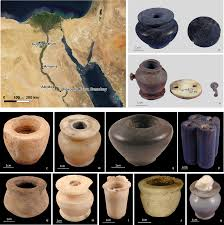
Ancient Egyptian Cosmetics: The Chemical Analysis of Kohl and Galena
The ancient Egyptians are well-known for their use of cosmetics, with eye makeup being one of the most iconic and recognizable elements of their culture. While makeup was used for aesthetic purposes, recent scientific and chemical analyses have revealed a sophisticated understanding of mineral chemistry and medicinal applications.
1. The Chemical Composition of Kohl
The dark eye paint known as kohl (referred to by ancient Egyptians as mesdemet) was not made from a single substance, but varied based on region, era, and the user's social status. Chemical analyses of remaining samples found in tombs and museums, such as those at the Louvre, have shown that its primary ingredients were complex minerals and compounds:
Galena ($\text{PbS}$): The most common mineral used for black kohl. It is a dense, metallic ore of lead and silver with a distinct dark gray, lustrous appearance.
Malachite ($\text{Cu}_2\text{CO}_3(\text{OH})_2$): Used predominantly in the earlier periods for green eye paint, known as udju.
Synthetic Lead Salts: Analyses have revealed the presence of laurionite ($\text{PbCl(OH)}$) and phosgenite ($\text{Pb}_2\text{Cl}_2\text{CO}_3$). These minerals are exceedingly rare in nature, leading scientists to conclude that the Egyptians synthesized them deliberately through a wet chemical process that required up to a month of preparation.
Other Additives: Trace materials found in samples include black oxide of copper, antimony, and organic binders such as plant resins, fats, and oils.
2. The Chemistry and Benefits of Kohl
For decades, the presence of heavy metals in ancient Egyptian cosmetics raised concerns about lead poisoning. However, recent scientific studies provide a clearer perspective on the chemistry of these formulations:
Nitric Oxide Production: Studies by researchers analyzed the effect of trace amounts of galena on human skin cells. They found that the lead salts in kohl cause the skin cells to release nitric oxide ($\text{NO}$), which triggers the immune system and increases the flow of immune cells to the eyelids, defending against bacterial eye infections.
UV Absorption: The dark pigment of galena naturally absorbs ultraviolet light, reducing the harsh glare of the desert sun and protecting the delicate skin around the eyes.
Antibacterial Properties: The lead-based compounds exhibit a weak antimicrobial effect, which helped prevent infections from bacteria common in the standing waters of the Nile during the annual floods.
3. Preparation and Cultural Significance
To make the cosmetic, the raw minerals were ground on stone palettes using pestles and rubbing stones. The resulting fine powder was then mixed with various binding agents:
Animal Fats and Plant Oils: Used to create a smooth, workable paste that adhered to the eyelids and could be applied above and below the eye.
Soot: Less wealthy citizens used soot and plant-derived ash (from almonds, frankincense, or date seeds) as an alternative to the expensive, high-quality galena.
Significance: The application of kohl was a daily ritual for both men and women. It held both practical utility and religious importance, as the makeup was associated with the protection of the god Horus.