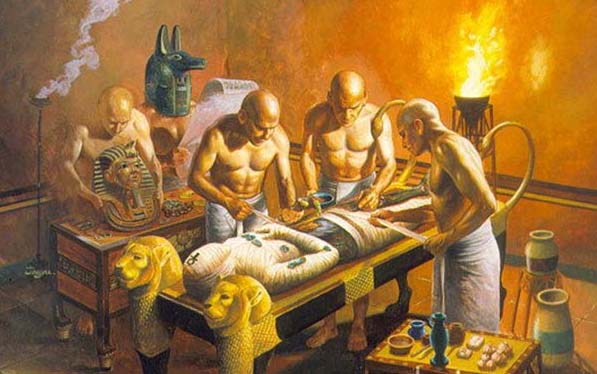
When we talk about mummification, we usually focus on the outer body shell. But from a biological perspective, keeping the torso intact was actually the easy part. The real challenge lay in preserving the internal viscera—the lungs, liver, stomach, and intestines. Because of their high water content and dense populations of digestive bacteria, these organs are the absolute ground zero for rapid autolysis (self-digestion) and putrefaction.
To circumvent this, Egyptian embalmers engineered a parallel chemical track to immortalize the organs separately.
1. The Chemistry of Visceral Extraction
During the initial phase of mummification, a specialist known as the parasachistes (cutter) used a razor-sharp blade of black obsidian to make a small, precise incision in the left lower abdomen. This choice of material wasn't purely ritualistic; volcanic glass can be fractured down to an edge only a few molecules thick, creating cleaner incisions that minimized tissue tearing compared to the copper or bronze knives of the era.
Once extracted, the organs were subjected to a rigorous protocol:
The Palm Wine Flush: The organs were thoroughly washed with palm wine, which typically had an alcohol content of 12% to 15%. This served as an effective disinfectant, denaturing bacterial proteins on contact.
The Infusion of Aromatics: Crushed spices—principally myrrh, cassia, and galbanum—were rubbed into the tissues. These plants contain high concentrations of volatile essential oils (like eugenol and cinnamic aldehyde) which possess potent broad-spectrum antimicrobial properties.
2. The Canopic System: Segregation of Decay
The Egyptians realized that different organs decayed at vastly different rates due to their unique biochemical environments. Rather than keeping them together, they segregated them into four distinct containers, known today as canopic jars.
Each jar was placed under the spiritual protection of one of the Four Sons of Horus, but practically speaking, each jar housed a unique microbiological environment:
Jar Deity & FormAssociated OrganThe Specific Preservation Challenge
Imsety
(Human-headed)
LiverHigh Lipid/Blood Mass: The liver is highly vascularized and rich in glycogen and fatty acids. It required prolonged immersion in dry natron to saponify the fats (turning lipids into stable, soap-like compounds) and prevent rancidity.
Hapy
(Baboon-headed)
LungsAir-Pocket Moisture: The spongy, cellular matrix of the lungs holds trapped air and moisture. Embalmers had to compress and pack the tissue tightly with natron packets to collapse the alveoli and draw out lingering water.
Duamutef
(Jackal-headed)
StomachAcidic Enzymes: The stomach contains residual hydrochloric acid and digestive enzymes like pepsin, which actively digest tissue even after death. The highly alkaline natron ($ \text{pH} \approx 9\text{–}10 $) was vital here to completely neutralize these acidic threats.
Qebehsenuef
(Falcon-headed)
IntestinesMicrobiome Ground Zero: The human gut houses trillions of anaerobic bacteria (E. coli, Clostridium). Without instant evacuation, purging, and chemical dehydration, these microbes would cause explosive gas buildup and tissue liquidation within 48 hours.
3. The One Exception: Why the Heart Remained Inside
While the lungs, liver, stomach, and intestines were ruthlessly hollowed out, the heart was almost always left untouched inside the thoracic cavity.
This was a strict biological command driven by theological necessity. The Egyptians believed the heart (Ib) was the seat of human intelligence, emotion, and memory—not the brain, which they dismissed as a useless organ and discarded.
[ THE HALL OF MA'AT ] ──► Heart placed on scales ──► Weighed against the Feather of Truth ──► Entry to afterlife
If the heart was removed or destroyed by the embalmers, the deceased would lose their cosmic "hard drive" of memories, making it impossible to answer the riddles of the underworld or pass the ultimate test of the soul. Chemically, leaving the heart inside was risky because it is a thick, muscular organ prone to anaerobic decay. To protect it without removal, embalmers poured hot, liquid resin formulations directly down the throat or through the thoracic incision, encasing the heart in situ within a sterile, rock-hard polymer block.
4. The Evolution to "Visceral Packets"
By the 21st Dynasty (c. 1070–945 BCE), Egyptian embalming chemistry hit its absolute peak of technical confidence. Embalmers grew so adept at preservation that they actually abandoned the use of canopic jars for a few centuries.
Instead, they extracted the organs, dehydrated them in natron for 40 days, coated them in molten wax and resin, wrapped them neatly in individual linen bundles, and stuffed them right back inside the empty body cavity.
To maintain the spiritual protections, they simply tucked a small wax or clay amulet of the corresponding Son of Horus inside each wrapped organ packet before sewing the incision closed. This transformed the mummy into a self-contained, fully integrated, chemically inert vessel an immortal biological time capsule that required no external jars to survive the ages.