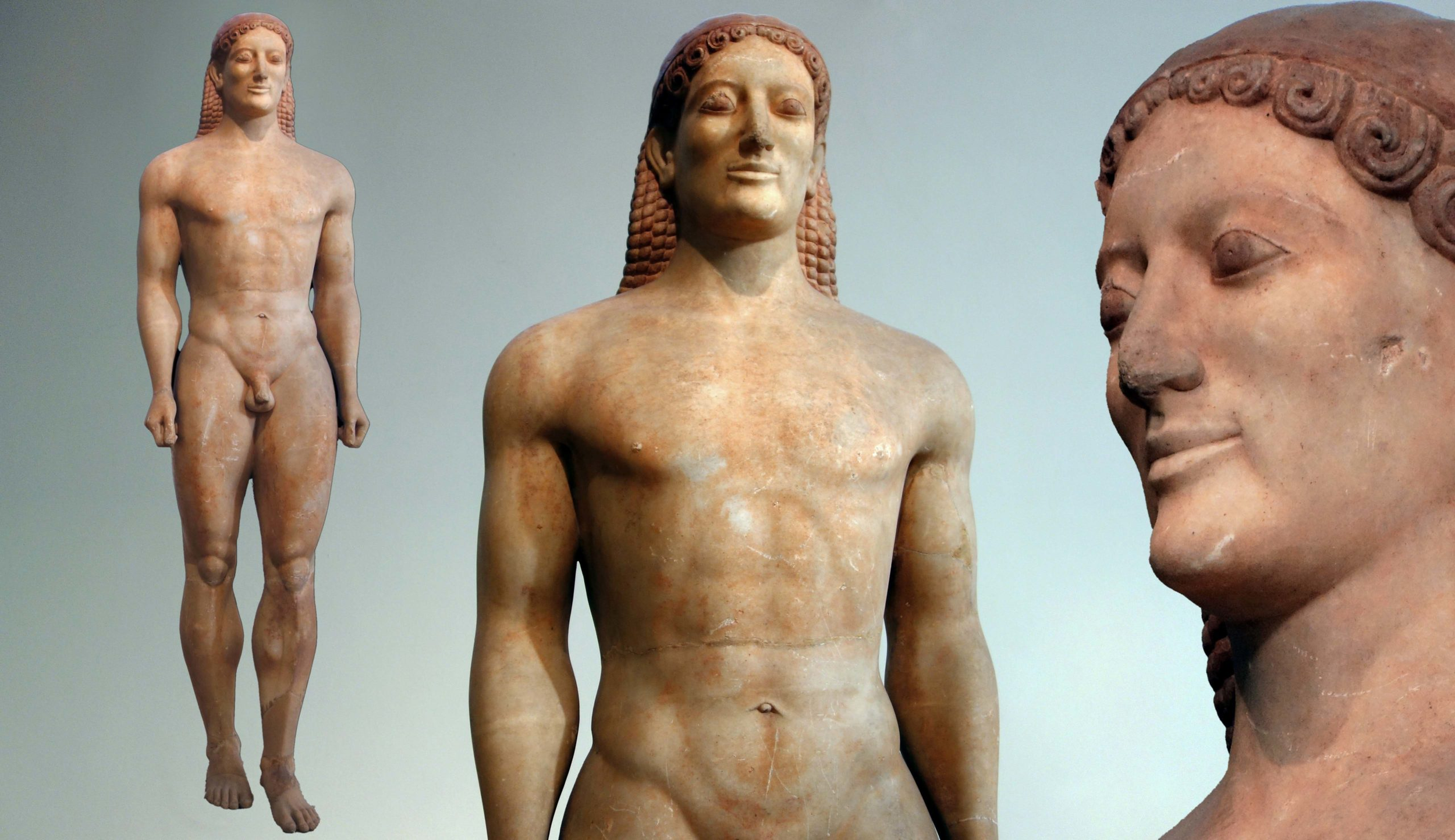
For generations, ancient Greek sculptors locked their subjects in stone. During the Archaic period (approx. 600–480 BCE), monumental statues of young men, known as kouroi (singular: kouros), were defined by an intense, block-like stiffness. Though they represented a massive leap forward in large-scale stone carving, they were fundamentally rigid formulas borrowed directly from Egyptian monumental art.
Then, in the early 5th century BCE, a sudden, radical shift occurred. The cold geometry of the Archaic style dissolved, giving way to an organic fluidity that made marble look like living, breathing tissue. This transition from the Kouros to the Classical style remains one of the most astonishing revolutions in art history—a visual reflection of Greece's shifting political, philosophical, and social worldview.
1. The Archaic Blueprint: Anatomy of the Kouros
To understand the revolution, one must first look at the traditional kouros. Typically carved as grave markers or offerings to the gods, these freestanding nudes followed strict, mathematical workshops rules:
Frontal Symmetries: The figures look directly forward. If you were to draw a vertical line down the center of an Archaic forehead, it would perfectly bisect the nose, the sternum, the navel, and the groin.
The Conceptual Walk: A kouros almost always advances its left foot. Yet, despite this forward step, both feet remain completely flat on the ground. There is no shifting of weight, no movement in the hips, and no bend in the knees. The illusion of motion is entirely artificial.
The Archaic Smile: Regardless of whether the statue marked a tragic death in battle or honored a god, its face wore a strange, closed-lip smile. This "Archaic smile" was not a psychological expression of happiness; it was a technical trick used by sculptors to give a flat, blocky face an artificial sense of three-dimensional life and animation.
2. The Turning Point: The Kritios Boy (c. 480 BCE)
The rigid paradigm shattered right around the time of the Persian Wars. The watershed moment is perfectly preserved in a single, fragmentary marble statue discovered on the Athenian Acropolis: The Kritios Boy.
At first glance, he looks similar to his Archaic ancestors, but looking closely reveals that the Kritios Boy is doing something no kouros had ever accomplished: he is naturally relaxing.
The sculptor (often attributed to Kritios) recognized that when a living human being stands, they do not distribute their weight equally across both limbs. Instead, they shift their weight onto one side. This discovery introduced the world to contrapposto (counter-pose)—the foundational structural dynamic of Western classical sculpture.
                  ┌────────────────────────────────────────┐
                  │          THE CONTRAPPOSTO LOOP         │
                  └───────────────────┬────────────────────┘
                                      │
         ┌────────────────────────────┴────────────────────────────┐
         ▼                                                         ▼
   [ ENGAGED SIDE ]                                         [ RELAXED SIDE ]
   • One leg bears the full weight.                         • The opposite knee bends freely.
   • The hip drops down and back.                           • The hip tilts upward.
         │                                                         │
         ▼                                                         ▼
    Spine curves into an organic 'S-shape'.          Shoulders shift to counter balance the hips.
The moment the hips tilted, the entire spine was forced to curve naturally. The shoulders shifted to counter-balance the hips, the head turned slightly to the side, and the rigid symmetry of the Archaic period vanished. The Kritios Boy looks as though he caught the viewer's eye and is about to take an actual step.
3. Comparing the Evolution: Archaic vs. Classical Style
The transition was not just about leg placement; it completely overhauled how artists treated facial psychology, anatomy, and bronze-casting technology.
FeatureArchaic Kouros (600–480 BCE)Early/High Classical (480–400 BCE)Weight DistributionStatic; weight split 50/50 on two rigid legs.Dynamic contrapposto; weight shifts to a single dominant leg.Anatomy TreatmentLinear; abdominal muscles are carved as abstract geometric lines.Volumetric; skin and muscle tissue swell and react naturally to gravity.Facial ExpressionThe stylized "Archaic Smile"; unblinking wide eyes.The Severe Style; calm, blank, idealized facial expressions.Primary MediumPrimarily marble blocks carved from the outside in.Cast bronze, allowing for expansive, free-reaching limbs.
4. The Severe Style and the Quest for the Ideal
As the Archaic smile disappeared, it was replaced by a calm, somber, almost melancholic expression known as the Severe Style. This change was deeply political. Following their unexpected victory over the Persian Empire, the Greeks—and the Athenians in particular—reengineered their civic identity.
[ PERSIAN DEFEAT ] ───► New Cultural Focus: Reason & Order ───► Sculptural Ideal: Emotional Restraint
They came to prize self-mastery, logic, and emotional restraint (sophrosyne) over raw emotion. A classical warrior or athlete was never depicted screaming in agony or gloating in victory; their faces remained entirely serene, demonstrating the ultimate triumph of human reason over chaotic passion.
Later, high classical sculptors like Polykleitos codified this obsession with cosmic order into physical form. In his treatise, the Canon, Polykleitos used advanced mathematical ratios to dictate the perfect human physique—arguing that true beauty was a byproduct of perfect symmetry ($ \sigma v \mu \mu \epsilon \tau \rho \iota \alpha $), where every single module of the body (a finger, a palm, a forearm) was perfectly proportional to the whole.
Through this transition, the Greeks transformed sculpture from a craft of stiff, symbolic representation into an investigation of nature itself—capturing the delicate, fleeting balance between physical motion and psychological rest.