Music was deeply woven into the fabric of ancient Egyptian life, present in everything from royal banquets and military processions to temple rituals and the daily labor of farmers. Because the Egyptians did not have a system of musical notation, we cannot know exactly what their music sounded like. Instead, our understanding comes entirely from the archaeological record: surviving instruments, tomb paintings, and hieroglyphic texts.
Based on these artifacts, we know their ensembles relied heavily on three distinct families of instruments: strings, winds, and percussion.
The Harp: The Backbone of the Ensemble
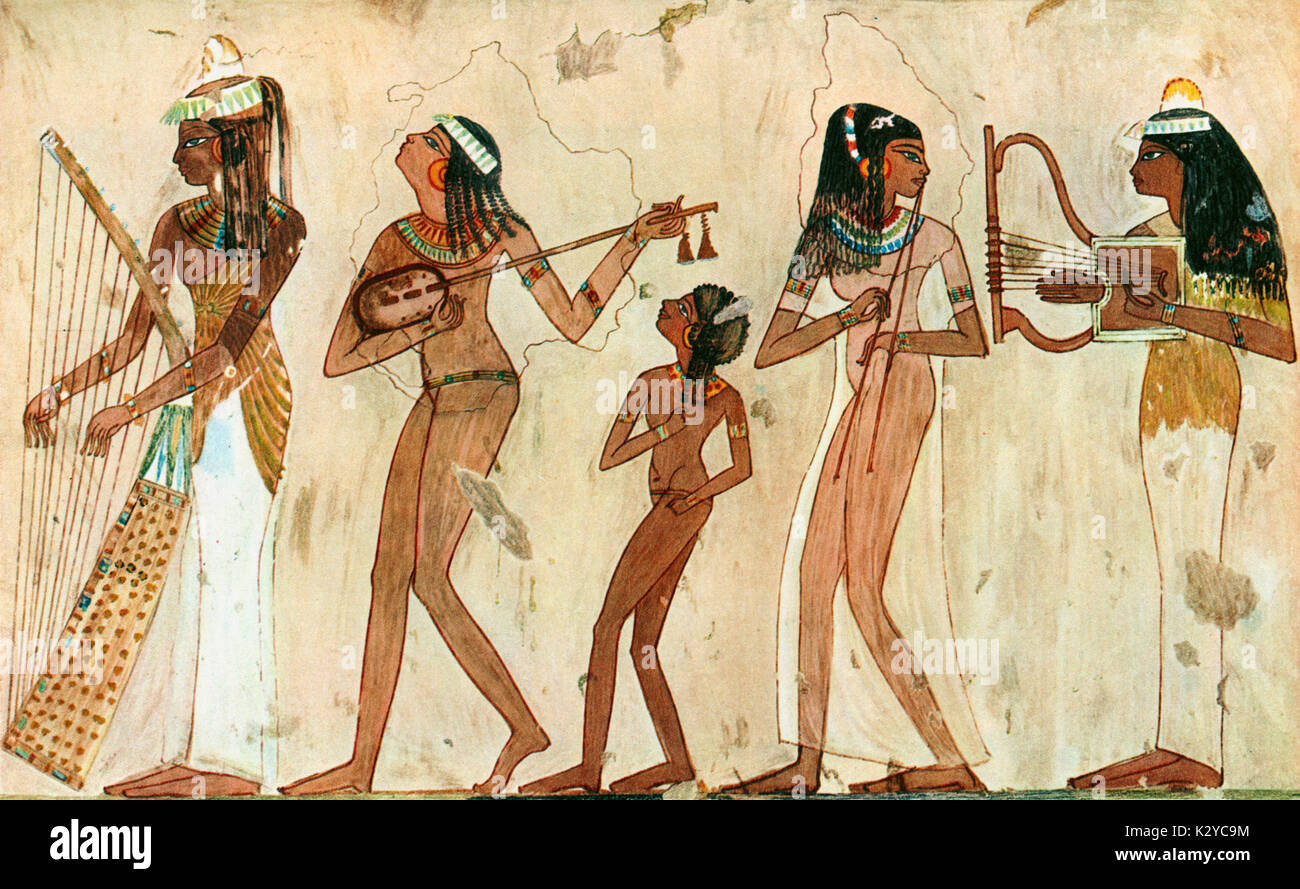
The harp was the premier string instrument of ancient Egypt. The earliest versions, dating back to the Old Kingdom (c. 2686–2181 BCE), were "arched" or bow-shaped harps with relatively few strings. By the New Kingdom, contact with Mesopotamia introduced the larger, more complex "angular" harp, which had more strings and a wider tonal range.
One of the most famous motifs in Egyptian funerary art is the blind harpist. These musicians were frequently depicted in the tombs of royalty and nobles, entertaining banqueters while singing contemplative lyrics about death, the afterlife, and the fleeting nature of life. While it is unclear if these harpists were literally blind or if the depiction was a symbolic convention, they held an honored position in society.
End-Blown Flutes
Woodwinds were essential for carrying the melody, often playing in unison or slight variation (heterophony) with the singers. The most common wind instrument was the end-blown flute, made from river cane or wood.
Similar to the modern ney still played in traditional Egyptian and Middle Eastern music today, these flutes were held at an angle, with the player blowing directly across the open rim. Tomb reliefs frequently show flute players sitting alongside singers, using hand gestures (chironomy) to signal melodic changes or rhythmic beats. Over time, the Egyptians also incorporated double-reed pipes (similar to early oboes), but the simple cane flute remained a staple for thousands of years.
The Sistrum: The Sound of the Gods
While harps and flutes were used for both entertainment and religion, the sistrum was an exclusively sacred instrument. It was a type of handheld rattle made of bronze or brass, featuring a U-shaped frame with sliding metal crossbars that jingled when shaken.
The sistrum was the primary instrument of the priestesses of Hathor, the goddess of joy, music, and motherhood. The instrument's ancient Egyptian name, sesheshet, is actually an onomatopoeia mimicking the soft, rustling sound it makes—a sound the Egyptians associated with wind blowing through the papyrus reeds where Hathor was believed to dwell.
During temple rituals and open-air processions, priestesses and queens would shake sistrums in sharp, rhythmic pulses. The sound was believed to clear negative energy, appease the deities, and invoke blessings. The instrument's shape was deeply symbolic; many sistrums featured a handle shaped like the ankh (the symbol of life) or were topped with the cow-eared face of Hathor herself.