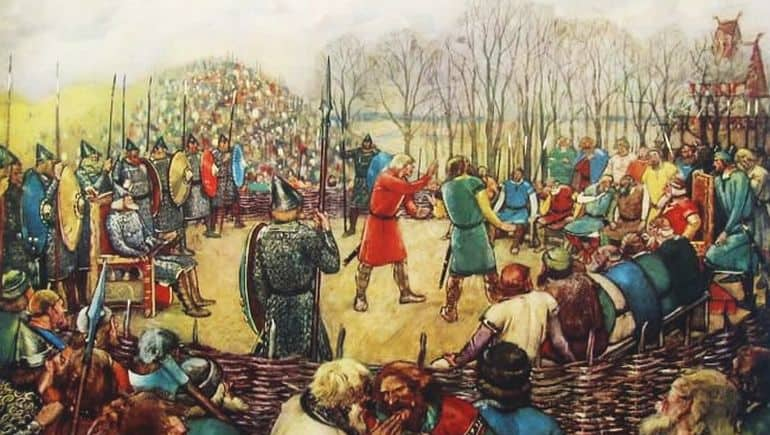
Introduction: The Heart of Norse Justice
The popular perception of Vikings often centers on bloodthirsty raiders and lawless conquerors, but Norse society was actually underpinned by a highly sophisticated, communal legal system. At the center of this society was the Thing (Old Norse: þing), a governing assembly composed of free men who gathered to enact laws, elect leaders, and judge disputes.
The Thing was an essential balancing mechanism for a warrior culture deeply bound by honor and clan loyalties. By providing a structured arena for public debate, negotiation, and judicial arbitration, the Thing prevented endless cycles of blood feuds and laid the ideological groundwork for early parliamentary democracy in Northern Europe.
1. Societal Structure: The Tiers of Justice
The Viking legal framework was deeply decentralized and built upon a tiered, geographical hierarchy that mirrored the social structure of the Norse world.
The Local Thing: The lowest level of assembly handled immediate community issues, petty crimes, and local land disputes. It allowed ordinary free people a direct voice in the governance of their immediate surroundings.
The Regional Thing: A larger gathering that mediated conflicts between different clans or communities, pulling together representatives and chieftains from several local districts to handle broader political and legal matters.
The National Assembly: In certain established territories, an overarching assembly governed the entire realm. The most famous example is the Icelandic Althing, which convened the nation's 36 district leaders and served as the supreme legislative and judicial authority for the island.
2. The Mechanics of the Gathering
A Thing was not merely a court of law; it was a vibrant socio-economic festival that could last for days or weeks, pulling communities together across vast distances.
The Location: Things were typically held outdoors in highly accessible, natural amphitheaters, often near reliable water sources. Sites were chosen for their acoustics, allowing speakers to be heard by massive crowds, and their geographical neutrality.
The Truce (Thingfriðr): Violence at the assembly was strictly forbidden. Attendees were required to leave their weapons—swords, axes, and spears—outside the boundaries of the meeting site (often marked by hazel poles or ropes) to ensure peaceful deliberation.
The Festival Atmosphere: While the core purpose was judicial, the gatherings attracted merchants, brewmasters, and artisans. The assembly functioned as a bustling bazaar and was a primary venue for arranging marriages, forging political alliances, and conducting major trade.
3. The Lawspeaker: The Living Constitution
Because Viking society operated primarily through oral tradition before the widespread use of written law codes, the integrity of the legal system rested on a single, highly respected official.
The Memorization of Law: The Lawspeaker (lögsögumaður) was elected for a set term and was responsible for memorizing the entirety of the community's laws, acting as a human legal encyclopedia.
The Recitation: At national assemblies, the Lawspeaker would stand at a prominent geographic feature—such as the Lögberg (Law Rock) in Iceland—and recite a portion of the laws aloud to the attendees each year, ensuring everyone understood their rights and obligations.
The Neutral Arbiter: While chieftains (goðar) held political power and influenced outcomes, the Lawspeaker acted as an impartial legal expert who clarified precedents and guided the assembly toward lawful, consistent verdicts.
4. Resolving Disputes: Blood Feuds and Compensation
The Norse culture of honor meant that an injury to one person was an insult to their entire clan, frequently triggering violent retribution. The Thing was specifically designed to interrupt this cycle.
The Outlawry Sentence: The Thing had no police force to carry out punishments. Instead, severe crimes resulted in the perpetrator being declared an "outlaw." Stripped of all legal protection, an outlaw could be killed by anyone without consequence, effectively forcing them into permanent exile.
The Weregild (Man Price): To avoid continuous bloodshed, the Thing established a complex system of financial compensation called weregild. Every individual, from a lowly freeman to a chieftain, had a specific monetary value based on their social status, which had to be paid to the victim's family in the event of injury or death.
The Burden of Proof: Trials were conducted publicly, relying heavily on sworn oaths and character witnesses. If a man was accused of a crime, he could clear his name by gathering a specific number of respectable men to swear an oath confirming his innocence.
5. The Enduring Legacies: Althing and Tynwald
The physical and political legacy of these Viking assemblies outlasted the Viking Age itself, embedding democratic principles into the territories they settled.
The Icelandic Althing: Founded in 930 CE at Þingvellir, it is widely considered the oldest surviving national legislature in the world. It operated continuously as an open-air assembly until the late 18th century and remains Iceland's parliament today.
The Manx Tynwald: On the Isle of Man, the legacy of Norse settlers lives on in the Tynwald (derived from the Old Norse Þingvöllr, meaning "assembly field"). Established over a millennium ago, the Tynwald is the world's oldest continuously operating parliament.
Every year on July 5th, the Isle of Man still celebrates Tynwald Day, where the modern Manx parliament gathers on the ancient four-tiered, artificial earthen mound to proclaim the year's new laws in both English and Manx Gaelic.