Introduction: A Bronze Age Apocalypse
During the height of the Bronze Age, the Eastern Mediterranean was dominated by the Minoans, a highly advanced, seafaring civilization based on the island of Crete and its surrounding archipelago. They were masters of maritime trade, renowned for their palatial architecture, vibrant art, and sophisticated engineering. However, in the mid-second millennium BCE (around 1600–1500 BCE), this flourishing culture was dealt a catastrophic blow by one of the largest volcanic events in human history: the Minoan Eruption of Thera.
The eruption completely reshaped the island of Thera (modern-day Santorini), blowing the island's core into the sky and generating a series of cascading environmental disasters. While it did not instantly erase the Minoan civilization from the map, the resulting tsunamis, ash fallout, and economic disruption shattered their maritime hegemony—their dominance over the sea lanes—leaving them critically vulnerable to foreign conquest and triggering a permanent geopolitical shift across the ancient Aegean world.
1. The Cataclysm: Anatomy of a Super-Eruption
Geological analysis indicates that the Thera eruption was a Ultra-Plinian event—a volcanic eruption of maximum intensity—scoring a 6 or 7 on the Volcanic Explosivity Index. It was multiple times more powerful than the 79 CE eruption of Mount Vesuvius that buried Pompeii.
The Precursor Phase: The eruption was preceded by violent earthquakes. Unlike later historical disasters, these early warnings gave the inhabitants of Thera time to evacuate the island with their valuables, as evidenced by the lack of human remains in the ruins.
The Plinian Column: When the main vent ruptured, it blasted a column of ash, pumice, and toxic gases up to 24 miles (39 kilometers) into the stratosphere. Winds carried this toxic cloud east, blanketing parts of Anatolia, the Levant, and Egypt in darkness.
Pyroclastic Flows: As the eruption column collapsed, superheated avalanches of ash, rock, and gas rushed down the volcano's flanks at speeds exceeding 100 miles per hour, instantly vaporizing anything left on the coast.
Caldera Collapse: Empty of magma, the volcano’s massive underground chamber collapsed inward, dragging the center of the island down into the sea and creating the dramatic, water-filled caldera that characterizes Santorini today.
2. Akrotiri: The Aegean Pompeii
Just as Vesuvius preserved Pompeii, the thick layers of volcanic ash and pumice on Thera sealed a prosperous Minoan-influenced settlement known to modern archaeologists as Akrotiri. Excavations have revealed a remarkably sophisticated bronze-age urban landscape frozen in time.
Urban Infrastructure: Akrotiri featured multi-story stone buildings, paved streets, and an intricate, subterranean sewer and indoor plumbing system that wouldn't be matched in Europe for another two millennia.
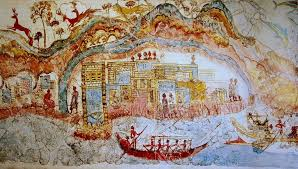
The Frescoes: The ash preserved breathtaking wall paintings that offer a window into the Minoan worldview. Rather than glorifying war or monarchs, these colorful murals celebrate the natural world, depicting monkeys, marine life, boxers, and blooming landscapes.
3. The Tsunami and the Blow to Crete
While Thera itself was completely obliterated, the most devastating consequence for the core Minoan civilization on Crete, located roughly 85 miles (140 kilometers) to the south, came from the ocean.
The Giant Waves: The colossal collapse of the caldera displaced billions of tons of water, generating massive tsunamis. Computer models and marine deposits suggest these waves hit the northern coast of Crete with heights up to 30 to 50 feet (9 to 15 meters).
Destruction of the Fleets: The tsunamis instantly wiped out the Minoan naval fleets, shipyards, and coastal trading ports. For a civilization whose economy and defense depended entirely on naval supremacy (thalassocracy), this loss was structurally fatal.
Agricultural Collapse: The immediate physical damage was compounded by atmospheric fallout. Dense clouds of sulfur and ash blanketed Crete's fertile plains, acidifying the soil, ruining crops, and inducing widespread agricultural failure and famine.
4. Geopolitical Realignment: The Rise of Mycenae
The Minoans survived the immediate aftermath of the eruption, quickly working to rebuild their fractured settlements. However, the catastrophic loss of their navy and the internal chaos caused by famine left them fundamentally weakened.
With the Minoan naval shield shattered, the trade routes of the Aegean lay undefended, creating a power vacuum that a hungry new empire was eager to fill.
From the Greek mainland, the Mycenaeans—a highly militaristic, chariot-driving warrior culture—seized the opportunity. Within a few generations of the eruption, Mycenaean artifacts and their distinct Greek script (Linear B) began replacing Minoan cultural traits across Crete. By roughly 1450 BCE, the grand Minoan palace at Knossos was occupied by Mycenaean rulers. The center of Aegean political, economic, and cultural gravity had permanently shifted from Crete to the Greek mainland, setting the stage for the classical Greek world.
5. Myths and Echoes: The Origin of Atlantis?
The memory of a wealthy, advanced maritime civilization that vanished into the sea in a single cataclysmic day left an indelible mark on the collective consciousness of the ancient world. Many historians believe this event serves as the historical core behind one of humanity's most enduring legends.
Roughly 1,200 years after the eruption, the Greek philosopher Plato wrote the story of Atlantis—a powerful island empire characterized by concentric rings of water and land, advanced architecture, and red and black stone walls, which sank beneath the ocean waves in a single night of misfortune. The striking physical parallels between Plato's description and the geological reality of Thera suggest that the Minoan apocalypse may well be the true story behind the myth of the lost continent.