Nefertiti remains one of the most enigmatic and influential figures in ancient Egyptian history. As the Great Royal Wife of Pharaoh Akhenaten during the 18th Dynasty (c. 1353–1336 BCE), she was not merely a consort but a central force in one of the most radical religious and political upheavals in the ancient world.
The Amarna Period: A Religious Revolution
Nefertiti’s reign is inseparable from the Amarna Period, a time when her husband, Akhenaten, dismantled the traditional polytheistic Egyptian religion in favor of Atenism—the monotheistic or henotheistic worship of the sun disk, the Aten.
Active Participation: Unlike traditional queens who were often depicted in a secondary, domestic role, Nefertiti was portrayed as an active partner. She frequently appears in relief scenes alongside Akhenaten, performing religious rites, offering to the Aten, and even smiting Egypt’s enemies—a prerogative historically reserved exclusively for the Pharaoh.
Ideological Partner: Scholars often describe her as Akhenaten's "ideological muse." Her name, Neferneferuaten-Nefertiti ("The Beautiful are the Beauties of Aten, the Beautiful One Has Come"), explicitly linked her identity to the new state religion. She served as a high priestess and a primary intermediary between the people and the god.
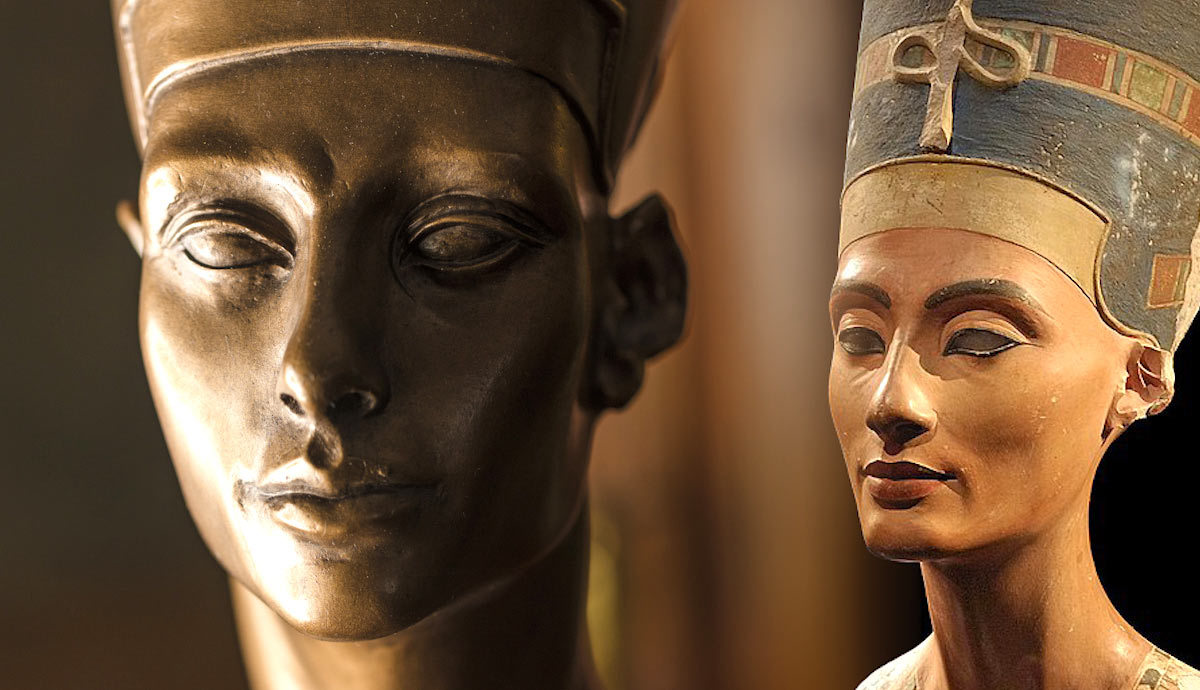
Artistic Innovation: The Amarna period introduced a distinctive artistic style characterized by more expressive, naturalistic, and even androgynous forms. Nefertiti’s imagery, including the famous portrait bust found in the workshop of the sculptor Thutmose, redefined the standard of beauty and royal authority.
Power and Possible Co-Regency
There is significant scholarly debate regarding the extent of Nefertiti's political authority. Many historians now believe she exercised power far beyond that of a typical queen consort.
Co-Ruler Theory: Several pieces of evidence suggest Nefertiti may have been a co-regent. She is depicted wearing pharaonic crowns and performing duties typically associated with the king, suggesting she was seen as a legal and divine equal.
The "Female Pharaoh" Hypothesis: Her disappearance from the records after the 12th year of Akhenaten's reign has led some to speculate that she did not simply die or fall from grace. A prominent theory is that she adopted the throne name Neferneferuaten and ruled either as a co-regent during the final years of Akhenaten’s life or as a sole female pharaoh after his death, just before the ascension of Tutankhamun.
The Mystery of Her Origin and End
Much of Nefertiti’s life remains veiled in mystery, partly because her legacy was systematically targeted by later pharaohs who sought to restore the old religious order and erase the memory of the "heretic" Amarna kings.
Origins: Her parentage is not recorded. While early theories suggested she might be a foreign princess (such as the Mitanni princess Tadukhipa), many modern scholars point to circumstantial evidence suggesting she was the daughter of the courtier Ay, who would later become Pharaoh himself.
Disappearance: Her "disappearance" from the historical record remains a major topic of study. While some believe she died during a plague or a time of internal turmoil, recent epigraphic discoveries, such as a graffito at Deir el-Bersha dating to the 16th year of Akhenaten’s reign, confirm that she was still alive and active late in his life, supporting the theory that she continued to wield power long after the initial years of their reign.
Nefertiti is ultimately remembered as a "powerbroker" who transcended the traditional limitations of her gender in a male-dominated society. Whether or not she ruled as a sole monarch, she was undeniably the female pillar upon which the most controversial reign in Egyptian history was built.