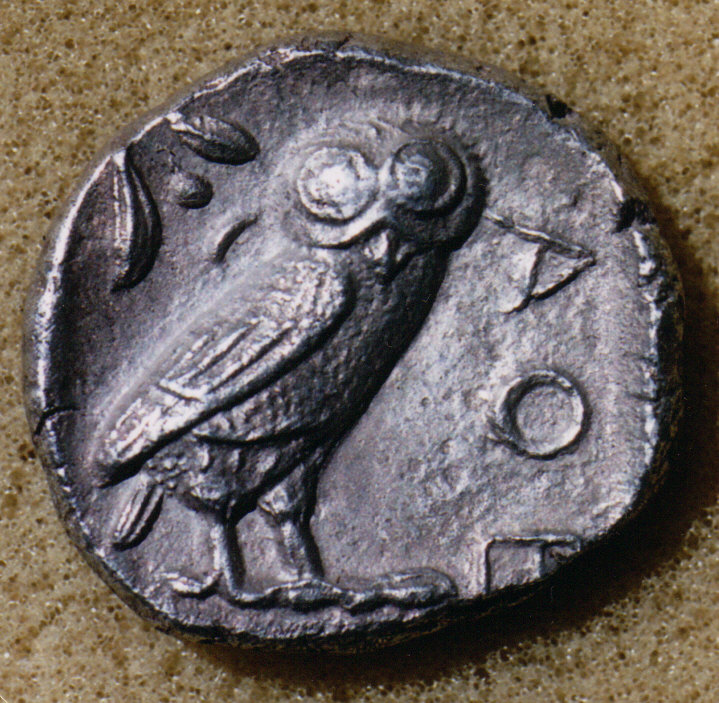
The Athenian Tetradrachm, often referred to as the "Owl," was the most influential coin of the ancient world. Produced for nearly 400 years, it was the "international reserve currency" of its day, accepted from the markets of Carthage to the borders of India.
1. The Birth of a Standard
Before the late 6th century BC, Greek coins were localized and varied wildly in weight and design. Around 510 BC, following the fall of the Peisistratid tyranny, Athens introduced a standardized silver coin: the Tetradrachm (meaning "four drachmae").
The timing coincided with the discovery of massive silver veins in the Laurion mines south of Athens. This sudden wealth allowed the city to produce millions of high-purity silver coins, which funded the construction of the Parthenon and the powerful Athenian navy.
2. The Iconic Imagery
The design of the Tetradrachm remained remarkably consistent for centuries, a deliberate choice by the Athenians to ensure the coin remained recognizable and trusted in trade.
The Obverse (Front): Features the head of Athena, the patron goddess of the city. She is depicted wearing a crested Attic helmet decorated with three olive leaves and a floral scroll. Her expression is usually characterized by the "Archaic smile," a stylistic hallmark of early Greek art.
The Reverse (Back): Features an Athene Noctua, the Little Owl associated with the goddess. Beside the owl is a small spray of olive (representing Athens' agricultural wealth) and a waning moon (the significance of which is debated, though some believe it commemorates the Battle of Marathon).
The Legend: The letters ΑΘΕ (ATHE) appear on the right side, an abbreviation for "of the Athenians."
3. Artistry and Evolution
While the core design was static, the artistic quality evolved through three major phases:
Archaic (c. 510–480 BC): These coins are thick and "dumpy." Athena’s eye is shown frontally even though her head is in profile—a common trait in early Greek art.
Classical (c. 440–404 BC): This was the peak of Athenian power. The artistry became more refined, with more realistic facial features and a more elegant, naturalistic owl. These are the coins that funded the "Golden Age" of Pericles.
New Style (c. 165–40 BC): Later versions featured a much wider, thinner silver flan (the metal disc). Athena’s helmet became far more ornate, and the owl was depicted standing on a horizontal amphora (wine jar), surrounded by a laurel wreath.
4. The "Chop Marks" of Global Trade
Because the Athenian Tetradrachm was so pure (consistently around 95-98% silver), it traveled far beyond the borders of Greece. Archaeologists often find these coins with "chop marks"—deep gouges or stamps made by foreign merchants. These were not acts of vandalism, but tests to ensure the coin was solid silver all the way through and not a plated bronze counterfeit.
The "Owl" was so popular that many foreign kingdoms, from Egypt to Arabia, began minting their own "Athenian-style" coins to capitalize on the trust associated with the design.
5. Economic Impact: The Drachma System
The Tetradrachm was the high-value denomination, used for state-level transactions, military pay, and international trade. To put its value in perspective:
A daily wage: A skilled stonemason or a rower in the Athenian navy typically earned one drachma per day.
The Tetradrachm's value: One Tetradrachm represented four days of hard labor.
Buying power: In the 5th century BC, a Tetradrachm could buy approximately 20-30 kilograms of grain, enough to feed a small family for weeks.
6. Legacy in Modern Currency
The Athenian Owl has never truly left the public consciousness. When Greece adopted the Euro in 2002, they chose the image of the ancient 5th-century BC Tetradrachm to grace the back of their €1 coin. It remains a symbol of the enduring connection between ancient economic stability and modern identity.