The Ancestral Puebloans, formerly known as the Anasazi, created some of the most iconic and mysterious architectural feats in North America. Between 600 and 1300 AD, they transitioned from living on the mesa tops to building elaborate stone cities tucked into the alcoves of sandstone cliffs in what is now Mesa Verde National Park, Colorado.
1. The Great Transition: From Pit Houses to Cliffs
For centuries, the Ancestral Puebloans lived in pit houses—circular dwellings dug into the ground—on the flat tops of the mesas. Around 1200 AD, a dramatic shift occurred. Within a single generation, they began moving their entire communities down into the natural sandstone alcoves.
While the exact reason for this move is debated, archaeologists point to a combination of factors:
Defense: The cliff alcoves provided a natural fortress against potential invaders, with limited access points that could be easily guarded.
Climate Control: The southern-facing alcoves acted as natural "passive solar" heaters, absorbing the sun's warmth in the winter while staying shaded and cool during the hot summer months.
Agricultural Access: Living below the mesa rim allowed them to stay closer to the springs that emerged from the cliff faces, while still being able to climb up to farm corn, beans, and squash on the mesa tops.
2. Engineering and Masonry
The construction of these dwellings was a masterpiece of pre-industrial engineering. They used local materials to build structures that have survived for over 700 years.
Sandstone Blocks: Builders shaped sandstone into rectangular blocks using harder river stones.
Mortar: A mixture of mud, water, and ash was used to bind the stones together.
Chinking: Small pieces of stone (chinking) were pressed into the mortar to provide extra stability and fill gaps.
Vigas: Large wooden beams, often made of Douglas fir or Ponderosa pine, were used as floor and roof supports. The ends of these beams often protruded from the walls, providing scaffolding for construction and repairs.
3. Cliff Palace: The Urban Center
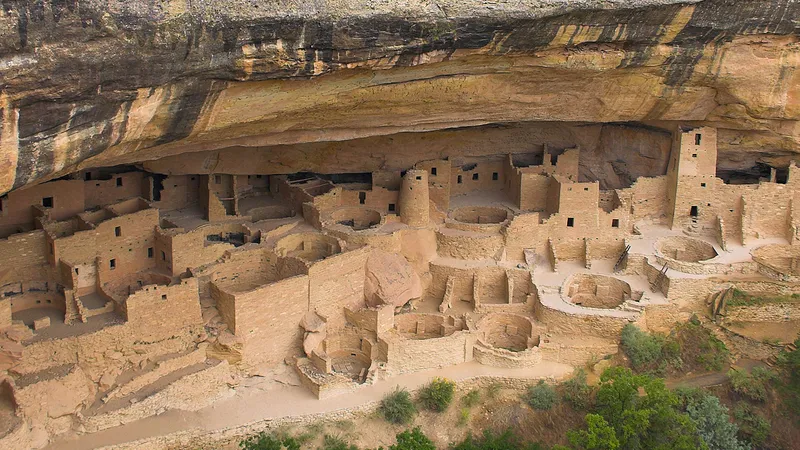
Cliff Palace is the largest cliff dwelling in North America. It is not just a house, but a complex urban center featuring 150 rooms and 23 kivas.
Social Stratification: The varying sizes of rooms suggest that different families or clans lived together. Some rooms were used specifically for sleeping, while others were dedicated to grinding corn or storage.
The Four-Story Square Tower: One of the most prominent features of Cliff Palace, this tower demonstrates the Ancestral Puebloans' ability to build vertical, multi-story structures without the use of metal tools or wheels.
4. The Kiva: The Spiritual Heart
Every cliff dwelling was built around the kiva, a subterranean circular room used for religious ceremonies, social gatherings, and as a workspace for men.
Key architectural features of a kiva included:
The Sipapu: A small hole in the floor representing the symbolic portal through which humanity first emerged into this world.
Pilasters: Stone pillars that supported a cribbed timber roof.
Deflector and Ventilator: An ingenious air-intake system that allowed a fire to burn in the center of the room without smoking out the occupants.
5. Balcony House: The Defensive Fortress
While Cliff Palace was a social hub, Balcony House highlights the defensive nature of this architecture. To enter, visitors (and residents) had to climb a 32-foot wooden ladder and crawl through a narrow, 12-foot-long tunnel on their hands and knees. This design meant that a single defender could protect the entire village from an outside force.
6. The Great Abandonment
By 1300 AD, less than 100 years after the cliff dwellings reached their peak, the Ancestral Puebloans abandoned Mesa Verde forever. Archaeological evidence, including tree-ring data, shows a "Great Drought" that lasted over 20 years.
This, combined with soil depletion and social unrest, likely forced the population to migrate south into modern-day New Mexico and Arizona. They did not "disappear"; they became the ancestors of the modern Pueblo peoples, including the Hopi and Zuni, who still carry the architectural and spiritual traditions of Mesa Verde today.