The walls of Babylon were considered one of the original wonders of the ancient world. Under the reign of Nebuchadnezzar II (605–562 BC), the city became the largest and most fortified metropolis in Mesopotamia, protected by a double-ring system of massive brick walls that were allegedly wide enough for two four-horse chariots to pass each other.
1. The Ishtar Gate: The Blue Jewel of the East
The Ishtar Gate was the eighth fortified gateway to the inner city of Babylon. Dedicated to the goddess of love and war, it served as the primary entrance for those arriving from the north.
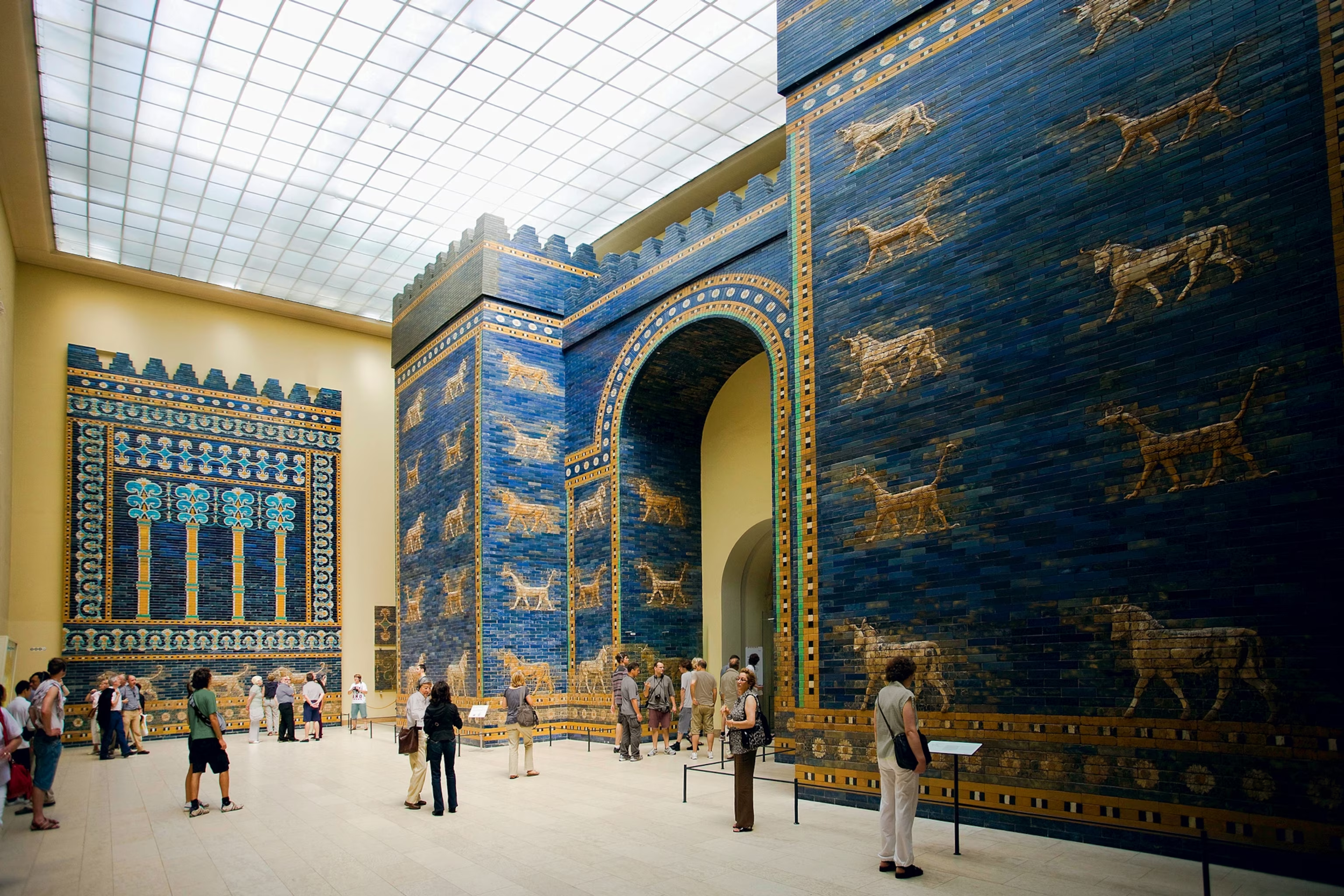
The Glazed Brick Technique: The gate was famous for its vibrant blue tiles, a color achieved through the use of cobalt. Unlike the sun-dried mud bricks of common buildings, these were kiln-fired and glazed to withstand the elements and project the immense wealth of the empire.
The Menagerie of Spirits: The gate was decorated with alternating tiers of bas-relief animals, each representing a specific deity.
Lions: Representing Ishtar, symbols of power and ferocity.
Dragons (Mushkhushshu): Representing Marduk, the chief god of Babylon, featuring a serpent’s head, a lion’s forelegs, and an eagle’s talons.
Bulls (Adad): Representing the storm god, symbolizing fertility and strength.
2. The Processional Way
The Ishtar Gate was not a standalone monument; it was the climax of the Processional Way, a magnificent paved corridor over half a mile long.
The Design: The walls lining the path were also made of glazed blue bricks and decorated with sixty lions on each side. The road itself was paved with large slabs of limestone and red breccia, with edges beveled to allow water to run off.
The Psychological Effect: For a visitor or a foreign dignitary, walking down the Processional Way was intended to be an overwhelming experience. The narrow, high walls and the repetitive imagery of roaring lions created a sense of awe and submission before one even reached the inner city.
3. The Akitu Festival
The primary functional purpose of the Ishtar Gate and the Processional Way was to serve as the stage for the Akitu, the Babylonian New Year festival.
Every spring, statues of the gods from neighboring cities were brought to Babylon by boat. These idols were carried through the Ishtar Gate and down the Processional Way in a grand parade led by the King. This ritual served to renew the King's divine right to rule and to ensure the city’s prosperity for the coming year.
4. The Inscription of Nebuchadnezzar
Hidden within the gate's structure was a foundation inscription written by Nebuchadnezzar II. It served as a message to future generations, stating:
"I pulled down these gates and laid their foundations at the water table with asphalt and bricks and had them made of bricks with blue enamel on which wild bulls and dragons were depicted... I placed wild bulls and ferocious dragons in the gateways and thus adorned them with luxurious splendor so that people might gaze on them in wonder."
5. Discovery and Reconstruction
The remains of the gate were excavated between 1899 and 1917 by German archaeologist Robert Koldewey. Because the gate had been built in stages as the ground level of the city rose, Koldewey found thousands of fragments of the glazed tiles buried in the sand.
These fragments were transported to Berlin, where they were painstakingly reassembled. Today, the most famous reconstruction of the Ishtar Gate stands in the Pergamon Museum in Berlin. While the reconstruction is smaller than the original outer gate, it still conveys the massive scale and brilliant color that once dominated the Babylonian skyline.