Between the 8th and 6th centuries BC, the Greek world underwent a massive expansion known as the apoikia (away-home). Driven by land hunger, population pressure, and a desire for new "Old Style" trade routes, thousands of Greeks left their mother cities (metropoleis) to establish new independent states. The most successful of these ventures was the settlement of Southern Italy and Sicily, a region so densely populated by Greeks that the Romans later named it Magna Graecia (Great Greece).
1. The Oikist and the Oracle
A Greek colony was not a haphazard settlement; it was a highly organized religious and political undertaking.
The Oracle at Delphi: Before sailing, the mother city would consult the Pythia at Delphi. The Oracle’s "Old Style" divine approval was necessary to ensure the gods favored the new location.
The Oikist: A leader, or oikist, was chosen to command the expedition. He was responsible for carrying the "sacred fire" from the mother city’s hearth to the new settlement. If the colony succeeded, the oikist was often worshipped as a hero after his death.
2. The Choice of Site: Fertile Soil and Safe Harbors
Unlike the rocky, "thin-soiled" terrain of mainland Greece, the lands of Southern Italy offered vast, fertile plains.
The "Choke Points": Colonies were often placed at strategic maritime locations. Zancle (Messina) and Rhegium (Reggio Calabria) were founded to control the narrow Strait of Messina, the gateway between the eastern and western Mediterranean.
Agricultural Wealth: Cities like Metapontum and Sybaris became fabulously wealthy by farming the deep alluvial soils. Metapontum even chose an ear of barley as the symbol for its coinage, reflecting its status as a "breadbasket" for the Greek world.
3. Urban Planning: The Hippodamian Grid
Magna Graecia served as a laboratory for "Old Style" Greek urban design. Because these cities were built from scratch, they often featured more regular layouts than the cramped, organic streets of Athens.
The Grid System: Cities like Paestum (Poseidonia) were laid out with wide, straight streets (plateiai) intersected by narrower alleys (stenopoi).
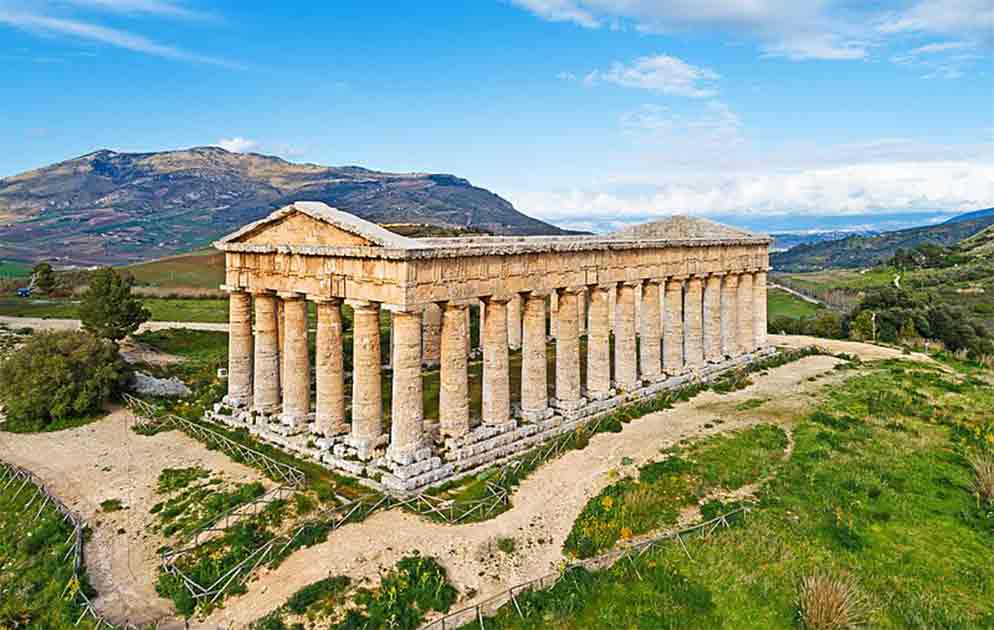
The Temenos: Large areas were reserved for the gods. The massive Doric temples at Paestum and Agrigento remain some of the best-preserved examples of Greek architecture today, often surpassing those in Greece itself in scale.
4. The Culture of Luxury: The "Sybarite" Lifestyle
The wealth of Magna Graecia led to a unique social atmosphere that was sometimes criticized by the more conservative mainland Greeks.
Sybaris: This city became a byword for opulence. Legend has it that the Sybarites banned blacksmiths and roosters to ensure the citizens’ sleep was never disturbed, and they invented the "patent" to protect the unique recipes of their chefs.
Cultural Fusion: While maintaining their Greek identity, the colonists interacted with local Italic tribes and the neighboring Etruscans. This led to a distinct "Western Greek" style in pottery and metalwork that was more flamboyant than the Attic style.
5. Intellectual Powerhouses: Pythagoras and Zeno
Magna Graecia was not just a center of trade; it was the "Old Style" Silicon Valley of ancient philosophy and science.
The Pythagorean School: Pythagoras moved from Samos to Croton, where he established a secretive, semi-religious community dedicated to mathematics, music, and the transmigration of souls.
The Eleatic School: In the city of Elea, philosophers like Parmenides and Zeno developed the foundations of metaphysics and logic, famously challenging the nature of reality and movement.
6. The Rise of Syracuse
By the 5th century BC, Syracuse in Sicily had become the most powerful city in the Greek world, rivaling Athens in size and military might.
The Tyrants: Leaders like Gelo and Hiero I transformed Syracuse into a regional superpower, defeating the Carthaginians at the Battle of Himera in 480 BC.
The Athenian Disaster: Syracuse’s strength was proven when it utterly destroyed the massive Athenian expeditionary force in 413 BC, a turning point that led to the eventual downfall of the Athenian Empire.
The legacy of Magna Graecia acted as the primary bridge between Greek culture and the rising power of Rome. Through these colonies, Greek alphabet, religion, and philosophy were passed to the Italians, forming the bedrock of what we now call Western Civilization.