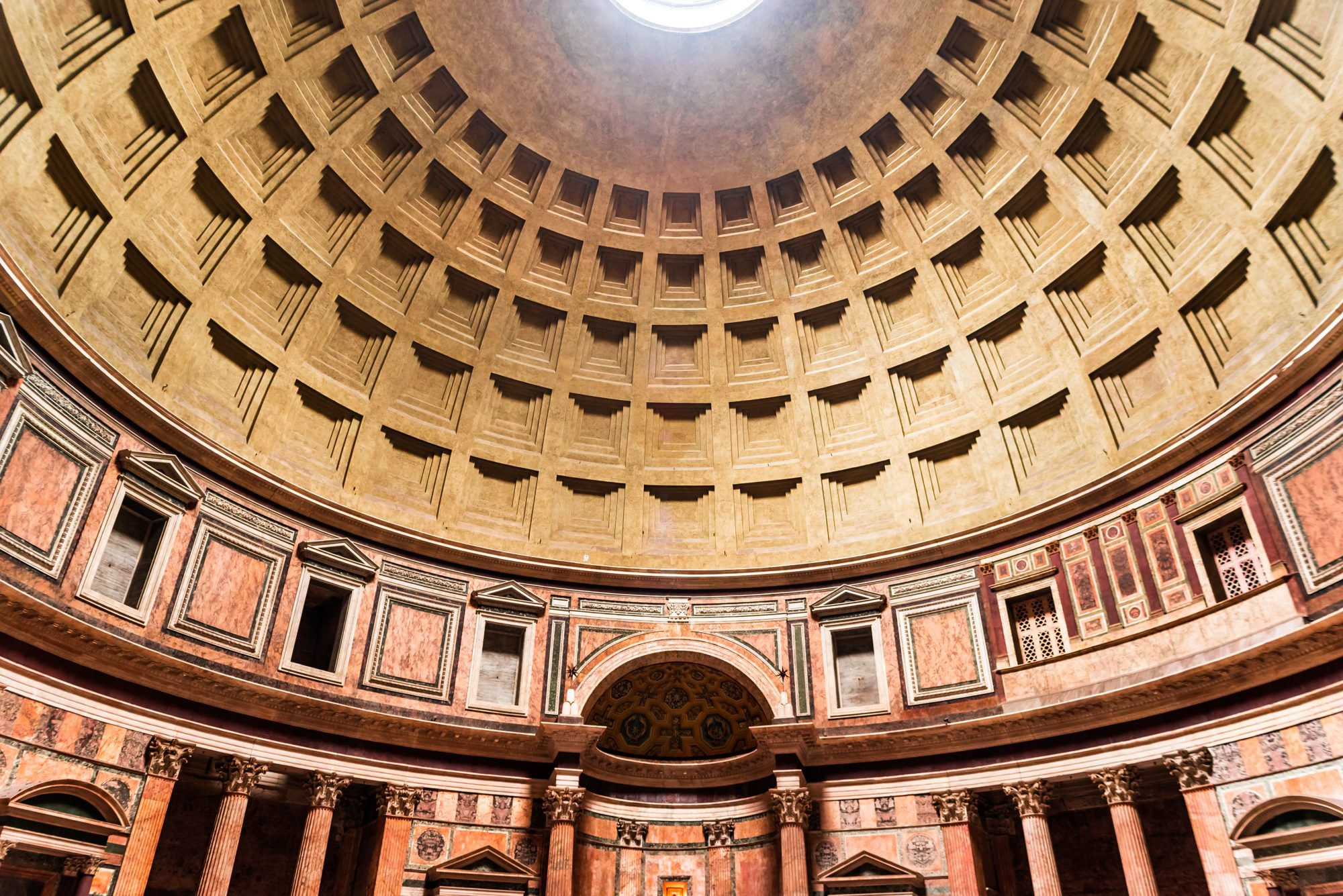
The Pantheon in Rome stands as the world’s largest unreinforced concrete dome, a record it has held for nearly 1,900 years. Completed under Emperor Hadrian around 125 AD, the "Old Style" structure was a revolutionary leap in engineering, achieved through a sophisticated understanding of chemistry, physics, and weight distribution that continues to fascinate modern architects.
1. The Recipe: Roman "Pozzolana" Concrete
The secret to the dome's longevity lies in its chemical composition. Unlike modern concrete, which often relies on steel reinforcement that can eventually rust and expand, Roman concrete was incredibly stable.
Volcanic Ash: The Greeks and Romans discovered that mixing volcanic ash (from Pozzuoli, near Mt. Vesuvius) with lime and water created a chemical reaction that allowed the concrete to set even underwater.
Self-Healing: Modern research suggests that the lime "clasts" in the mix allowed the concrete to "self-heal"; when cracks formed, water would dissolve the lime and recrystallize it into the gaps, sealing the structure.
2. Graduated Density: The "Lightening" Trick
The dome is a massive hemisphere with a diameter of 43.3 meters (142 feet). To prevent it from collapsing under its own weight, the Roman engineers used an "Old Style" method of varying the density of the materials (caementa) used in the concrete mix.
The Base: At the lowest levels, the concrete was mixed with heavy, dense basalt.
The Mid-Section: As the dome rose, the builders transitioned to lighter bricks and tufa.
The Summit: At the very top, the mix utilized pumice—a volcanic stone so light and porous that it can float on water.
Thinning the Shell: The concrete shell itself is about 6.4 meters thick at the base but tapers to just 1.2 meters at the summit.
3. Step Rings and Coffering
The exterior and interior of the dome feature structural designs that serve both aesthetic and mechanical purposes.
Exterior Step Rings: On the outside, seven "steps" or rings of thick masonry wrap around the base. these act like the hoops on a barrel, providing the compression needed to counteract the outward "thrust" of the dome.
Interior Coffers: The sunken square panels (coffers) on the ceiling are not just decorative. By "scooping out" these sections of concrete, the architects significantly reduced the total weight of the dome without sacrificing its structural integrity.
4. The Oculus: The Eye of the Dome
At the exact center of the dome is a 9-meter wide opening called the Oculus.
Structural Necessity: By leaving the apex open, the engineers removed the heaviest part of the dome—the part that would have been most likely to cave in.
The Compression Ring: The edge of the oculus is lined with a ring of brick and bronze that keeps the entire structure in a state of constant, stable compression.
The Sun and the Rain: The oculus acts as a solar clock, casting a moving beam of light across the interior. When it rains, the water falls onto a floor that is slightly convex, draining through 22 tiny hidden holes in the marble.
5. Hidden Arches: The Skeleton in the Walls
The massive drum (the circular wall) that supports the dome is nearly 6 meters thick. However, it is not a solid block.
Relieving Arches: Inside the brickwork of the drum, Roman builders constructed a series of "Old Style" hidden arches. These act like a skeleton, funneling the immense weight of the dome away from the weak points (like the niches and doorways) and down into the deep, solid foundations.
6. Legacy and Influence
The Pantheon served as the primary inspiration for the great domes of the Renaissance, from Brunelleschi’s Duomo in Florence to the U.S. Capitol. However, despite their genius, it took nearly two millennia for humans to again build a dome that could match the Pantheon's span without the use of modern steel support.