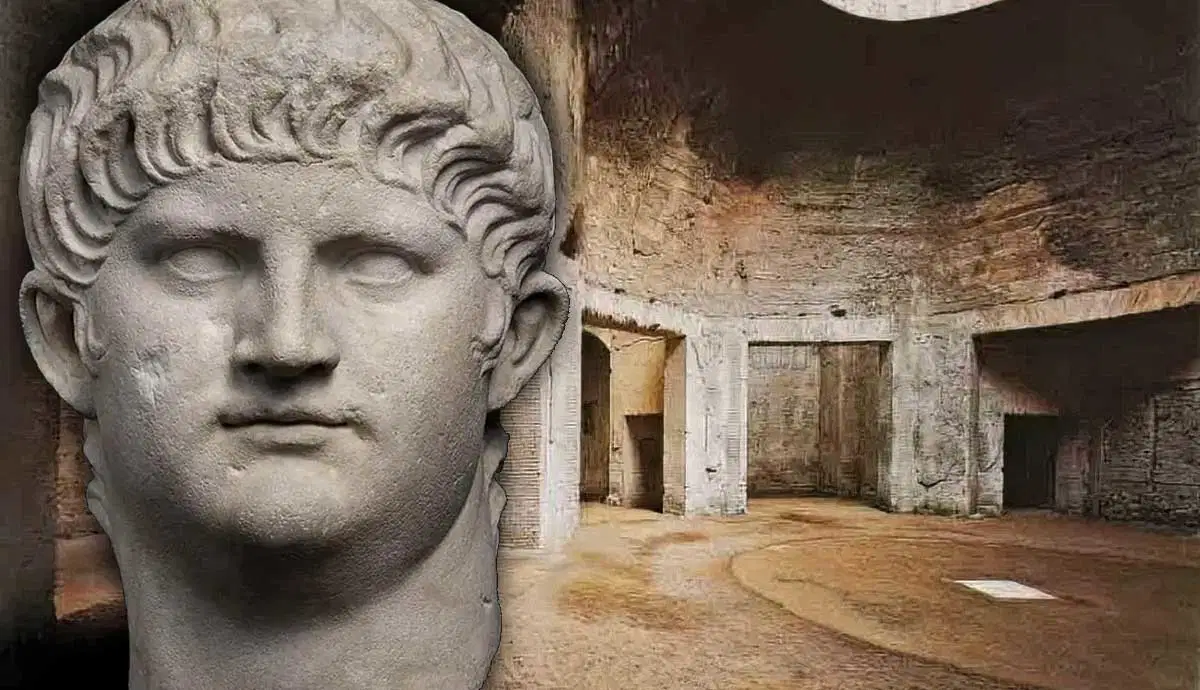
Following the Great Fire of Rome in 64 AD, the Emperor Nero seized a massive portion of the city's charred center to construct the Domus Aurea (Golden House). This was not merely a palace, but a sprawling landscaped villa that transformed the heart of an urban empire into a private parkland. It represented the "Old Style" of Roman luxury pushed to its absolute megalomaniacal limit.
1. The Landscape: An Artificial Countryside
Nero’s architects, Severus and Celer, designed the palace to feel like a rural retreat in the middle of Rome.
The Scale: The estate covered between 100 and 300 acres, spanning the Palatine, Esquiline, and Caelian hills.
The Lake: At the center of the valley sat a massive artificial lake—the very site where the Colosseum stands today. Nero surrounded this water with meadows, vineyards, and woods stocked with exotic wildlife.
The Colossus: In the palace vestibule stood a 36-meter (120-foot) bronze statue of Nero himself as the Sun God (Sol). After his death, it was moved to the exterior of the Flavian Amphitheatre, eventually giving the "Colosseum" its name.
2. Architectural Innovation: The Octagonal Room
The most revolutionary part of the Domus Aurea was its pioneering use of concrete and geometry.
The Dome: The Octagonal Room featured a concrete dome that appeared to float over the space. It lacked visible support columns, instead using hidden buttresses to distribute the weight.
The Oculus: Like the later Pantheon, the dome was topped with a central opening (oculus) that flooded the interior with natural light, creating a dramatic interplay of shadow and illumination.
Waterfall Integration: In a display of "Old Style" engineering mastery, the architects funneled water from an aqueduct to run down the back walls of the dining room, cooling the air and creating the sound of a natural grotto.
3. Interior Opulence: Gold, Gems, and Ivory
The name "Golden House" was not a metaphor. The palace was designed to overwhelm the senses.
Gold Leaf: Massive stretches of the walls and ceilings were covered in gold leaf, reflecting the light from the oculus to create a shimmering, ethereal environment.
Inlaid Jewels: Rare stones like mother-of-pearl and lapis lazuli were inlaid directly into the plaster.
Ivory Ceilings: Some dining rooms featured sliding ivory panels on the ceilings. During banquets, these panels would slide back to shower guests with flower petals or scented mists.
4. The "Grotesque" Art: Pompeian Style
Because the palace was later filled with rubble by Nero’s successors, its wall paintings were preserved for centuries.
The Rediscovery: During the Renaissance, artists like Raphael climbed down into the "caves" (the buried palace rooms) to study the paintings.
Grotesques: Because the rooms were found in "grottoes," the style of whimsical, spindly figures and floral garlands became known as Grotesque. This discovery directly influenced the decoration of the Vatican Loggias.
5. The Rotating Dining Room
Perhaps the most famous legend of the Domus Aurea, recently supported by archaeological finds on the Palatine Hill, was a dining room that moved.
Celestial Motion: According to the historian Suetonius, the main banquet hall was circular and rotated day and night, mimicking the movement of the heavens.
Mechanical Engineering: Archaeologists have discovered a large circular structure with evidence of a water-powered gear system, suggesting the floor or the ceiling actually rotated via a "Old Style" hydraulic engine.
6. The Damnatio Memoriae
Nero’s extravagance was his undoing. After his suicide in 68 AD, the palace became a symbol of tyranny.
Burial: The Emperor Trajan used the lower levels of the Domus Aurea as the foundations for his massive public baths, effectively burying Nero’s legacy in dirt.
The Colosseum: The Flavian emperors drained Nero’s lake and built the Colosseum on top of it, returning the land "stolen" by Nero to the Roman public.