The discovery of thousands of carved soapstone (steatite) seals at Mohenjo-Daro and other Indus Valley sites has provided the most significant, yet enigmatic, window into one of antiquity's "Old Style" great powers. These small, square artifacts—dating primarily from 2600 to 1900 BC—served as tools of commerce, markers of identity, and perhaps the most important archaeological clues to a script that remains undeciphered.
1. The Technology of the Seal
The seals were masterpieces of miniature relief carving.
Material: Most were made from steatite, a soft stone that is easy to carve but becomes extremely hard and durable when fired in a kiln.
The "Boss": The back of each seal featured a pierced "boss" or knob, allowing the owner to thread a cord through it and wear it as an amulet or carry it as a tool of office.
Mechanism of Trade: They were used to press impressions into wet clay tags (bullae) attached to bundles of trade goods. Archaeologists have found these Indus clay impressions as far away as Mesopotamia, proving a robust maritime trade network existed between the two civilizations.
2. The Undeciphered Script
At the top of nearly every seal is a series of symbols known as the Indus Script.
Logographic-Syllabic: The script consists of roughly 400 to 600 distinct signs. It is generally believed to be read from right to left.
The Decipherment Challenge: Unlike the Rosetta Stone for Egyptian Hieroglyphs, no bilingual text has ever been found for the Indus script. Most inscriptions are incredibly short—averaging only five characters—making it difficult to identify patterns or grammar.
Content Theories: Many scholars believe the inscriptions represent the names of merchants, officials, or perhaps the specific "Old Style" contents and weights of the goods they guarded.
3. Iconography: The "Unicorn" and Nature
The central imagery of the seals is dominated by the animal kingdom, rendered with remarkable anatomical realism.
The "Unicorn": The most common motif is a one-horned, bull-like creature. Because it always appears in profile, it is unclear if this is a mythical unicorn or a stylized representation of an ox. It is almost always depicted standing before a "cult object" or incense burner.
The Zebu and the Elephant: Other seals feature powerful humped bulls (Zebu), elephants, rhinoceroses, and tigers. These animals likely held totemic significance, representing different clans, guilds, or administrative regions within the city.
4. Religious Enigmas: The Pashupati Seal
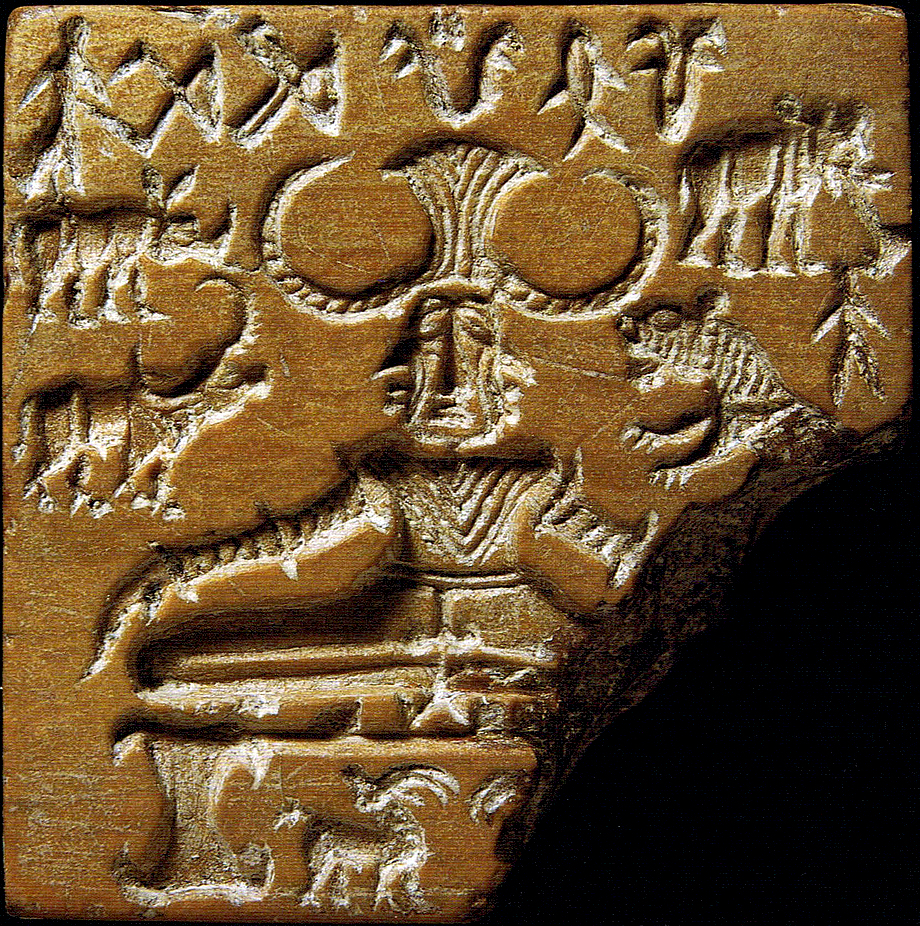
Perhaps the most famous artifact from Mohenjo-Daro is the Pashupati Seal.
The Figure: It depicts a three-faced figure seated in a meditative, yogic posture, wearing a horned headdress.
The Lord of Animals: The figure is surrounded by a rhinoceros, an elephant, a tiger, and a water buffalo.
Proto-Shiva Theory: Early archaeologists, such as Sir John Marshall, argued this was a "Proto-Shiva"—an early representation of the Hindu god Shiva in his aspect as the Lord of Animals. While this remains a subject of intense debate, the seal strongly suggests a sophisticated "Old Style" religious tradition involving meditation and animal worship.
5. Mythological Narrative Seals
While most seals feature a single animal, some depict complex scenes that hint at lost Indus myths.
The Tree Goddess: One seal shows a figure (possibly a deity) standing inside a Pipal tree, while a worshiper kneels before them and a human-headed goat looks on. The Pipal tree remains sacred in South Asia to this day.
Heroic Feats: Another motif depicts a man grappling with two tigers, a theme strikingly similar to the "Master of Animals" motif found in contemporary Sumerian and Elamite art, suggesting a shared pool of Bronze Age mythological symbols.
6. Social and Administrative Function
The high quality and standardized nature of the seals across hundreds of miles suggest a centralized authority.
Identity Markers: Just as a modern signature or digital key works today, the seal was a personal or institutional guarantee of quality and origin.
The Loss of the Seals: When the great cities of the Indus began to decline around 1900 BC, the production of these high-quality steatite seals stopped abruptly. This suggests that the seals were tied specifically to the "Old Style" urban, literate, and mercantile culture of the Harappan period; once the long-distance trade networks collapsed, the need for the seals vanished.