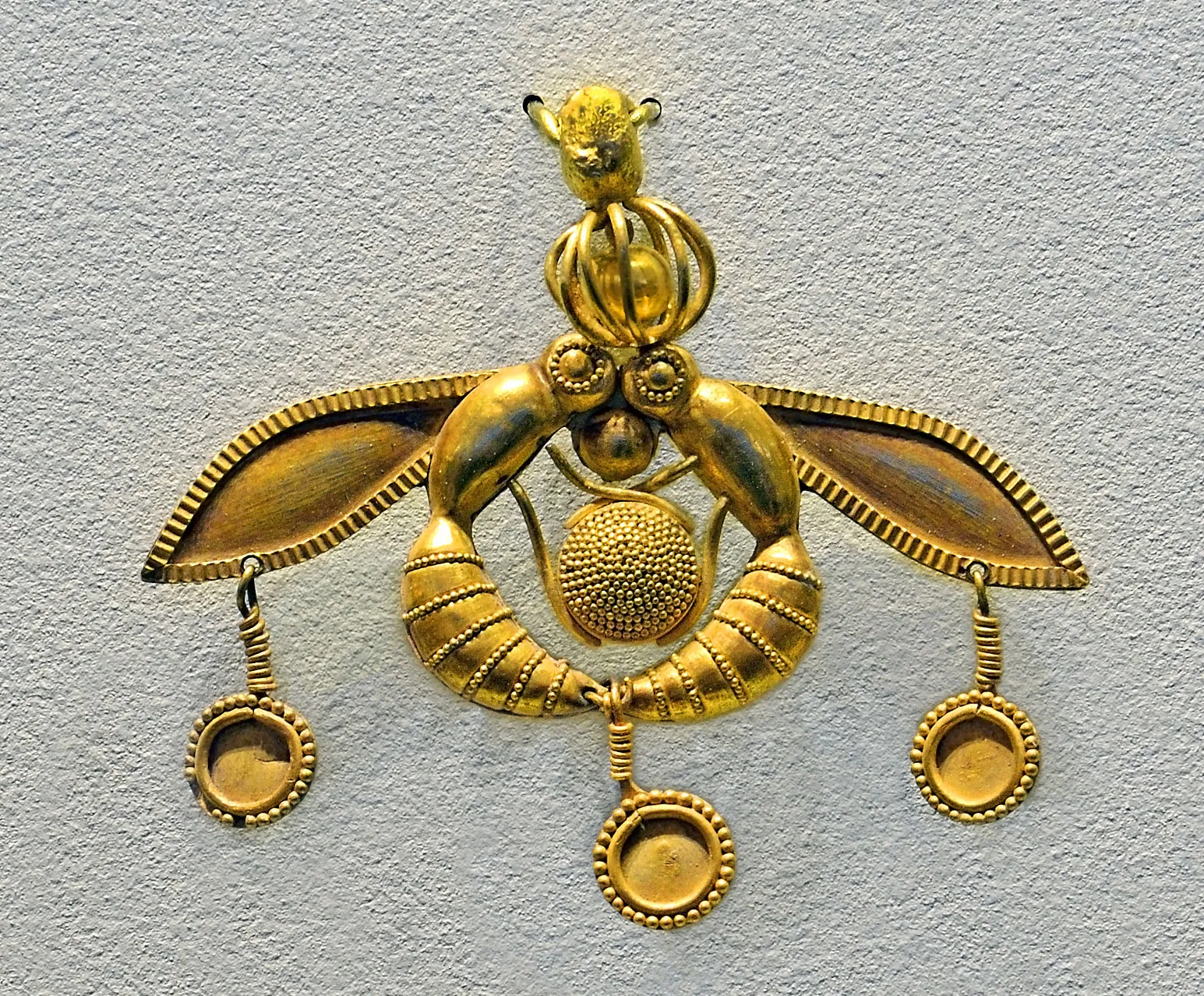
If you look closely at a piece of royal jewelry from the Classical or Hellenistic periods of ancient Greece, you might find yourself reaching for a magnifying glass. Hanging from gold earrings or woven into intricate necklaces are miniature worlds: tiny rosettes with individual petals, winged goddesses steering microscopic chariots, and surface textures that look like they have been dusted with golden sugar.
What makes this artistry so astonishing is that it was achieved without electricity, modern magnification tools, or pressurized gas torches.
Instead, Greek goldsmiths relied on an almost superhuman level of patience and mastery over physics. Rather than focusing on casting heavy, solid blocks of gold, their signature style was defined by two incredibly delicate, microscopic manipulation techniques: filigree and granulation.
1. Filigree: Drawing Out the Golden Thread
Filigree comes from the Latin words filum (thread) and granum (grain). In practice, it is the art of using incredibly thin, pliable wires of precious metal to construct intricate, lace-like patterns on a solid metal background or as openwork designs.
To achieve this, ancient smiths had to manually engineer gold wire—a grueling process because the modern wire-drawing plate (forcing metal through smaller and smaller holes in a steel plate) didn’t exist yet.
[ Block of Gold ] ──► Beaten into ultra-thin sheets ──► Cut into narrow strips ──► Twisted & rolled smooth
Once the smooth wire was created, smiths often embellished it further to create distinct textures:
Twisted Filigree: Two or more wires spun tightly together to mimic a miniature rope.
Beaded Filigree: A wire deliberately notched or rolled over a serrated tool to create the illusion of a string of microscopic beads.
Using delicate iron tweezers and a steady hand, the artisan bent these microscopic wires into spiraling scrolls, palmettes, and floral rosettes, securing them onto the jewelry’s surface with temporary plant glues before permanently soldering them in place.
2. Granulation: Crafting with Golden Dust
If filigree is drawing with gold wire, granulation is painting with gold droplets. This technique involves fusing hundreds—sometimes thousands—of microscopic gold spheres (granules) onto a smooth metal surface to outline patterns, add texture, or create three-dimensional relief.
The first challenge was making thousands of perfectly uniform spheres, some measuring less than 0.2 millimeters in diameter.
To achieve this, goldsmiths relied on surface tension and the natural physical laws of molten metal:
1.Cutting the Gold:Phase 1.
The artisan cut ultra-thin gold wire or sheets into tiny, uniformly sized square clippings.
2.The Charcoal Bed:Phase 2.
These clippings were packed into a crucible, layered with layers of fine charcoal dust to prevent them from melting into one giant puddle.
3.The Melting Point:Phase 3.
The crucible was heated past gold's melting point. Deprived of oxygen by the charcoal, each individual square snippet liquefies and naturally pulls itself into a perfect, uniform ball due to surface tension.
4.Sifting and Sorting:Phase 4.
Once cooled, the gold spheres were washed out of the charcoal and sifted through fine meshes to sort them by their exact microscopic diameters.
3. The Lost Secret: Chemical Integration Soldering
The greatest mystery of ancient jewelry—one that stumped European jewelers for centuries—was how these ancient smiths attached these micro-granules and wire threads without destroying them.
If you use standard modern solder (melting a separate alloy over the join), capillary action takes over. The solder flows over the tiny spheres, melting them together into an unappealing, clumpy golden smudge. The ancient Greeks achieved a clean join where each sphere touches the base plate at a single, microscopic point.
The secret, rediscovered in the 20th century, was colloidal or chemical integration soldering.
[ Copper Salt + Glue ] ──► Painted onto surface ──► Heated to 890°C ──► Localized molecular bond
Instead of using modern solder, ancient smiths painted the area with a mixture of a copper salt (like malachite powder) and an organic glue (such as fish glue or plant gum).
When the jewelry piece was heated in a reduction furnace, the organic glue charred away, releasing carbon. This carbon lowered the melting point of the copper molecules directly touching the gold. At exactly 890°C, a localized alloy formed precisely at the contact point, fusing the granule or wire to the base plate at a molecular level without melting the rest of the piece.
4. Shifts in Style: Classical vs. Hellenistic Aesthetics
As Greek history moved forward, the way these technical skills were used shifted dramatically to match changing cultural values.
Chronological EraDominant AestheticUse of Metal and StoneCultural Influence
Classical Period
(c. 5th – 4th Century BCE)
Pure, structural goldsmithing. Intense reliance on complex filigree and micro-granulation. Very few stones.Monochromatic Gold: Focus was entirely on how light interacted with the textured, granulated surfaces.Reflected classical ideals of balance, harmony, and structural restraint.
Hellenistic Period
(c. late 4th – 1st Century BCE)
Poly-chromatic luxury. Gold became a frame for vibrant, exotic colored gemstones and glass inlays.Color Explosion: Widespread integration of garnets, amethysts, emeralds, and pearls alongside filigree.Sparked by Alexander the Great’s conquests, which flooded Greece with Persian gold and eastern gemstones.
Through this hidden chemistry and incredible manual dexterity, ancient Greek jewelers turned a heavy, stubborn element of the earth into weightless, light-catching wearable lace—an achievement that remains a high-water mark of human craftsmanship to this day.