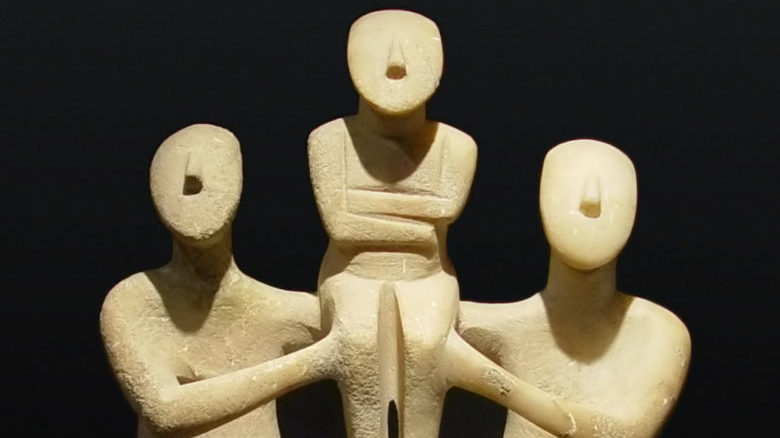
In the early twentieth century, pioneering modern artists like Constantin Brâncuși, Amedeo Modigliani, and Pablo Picasso stunned the art world with a radical new style. They stripped away centuries of realistic detail, reducing the human form to its barest, most essential geometric shapes.
The world called it avant-garde. But what these artists had actually done was rediscover a design language that had been perfected five thousand years earlier.
During the Early Bronze Age (c. 3200–2000 BCE), a mysterious, literate-less seafaring culture flourished across the Cyclades—a cluster of islands scattered across the shimmering Aegean Sea. Armed with nothing more than stone chisels and abrasive emery sand, these ancient craftsmen carved thousands of stylized marble figures.
Today, these Cycladic figurines stand as the earliest masterpieces of abstract sculpture in Europe, challenging our entire understanding of how ancient humans viewed the spiritual world.
1. The Typology of Minimalism
Cycladic sculptures were almost exclusively carved from the fine, translucent white marble native to the islands of Naxos and Paros. While they range in size from tiny pocket amulets to rare, near-life-sized statues, they evolved through two distinct artistic phases:
Early Phase: Schematic "Violin" Figures
The earliest iterations were hyper-abstract, entirely lacking limbs or facial features. These are known as violin-shaped figurines due to their distinct silhouettes. A long, smooth vertical stalk represents the neck and head, while a pronounced narrowing in the center of the marble block mimics a human waist.
Canonical Phase: Folded-Arm Figures
By the mid-third millennium BCE (the Keros-Syros culture), the islands settled on a highly disciplined, universally recognized design template known as the Folded-Arm Figure (FAF).
The Flat Profile: These figures feature a flat, wedge-shaped head tilted backward at a slight angle.
The Shield-Like Face: The face is entirely blank, completely devoid of eyes, a mouth, or ears. The only physical feature carved in relief is a sharp, prominent, wedge-like nose.
The Folded Arms: The arms are invariably folded across the torso just below the breasts. In nearly every canonical piece, the left arm is placed over the right arm—a rigid cultural rule followed by hundreds of independent island sculptors over several centuries.
2. Chronological Evolution of Cycladic Sculpture
The artistic progression across the islands moved steadily from simple structural shapes to highly stylized, geometric human forms.
Grotta-Pelos Culture (Early Schematic)
c. 3200 – 2800 BCE
The emergence of violin-shaped idols and highly abstract, flat silhouettes with completely unformed anatomy.
Keros-Syros Culture (The Canonical Peak)
c. 2800 – 2300 BCE
The standardization of the Folded-Arm Figure (FAF). Proportions become highly regulated using precise geometric templates.
Phylakopi I Culture (Late Decline)
c. 2300 – 2000 BCE
Proportions lose their strict geometric balance. Figures become blockier, rougher, and less stylized before fading out entirely.
3. The Geometry of Proportion
The minimalism of Cycladic figures was not an accident born of primitive tools. It was the result of highly complex, mathematically calculated design work.
Recent forensic analysis of the canonical figures reveals that sculptors used a compass and ruler to map out the stone before making a single cut. The entire body was meticulously partitioned based on a geometric grid:
  [ Head and Neck ] ────────► Exactly 1/4 of total height
                                     │
                                     ▼
  [ Torso to Crotch ] ──────► Exactly 1/4 of total height
                                     │
                                     ▼
  [ Thighs to Ankles ] ─────► Exactly 1/4 of total height
                                     │
                                     ▼
  [ Feet and Base ] ────────► Remaining 1/4 of total height
This four-part proportional system meant that every angle, from the slope of the shoulders to the taper of the shins, was completely harmonious. The clean lines we admire today as "modernism" were actually a strict ancient formula for cosmic balance.
4. The Myth of the Stark White Idol
When these statues are displayed in modern museums under soft spotlights, they appear as icons of pristine, minimalist white marble. But this is an archaeological illusion caused by millennia of erosion.
The ancient Cycladic world was actually a world of brilliant color.
[ RAW WHITE MARBLE ] ──► Painted with mineral pigments ──► Vivid eyes, red tattoos, blue hair
Using microscopic analysis and UV lighting, archaeologists have found traces of red pigment (ochre) and blue pigment (azurite) bound to the stone.
The blank, faceless shields we see today were originally painted with giant, staring eyes on the cheeks and foreheads. Necks and faces were frequently adorned with vertical red stripes, likely representing ritual scarification or celebratory body paint worn during mourning or transition ceremonies.
5. What Were They For? The Archaeological Enigma
Because the Cycladic culture left behind no written records, the true purpose of these figures remains one of the greatest riddles of archaeology.
However, because 95% of these figures depict females with subtly emphasized pubic triangles and pregnant bellies, and because they are almost exclusively found lying flat on their backs in graves, historians have formed two primary theories:
InterpretationConceptual CoreSupporting EvidencePsychopomps / Soul GuidesServants or protectors meant to guide the deceased through the underworld.The feet are pointed downward at a steep angle; the figures cannot stand upright on their own and were designed exclusively to lie flat.Great Mother GoddessesSymbols of fertility, regeneration, and cosmic rebirth.Many figurines display faint horizontal lines incised across the abdomen, closely mimicking postpartum stretch marks.
6. The Tragedy of Modern Discovery
The deep aesthetic connection between Cycladic art and twentieth-century modernism ultimately proved to be the artifacts' undoing. As collectors rushed to buy these "prehistoric Modiglianis," an epidemic of illegal looting tore through the Cycladic islands during the 1950s and 60s.
Tombs were systematically ransacked with bulldozers to feed the black market art trade. Out of the roughly 1,400 Cycladic figurines housed in museums and private collections today, only about 40% were found by professional archaeologists.
For the remaining 60%, their historical context—the specific islands they came from, the identities of the people buried with them, and the exact rituals they performed—has been lost forever, leaving these silent marble figures to guard their prehistoric secrets in absolute anonymity.