Introduction: The Canvas of the Commonplace
When we think of ancient Greek art, we often picture towering white marble statues or the legendary deeds of gods and heroes. Yet, the most complete, intimate record of how the Greeks actually lived does not come from monumental state architecture. It is preserved on the surfaces of fired clay vessels: ancient Greek pottery.
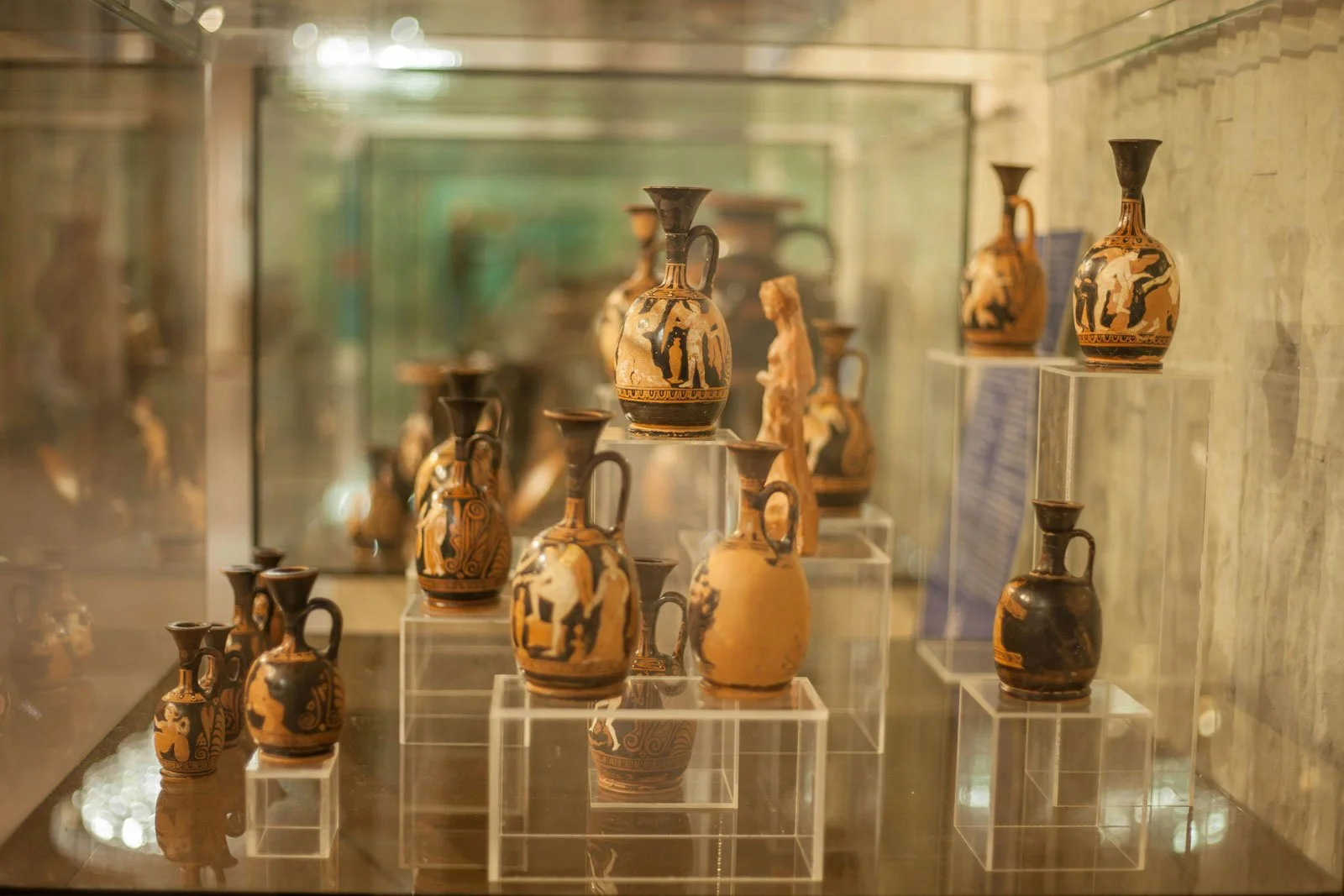
Mainly produced in the workshops of Athens (Attica) between the 6th and 4th centuries BCE, painted vases were mass-produced utilitarian objects used for storing wine, water, and oil. To appeal to buyers, potters decorated them with scenes that jumped directly from the streets of the polis. By decoding these illustrations, modern historians can peer through a window into the ancient world, discovering the realities of manual labor, domestic dynamics, education, and social spaces that ancient literature largely ignored.
1. The Craftsman's World: The Reality of Manual Labor
While aristocratic Greek writers like Plato looked down on manual labor, labeling artisans and merchants as lower-class banausoi, pottery painting tells a far more respectful story of the urban working class.
The Shoemaker's Shop: The Attic vase shown above captures the bustling interior of a shoemaker’s (suteknos) workshop. A craftsman sits on a low stool, leaning forward to carefully cut leather around a customer’s foot, who is standing directly on top of the workbench. Tools of the trade—knives, awls, and spare leather strips—hang conspicuously from the wall in the background, showing how specialized and organized these small urban storefronts were.
The Metallurgists: Other popular scenes depict bronze foundries and blacksmith shops. Vases show workers stoking heavy furnaces with bellows, hammering out sheets of armor, and polishing finished statues, illustrating a deep civic pride in the industrial output that fueled the Athenian economy.
2. The Gynaeceum: Unveiling the Private Lives of Women
Because respectable citizens restricted freeborn women to the domestic quarters of the home (gynaeceum), their lives are rarely documented in classical literature. Pottery provides the missing visual narrative.
Textile Production: The ultimate marker of a virtuous Greek housewife was textile mastery. Countless vessels depict women sitting together in groups, spinning raw wool into thread using drop spindles, or weaving intricate patterns on massive vertical warp-weighted looms.
The Wedding Preparation: Large, specialized water jars called loutrophoroi—used to carry water for a bride's ritual bath—frequently feature scenes of the bridal dressing room. Attendants are shown adjusting the bride's veil, applying perfumed oils, and presenting jewelry boxes, illustrating the supportive, communal networks shared by women on the eve of marriage.
3. The Paidagogos: The Mechanics of Education
Athenian education (paideia) was reserved exclusively for boys of wealth, and pottery paintings document the exact curriculum and strict discipline of these early academies.
The Three Pillars: Vases regularly show schoolrooms divided into distinct instructional zones. One boy is shown reading aloud from a papyrus scroll rolled around wooden dowels, another practices chords on a seven-stringed tortoise-shell lyre, while a third uses a stylus to incise letters into a wax-coated wooden tablet.
The Paidagogos: Sitting quietly in the corner of these scenes is a mature, often bearded man holding a gnarled walking stick. This is the paidagogos—a trusted family slave tasked with chaperoning the boy to school, carrying his books, and monitoring his moral behavior. If the boy slouched or played a wrong note, the vase paintings show the schoolmaster or slave lifting a split cane reed to administer immediate physical discipline.
4. The Symposium: The Intersection of Politics and Pleasure
At the absolute opposite end of the social spectrum from the schoolroom was the symposium—the elite, all-male drinking banquet that served as the primary social arena for political networking, philosophical debate, and hedonistic release.
   ___________    ___________
  |   Couch   |  |   Couch   |
  |___[Klinai]|  |___[Klinai]|
       \                /
        \    Kylix     /
         \  [Cup]     /
          \___  _____/
              ||
The Reclining Posture: Symposiasts are universally depicted reclining on their left elbows across cushioned banqueting couches (klinai), arranged in a circle around the perimeter of the room so every guest could see and hear one another.
The Game of Kottabos: Vases offer a lighthearted look at ancient drinking games. Guests are frequently shown looping a finger through the handle of a wide, shallow wine cup called a kylix. They would swirl the dregs of their unfiltered wine and fling the liquid across the room, attempting to cleanly knock down a small bronze disk balanced precariously on a central stand.
The Dark Side of Excess: Greek painters were unflinchingly realistic. The exterior of many drinking cups features humorous, cautionary tales of the symposium’s aftermath: guests losing their balance, picked up by attendants, or vomiting into brass basins held by sympathetic flute-girls, reminding the user of the fragile line between civilized aristocratic refinement and chaotic overindulgence.